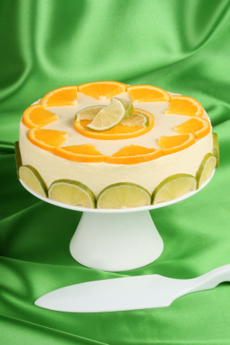
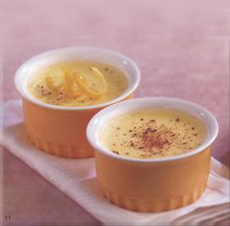
A modern-style Bavarian cream (the originals were made in fluted molds). Photo by Massimiliano Pieraccini | IST.
September 2006
Last Updated November 2025
|
|
Types Of Custard: A Custard Glossary
All About Custard, The Eggy Splendor From The Middle Ages
Page 1: Types Of Custard A ~ B
Custard History
Custard as we know it dates back to the Middle Ages, when it was used as a filling for a flan or a tart.
The word custard is derived from “crustade,” a tart with a crust. After the 16th century, fruit creams became popular, and it was about this time that custards began to be made in individual dishes or bowls rather than as fillings for a crust.
Yet, as things move full circle, today custard is used to fill tarts, Danish pastry, flans, cream puffs, and éclairs; it is mixed into trifles and otherwise part of other sweet and savory delights.
Custards are prepared in two ways: stirred or cooked on top of the stove, or baked in the oven.
The Difference Between Custard & Pudding
American pudding is a sweetened milk mixture thickened with cornstarch, then cooked. It has no eggs in it. In the U.K. and Europe, it is also known as blancmange and is thickened with starch.
- In the U.K., it refers to any dessert. It also refers to sweet, cake-like baked, steamed, and boiled puddings, usually made in a mold.
- Then there’s the category of creamy puddings—what Americans typically think of as pudding, mostly enjoyed in the form of chocolate pudding, vanilla pudding, butterscotch pudding, and lemon pudding. They do double duty as pie filling.
- When a recipe is exceptionally smooth and light, it is often called silk pudding for its silky texture.
- There are also savory puddings and other foods that are called pudding: black pudding or blood pudding (sausage), Yorkshire pudding (baked batter, served as a side), bread pudding (stale bread baked in a custard sauce), and steamed pudding (cake).
Custard, on the other hand, is an eggy delight that can be either baked or cooked on the stovetop. The egg protein is the thickener.
There are hybrids, such as pastry cream (the filling of cream puffs and éclairs).
Types Of Custard: A Glossary Of Custard Terms
If you think we should consider definitions other than those we have provided, click on the Contact Us link on the page. We have more than 100 food glossaries to provide insights and reference on your other favorite foods. This is a five-page glossary; click on the alphabet link to visit the appropriate page.
Use this index bar to visit other pages.
a b c d e f g h i j k l m n o p q r s t u v w x y z
This glossary is protected by copyright and cannot be reproduced in whole or in part. You are welcome to link to it.
BAIN MARIE or WATER BATH
A technique of baking custard and other delicate, egg-based dishes to prevent cracking or curdling in a hot oven, and to prevent sauces from curdling on the stove. The proteins in the eggs are very heat-sensitive and need to be cooked slowly and gently. In this technique, the pie plate, custard cups or other baking container is placed inside a baking pan; simmering hot water is poured up to the level of the filling inside the mold to protect the custard from the heat.
|
|
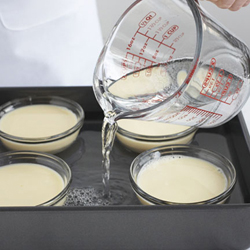
It’s easy to make a bain-marie. Photo courtesy of American Egg Board. |
BAKED CUSTARD
Custard, a mixture of cream and eggs, can be made in either sauce form or baked in a variety of forms, where it thickens and sets. Tarts, pies, and quiches are examples. In its simplest form, a plain custard is baked in a dish, ramekin, or custard cup. More elaborate baked custards include crème caramel (flan) and crème brûlée.
|
|
Popular in the U.K. for an “instant” custard sauce. Photo courtesy Egg Farmers Of Alberta. |
BAVARIAN CREAM or CRÈME BAVAROIS
A mold of crème anglaise (a rich custard, see photo at top), combined with gelatin, beaten egg whites, and lightly whipped cream. It can be flavored with vanilla, fruit purée, chocolate, liqueur, etc., then put into a decorative mold, chilled, and unmolded. See the photo at the top of the page. The dessert originated in France in the early 19th century. The great chef Marie-Antoine Carême is generally credited with the invention. While the connection to Bavaria is obscure, Carême created great dinners for royalty and others at the top of society, so the dessert may well have been created to honor guests from Bavaria.
What’s the difference between a Bavarian cream and a Charlotte?
|
|
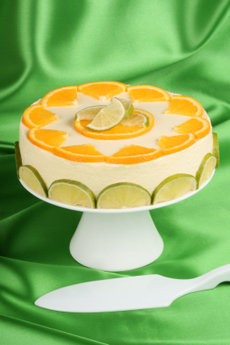
Bavarian cream, a dessert fit for a king. Photo by Massimiliano Pieraccini | IST. |
Bavarian cream is a type of set custard mousse made from custard, gelatin, and whipped cream, usually molded and served as-is.
Charlotte is a dessert built in a mold lined with cake, ladyfingers, or bread and filled with a cream or fruit mixture, which can be a Bavarian cream or another type of cream (e.g. fruit mousse, a custard and fruit mixture, or even ice cream, which is called a Charlotte glacée).
Think of Bavarian cream as a filling, and Charlotte as a way of presenting the filling—under a cloak of cake or similar.
BIEN ME SABE or PUERTO RICAN
COCONUT CREAM
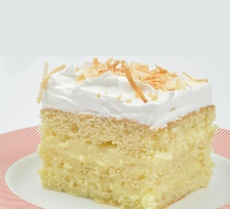
Not a true custard, because it uses coconut milk instead of cow’s milk or cream. This popular pudding means “It tastes good to me” in Spanish. The grated meat and milk of a fresh coconut are cooked with egg yolks and sugar to a thick consistency, then flavored with vanilla or rum. It is popularly served over sponge cake or incorporated into a layered sponge cake with whipped cream, as shown in the photo. Here’s a recipe.
|
|
Popular in the U.K. for an “instant” custard sauce. Photo courtesy ImperialSugar.com. |
BIRD’S CUSTARD
An artificially-flavored commercial custard powder, one of the numerous instant and commercial “custards” that are not true custards because they are not thickened with eggs but with cornstarch. It was invented by Alfred Bird and Sons Ltd. of Birmingham, England, in 1837. Bird created it because his wife was allergic to eggs, the key ingredient used to thicken traditional custard. Some people prefer using powdered custard sauce because it is much easier to make and there is no concern with the eggs curdling, the chief challenge of making a traditional custard.
|
|
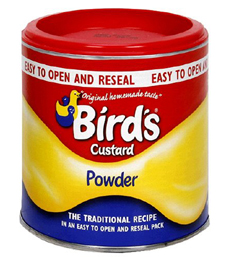
Popular in the U.K. for an “instant” custard sauce. Photo courtesy Bird’s. |
BLANCMANGE or BLANC MANGE
Blancmange is not a custard but a cornstarch pudding; it does not contain eggs, but uses cornstarch as the thickener. French for “white food,” it can be a white or pinkish molded pudding made from milk or almond milk and/or cream, sugar, gelatin or cornstarch, and a flavoring, usually almond. The original blancmange used pulverized almonds instead of cornstarch. It can be made in butterscotch and chocolate pudding variations as well. It is pronounced blah-MOHNGE.
BOILED CUSTARD
See crème anglaise.
|
|
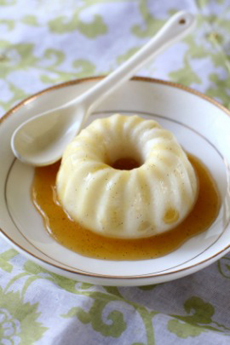
Blancmange. Photo courtesy Delicious-Cooks.com. |
BREAD PUDDING
Originally a way to use stale bread, cubes or slices of bread are drenched (similar to French toast) with a mixture of milk, eggs, sugar, vanilla, and spices—in essence, a custard. The bread-custard pudding can be baked plain, or with any combination of fruits and/or nuts. The dish can be served hot or cold, with or without whipped cream or a sauce, such as hard sauce or custard sauce.
Continue To Page 2: Terms With C
Go To The Article Index Above
|
|
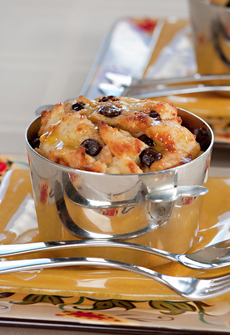
Bread pudding. Photo courtesy of Between the Bread | NYC.com. |
Nibble Tip
- One of our favorite complements to custard—whether a sauce or a baked custard—is nutmeg.
- When baking a vanilla or chocolate custard, grate some fresh nutmeg over the top.
- We like making a savory custard sauce by cooking a crème anglaise without the sugar and substituting nutmeg for vanilla.
|
|
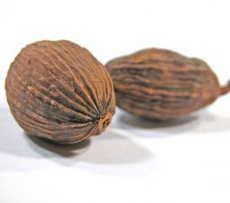
Nutmeg. Photo by Tijmen Van Dobbenburgh | SXC. |
|