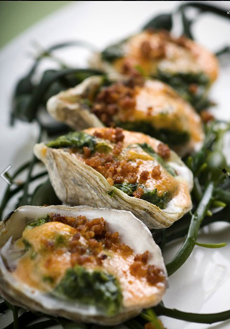
A delicious plate of Oysters Rockefeller from Arch Rock Fish restaurant in Santa Barbara, California.
July 2007
Last Updated January 2017
|
|
All About The Oyster
Oyster Glossary
Part 7: Oyster Types Beginning With O To R
CAPSULE REPORT: This is page seven of a nine-page article about the oyster. Here, oyster types beginning with O To R. Click on the black links below to visit other pages. Also visit our more than 50 food glossaries that focus on other favorite foods, including a 13-page Seafood Glossary.
OLYMPIA OYSTER
(Ostrea lurida): Native to the west coast, the Olympia was once plentiful in Washington Sound, San Francisco Bay and other areas. As the Gold Rush brought droves of people to the area, the Olympia was over-fished beyond recovery by the 1870s. It is no longer available commercially on a significant basis, but is cultivated by few dedicated farmers in the area of Olympia, Washington, as the species is very slow and difficult to grow: Olympias take up to four years to grow to the size of a quarter. At maturity, the Olympia is still a small oyster, no more than 2 inches in size. The smaller cousin of the European flat oyster, the Olympia is very flavorful, with notes of celery, and copper and sweet cream.
OSTREIDAE
The family of edible oysters. There are two genera (the plural of genus) in the family, Crassostrea and Ostrea. |
|
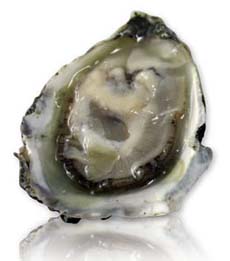 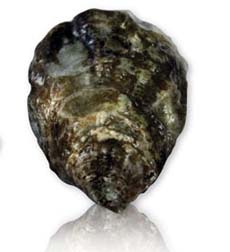
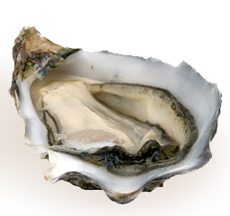
Olympia oyster from Puget Sound, Washington, available from MarxFoods.com. |
OYSTER CHOWDER
A chowder is a fish or seafood soup made with potatoes and onions. The word chowder has its roots in the Latin word calderia, which originally meant a hearth for warming things and later came to mean a cooking pot. The word evolved to cauldron, which in French became chaudiere, which became chowder. The first chowders in our culture were fish chowders, made in cauldrons in fishing villages along the coast of France and in the Cornwall region of Southwestern England, and brought by those fishermen to Nova Scotia and New England. Oyster stew is a thicker recipe than chowder. |
|
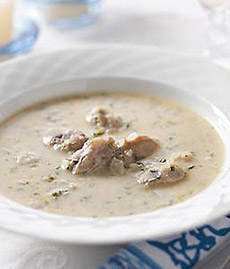
Oyster chowder. Photo courtesy MackenzieLtd.com. |
OYSTER CRACKERS
Oyster crackers are small, salted, soup crackers, typically hexagonal in shape and molded into two halves, roughy suggestive of an oyster shell. They were invented by Adam Exton, who opened a bakery in Trenton, New Jersey in 1846. The crackers were so-named because they were commonly served with oyster chowder, stew and similar fish and seafood dishes. They are made from wheat flour, yeast and vegetable shortening plus leavening, malted barley flour and salt. (You can purchase these oyster crackers at Shamanshop.net.)
|
|
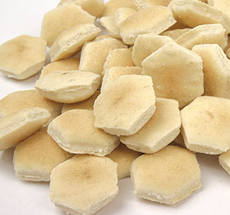
Hexagonal-shape oyster crackers. |
OYSTER MUSHROOMS
The oyster mushroom, Pleurotus ostreatus, has nothing to do with oysters. Some people believe the it was so-named for its faint seafood flavor. Others say the mushroom resembles a seashell growing from dead wood. Check it out for yourself and you may find that both are a stretch. There are several varieties of oyster mushroom, which can have white, cream, yellow, gray-blue or reddish-brown caps.
|
|
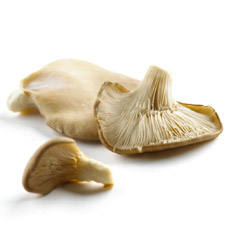
Oyster mushrooms. Photo | Dreamstime.
|
OYSTER SAUCE
A popular condiment in Chinese and Filipino cuisine, oyster sauce is often used as a topping for steamed vegetables and in stir fries. A viscous sauce, it is prepared from oysters and brine. A true oyster sauce is aromatic with intense flavor and is expensive: Most oyster sauces on the market are diluted solutions of concentrated ones. Today there are vegetarian versions made from mushrooms that are also less expensive. Oyster sauce is said to have been invented in 1888 by Mr. Lee Kam Sheung, in Nam Shui Village in Guangdong Province, China. His company, Lee Kum Kee, continues to produce oyster sauce along with a wide variety of fine Asian condiments. THE NIBBLE has selected their soy sauces as some of the best. |
|
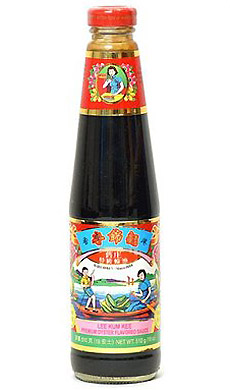
Oyster sauce. Photo courtesy Lee Kum Kee.
|
OYSTERS ON THE HALF SHELL
A plate of fresh oysters, with the top half of the shell removed, leaving the oyster on the “half shell.” They are typically served on a bed of crushed with fresh lemon wedges. Classic accompaniments include chili sauce, mignonette sauce and cocktail sauce (seafood sauce). Some people serve Worcestershire sauce and some serve hot sauce, although given the expense and subtle flavor of raw oysters, drowning the flavor in hot sauce is a questionable choice. And that brings us to the topic of fresh. Oysters are considered fresh within two days of harvesting from the ocean/bay, assuming they are kept unopened and refrigerated. Their flavor is so pristine, they need no accompaniment, not even a squeeze of lemon. For the next couple of days, lemon, cocktail sauce, etc. can help out the still-healthy-to-eat-raw oysters.
|
|
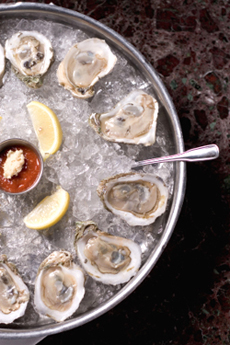
Oysters on the half shell. Photo by Nathan Maxfield | IST.
|
OYSTERS ROCKEFELLER
An appetizer or first course created at Antoine’s restaurant in New Orleans during the Gilded Age. In the original recipe, oysters on the half shell are topped with herbed French breadcrumbs, butter and cream, then broiled. The herbs include flat-leaf Italian parsley, celery leaves, tarragon leaves, chervil and green onions. Seasonings included salt, pepper and hot sauce. With 12 tablespoons of unsalted butter (for two dozen oysters!), 2 tablespoons of Herbsaint (an anise liqueur) or Pernod and the cream, the dish was “rich enough for Rockefeller” (John D. Rockefeller, Sr.). A later variation of the recipe substituted spinach for most of the herbs. Here’s more history and a recipe. |
|
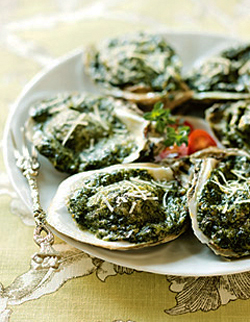
Oysters Rockefeller, ready to heat and eat, are available from Mackenzie Ltd.
|
OYSTER STEW
A rich soup made of butter, cream (or half-and-half) and shucked oysters, with celery, onions and shallots, seasoned with salt, pepper and cayenne. There is a thin line between oyster chowder (above) and oyster stew: both are chunky soups made with oysters, vegetables and potatoes, plus milk or cream. Stews generally contain less liquid; thus, more oysters and vegetables and less soup base than chowder. Here’s more about the different types of soups.
|
|
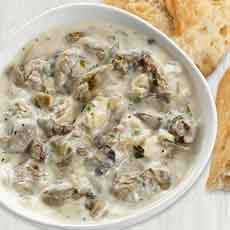
A hearty bowl of oysters stew. Photo courtesy Chicken Of The Sea. |
PACIFIC OYSTER or MIYAGI
OYSTER
Crassostrea gigas, Also called the Japanese oyster, the Pacific oyster is originally from Japan. It was brought to Washington State in the 1920s to save the oyster industry when the native Olympia oyster became depleted. It is now grown as a “native” oyster in the U.S. and in Europe and is the most widely cultured oyster in the world. and consumed oyster on the West Coast, grown from Baja California all the way to Alaska. A very hardy variety, it can grow, quickly, in almost all aquatic environments (many aquacultured Pacific oysters can reach market size in just eighteen months). Pacific oysters can often be distinguished by their fluted, jagged shells and vivid multi-colors ranging from royal purple to jade green. |
|
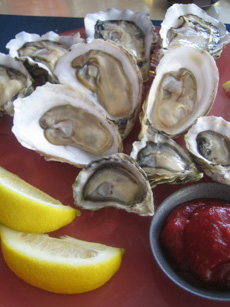
Pacific oysters from Willapa Bay, Washington. Photo by Melody Lan | THE NIBBLE.
|
In flavor and texture, Pacifics are generally creamier and brinier than other oysters. They tend to be known for minerality, based on their terroir. They finish with fruit and vegetal notes ranging from an herbaceous to a melony, also depending on the terroir. Typically large in size, the elongated shell can reach up to 12 inches. Oysters larger than six inches are cut up for soups, stews and other dishes. Varieties include Fanny Bays, Golden Mantle, Hama Hamas, Mad River, Malaspina, Penn Cove, Royal Miyagi, Samish Bay, Shoalwater, Skookum, Steamboat, Tomales Bay, Totten and Yaquina Bay oysters.
PATUXENT OYSTER
This variety of Virginica oyster once thrived in Maryland’s Patuxent River, but like other varieties throughout Chesapeake Bay, it has been harvested to the point of extinction. Pollution has compounded the problem, as the population in Chesapeake Country has expanded; the few surviving oysters have been ravaged by two diseases, MSX and dermo. The state hopes to restore the oyster population.
PEARL BAY OYSTER
A cultured Pacific oyster from Pearl Bay, on the Canadian coast, about an hour north of Vancouver. The deep waters are remote, very clean and nutrient-rich. The oyster meat is plump and sweet, with salty overtones. The Pearl Bay oyster has a mild watermelon flavor and a clean finish. It is available October to July.
PEARL POINT OYSTER
On the Oregon Coast near Tillamook, Netarts Bay, fed by two small, pristine mountains streams, has higher than average salinity. The combination of salinity and water purity produces a Pacific oyster with a pleasing flavor and cantaloupe finish. The oyster is typically 3 to 3-1/2 inches in size.
PEMAQUID OYSTER
A variety of Virginica oyster from Maine, this oyster is sweet and mildly salty, with an almond-like finish.
PINE ISLAND OYSTER
A variety of Virginica oyster known for its fruity finish.
PLATE or FLAT OYSTER
A colloquial term for the European flat oyster (Ostrea edulis). “Plate” (pro-nounced PLAHT) means flat in French; “huître plate” was for years the reigning oyster in Europe. Instead of a shell with a mounded top, the top of the shell is flat. Also see flat oyster.
PORTUGUESE OYSTER
Crassostrea angulata is a single species that originated in Spain. Since about the mid-1970s, the Pacific oyster has been the main oyster cultivated in Europe. Prior to then, the Portuguese oyster (also called a “creuse”) was the principal oyster. From 1968 to 1972, an oyster disease devastated the species. |
|
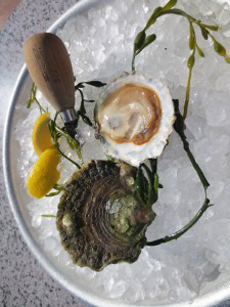
The plat, or European flat oyster. Photo courtesy Bar | SF. |
PUGWASH OYSTER
A variety of Virginica oyster from Pugwash Point in Nova Scotia.
QUILCENE OYSTER
Quilcene Bay is located on Washington State’s tranquil Hood Canal. The bay is reported to have the purest, most pristine salt water on the west coast of America. Its oyster is very delicate in texture and slightly salty, with a slightly sweet finish. A typical size of a Quilcene oyster is 3 to 3 1/2 inches.
|