
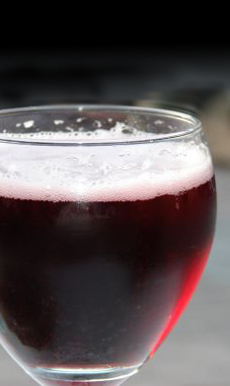
Red ale gets its color from roasted barley. Photo by Stefan Smets | SXC.
February 2005
Last Updated June 2017
|
|
Beer Glossary
Page 7: Beer Types ~ Q To S
This is Page 7 of an eight-page glossary of beer terms. Click on the black links below to visit other pages. Also see our many other food glossaries, chock-full of information about your favorite foods.
This glossary is protected by copyright and cannot be reproduced in whole or part.
You are welcome to link to it.
|
QUAFF
To drink deeply.
RAUCHBIER
Rauchbier, smoked beer, originated in the town of Bamberg in the Bavaria region of Germany. It dates to the 1500s. The green malt is first dried over a fire of beech wood, imparting the Rauch, which is German for smoke. It imparts an assertive, smoked meat-type smokiness to the beer. The flavor is very strong—it has been called bacon-like—and takes a few sips to get used to. It goes well with grilled foods—meats, sausages, veggies. A classic pairing is Rauchbier with grilled bratwurst.
|
|
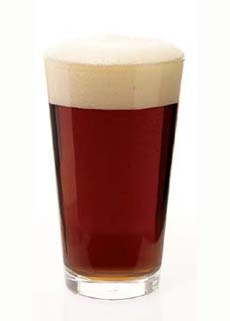
Rauchbier, smoked beer (the malt is smoked prior to brewing. Photo courtesy Schwartzbier. |
|
RED ALE or IRISH RED ALE or IRISH
ALE
A lighter style of ale that has a slightly reddish color from the use of a small amount of roasted barley. For beer drinkers who prefer less hop influence, Irish Reds offer virtually no hop aroma low to moderate hop flavor, as well as low to moderate malty aroma and flavor. They have a very clean finish with a low buttery or toffee flavor. The use of roasted barley for coloring often results in a slight roasted finish and also creates a dry finish for the beer. Unlike English Ales, Irish Red has no ester (fruity) flavors.
In Ireland, the brew is called Irish red ale, red ale, or Irish ale; elsewhere it is called red beer. Irish Red Ale is a style closely related to English bitters. As with all recipes, there are numerous variations; but all tend to have the characteristic deep red color and mild flavor.
|
|
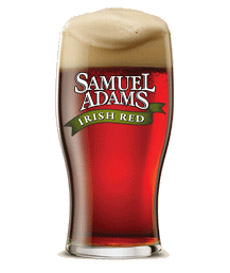
The signature color of Red Ale. Photo courtesy Samuel Adams. |
In America, some brewers of amber ale call their beers “Irish Red Ale.” The recipes are very similar, there are differences that can only lead to confusion. The main difference is the measure of bitterness in the beer. Amber Ales use more hops to achieve more bitterness. The secondary difference is the origin of the hops and the type of malts: Irish Red use more English malts (often toasted malts) and hops, American Amber Ales use more American malts and hops.
|
RAUCHBIER
Rauchbier, smoked beer, originated in the town of Bamberg in the Bavaria region of Germany. It dates to the 1500s. The green malt is first dried over a fire of beech wood, imparting the Rauch, which is German for smoke. It imparts an assertive, smoked meat-type smokiness to the beer.
RHEINHEITSGEBOT or GERMAN PURITY LAW
Pronounced rhine-HEIGHTS-geh·bot, this is the German Purity Law that specifies that beer can only be made with three ingredients: barley, hops and water. The law dates back to 1516; at the time no one knew that the yeast in the air was involved in the process. Yeast is, of course, the fourth ingredient.
|
|
Rauchbier, smoked beer (the malt is smoked prior to brewing. Photo courtesy Schwartzbier. |
|
ROGGENBIER or RYE BEER
Roggenbier, German for rye beer, is typically made up of at least 50% malted rye, a much more assertive flavor than the barley typically used in beer. The rye contributes grain spice flavors, with low bitterness. There are typically classic weizen yeast notes: bubble gum, tart citrus, vanilla. Rye beers were once popular in Bavaria, but fell out of favor after 1516 when Reinheitsgebot (see item above) was adopted. The law specified that only barley, hops and water could be used in the brewing of beer. Classic roggenbier is cloudy (naturtrüb in German, meaning naturally turbid); the style predates beer filtration, which was invented in 1878. A high level of carbonated was also characteristic.
|
|
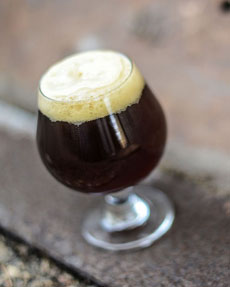
Roggenbier, rye beer. Photo courtesy CraftBeer.com. |
SAISON
Saison (the French word for season) is a Belgian farmhouse ale initially brewed in the French-speaking Wallonia area of Belgium. Historically, it was a refreshing summer ale made by farmers for their own consumption and their workers’. Modern versions are generally around 7% ABV, highly carbonated, fruity and spicy (sometimes from hops, sometimes from the addition of spices).
|
SCHWARZBIER
Black (schwarz) or very dark beer. The most famous is made in Kostritz, Germany.
SCOTCH ALE
A very strong, often extremely dark, malt-accented, Scottish specialty beer.
SESSION BEER
A beer that has a mid-level alcoholic content, perhaps 5% to 6%. The term comes from the British concept of a beer that can be drunk of the course of a multi-hour session of drinking, without rendering the drinker drunk. Such beers are also referred to as “sessionable.”
|
|
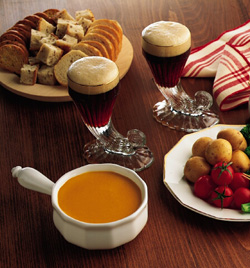
Scotch ale served with a rarebit of sharp Cheddar. Photo courtesy Wisconsin Milk Marketing Board. |
SHANDY
Shandy is beer mixed with a soft drink that can be carbonated or still: apple juice, ginger ale, ginger beer, lemonade, orange juice and so forth. The proportions of the two ingredients are usually half-and-half, but can be adjusted to taste.
SOUR BEER
Sour beer is style intentionally brewed to have an acidic, tart, sour taste. Examples include Belgian lambics, gueuzes and Flanders red ale. Unlike traditional brewing, which is done in a sterile environment to guard against the intrusion of wild yeast, sour beers deliberately allow wild yeast or bacteria into the brew. Another method for achieving a tart flavor is by adding fruit: cherries added to produce kriek and raspberries to produce raspberry lambic are two prominent examples.
SPICED ALE
An ale brewed with spices—often, what we would call “pumpkin pie spices,” such as clove and nutmeg. Not surprisingly, spiced pumpkin ale is a popular variation.
STEAM BEER
While cream ale is an American invention, steam is considered the only classic American beer style. It has a deep amber color, a sharp flavor and a great deal of carbonation. Steam beer was invented in California during the Gold Rush days. It pairs well with moderately spicy sausage, like garlic bratwurst and Portuguese linguica.
|
STOUT
The darkest and heartiest of beers, a stout is top fermented and differentiated from a regular ale by its brown-black color, chocolate-coffee flavors and fuller body. This is achieved by brewing with barley that has been dark-roasted to the point of charring (think of espresso beans, compared to a medium-roast coffee). It is thus both darker and maltier than porter, has a more pronounced hop aroma, and may reach an alcoholic content of 6% to 7%. Stout originated in Ireland, where most traditional
stouts are very rich, yet sharp and slightly bitter. Stout is well-paired with strong cheese and a spicy sausage such as Andouille.
Chocolate Stout is a sub-category that uses different malts for an even more pronounced chocolate flavor. These days, some brewers add actual chocolate into the brew, or brew over cacao beans, or both.
|
|
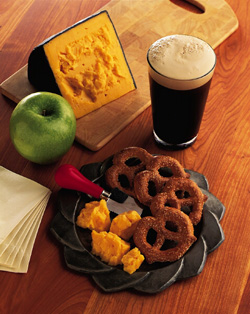
Stout served with a snack of Cheddar, Granny Smith apple and pretzels. Photo courtesy Wisconsin Milk Marketing Board. |
Coffee Stout uses dark roasted malts to add a bitter coffee flavor. With the tandem growth of interest in microbrews and fine coffee, craft brewers have added specific ground beans to create, for example, “Breakfast Coffee Stout,” “Espresso Stout” and “Guatemalan Coffee Stout.”
Cream Stout or milk stout is a style made sweeter with unfermentable lactose (milk sugar).
Dry Stout or Irish Stout is very dark and toasty or coffee-note style, exemplified by the world-famous Guinness.
Imperial Stout or Russian Stout or Russian Imperial Stout has more of a rich, roasted quality and a higher level of alcohol. These are potent beers that can be almost as thickly textured as liqueur. Examples include Samuel Smith’s Imperial Stout at 7% alcohol and Brooklyn Brewery’s Black Chocolate Stout, at 8.7% alcohol. The alcohol content of imperial stouts can go to 9% and 10%.
Milk Stout: See cream stout, above.
Oatmeal Stout adds oatmeal to the mash, which gives a smoothness and creaminess to the stout. It has more restrained flavors and less alcohol than Imperial stout. Samuel Smith makes a benchmark oatmeal stout, with notes of fruit, licorice, chocolate and toffee.
Continue To Page 8: Terms Beginning With T To Z
Go To The Article Index Above
Some terms in this glossary are © 2005 National Beer Wholesalers Association. All rights reserved. Other content is © Lifestyle Direct Inc. All rights reserved.
|

