Is it a trip to paradise, or just another nice bottle of water?
|
KAREN HOCHMAN is Editorial Director of THE NIBBLE.
|
|
April 2007
Updated December 2008
|
|
FIJI Natural Artesian Water
Mineral Water From The Remote South Seas
Page 1: Overview
CAPSULE REPORT: Nearly 50% of the water sold in the U.S. is purified municipal water (Aquafina and Dasani) or spring water—not the purest sources of water. FIJI Water is the only brand among the top 10 water brands to come from a pure source—a natural aquifer in an unspoiled continent, made from rain that fell 450 years ago on unspoiled highlands and tropical forests. The great artesian waters (see the others reviewed by THE NIBBLE) have tiny market shares, and are difficult to find. Thanks to strong marketing, FIJI is everywhere. If you’re drinking bottled water for its purity, consider FIJI before the other top 10 brands. This is Page 1 of a three-page article. Click on the black links below to visit other pages.
Overview
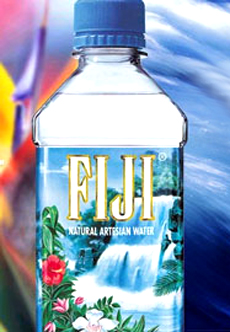
FIJI Water appeared out of nowhere in late 1997 and captured the public fancy. Was it the square bottle with the peekaboo illustration of the tropical waterfall? Or was the pure, flavorless water, enticing with a crisper flavor profile and a more refreshing palate experience than the popular Evian (which it is about to replace as the #1 imported still water)?* Apart from tourism, Fiji Water has become the biggest industry in this small Pacific nation.
*With its high level of silica, a mineral often found in waters that derive from volcanic geology, the flavor profile is very different from Evian, which has a very heavy level of bicarbonate (you can taste it in the water) and a good amount of calcium, both of which give the water a flatness.
Perhaps it was the high-powered marketing. The company was founded in 1996 by David Gilmour, a wealthy Canadian who owns the Wakaya Club, an exclusive resort in Fiji (Bill and Melinda Gates honeymooned there in 1994). As the story goes, he noticed that guests tended to bring cases of bottled water with them, transporting the heavy products thousands of miles. He sought out a water source in Fiji and within a few years, FIJI Water was producing 25 million bottles—ironically, exporting almost all of it thousands of miles to the United States. In 2004, the company was sold to Roll International, owners of Teleflora and Pom Wonderful pomegranate juice.
Both owners spent money on marketing—something essential to build the brand. FIJI Water hangs its hat on its remote island purity. It’s true that among bottled waters, FIJI 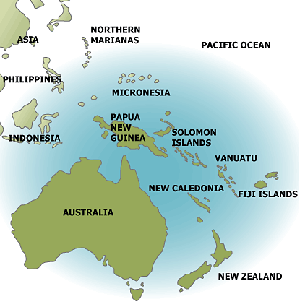 Water gets the Remote Award—you can see on the right side of the map how far Fiji is from the nearest continent (Australia) or industrialized civilization. The aquifer is located at the edge of a primitive rainforest in the remote Yaqara Valley of Viti Levu (that’s the island perched on top of the “IS” on the map). The company claims that that distance is part of what makes their water so much more pure and healthy than other bottled waters, and that their rainfall is purified by equatorial winds after traveling thousands of miles across the Pacific Ocean. Europe and the U.S., by implication, are buffeted by winds that carry acid rain and pollutants. Nice marketing message: They should hold it for a few years because there’s no acid rain in the European aquifer water supply yet. As with most aquifer waters, what begins as rain filters through the ground for hundreds of years before entering the aquifer. That which is being pumped now entered the system in the good old days, before acid rain: FIJI Water, for instance, has been carbon-dated to 450 years ago, 250 years before the Industrial Revolution! Water gets the Remote Award—you can see on the right side of the map how far Fiji is from the nearest continent (Australia) or industrialized civilization. The aquifer is located at the edge of a primitive rainforest in the remote Yaqara Valley of Viti Levu (that’s the island perched on top of the “IS” on the map). The company claims that that distance is part of what makes their water so much more pure and healthy than other bottled waters, and that their rainfall is purified by equatorial winds after traveling thousands of miles across the Pacific Ocean. Europe and the U.S., by implication, are buffeted by winds that carry acid rain and pollutants. Nice marketing message: They should hold it for a few years because there’s no acid rain in the European aquifer water supply yet. As with most aquifer waters, what begins as rain filters through the ground for hundreds of years before entering the aquifer. That which is being pumped now entered the system in the good old days, before acid rain: FIJI Water, for instance, has been carbon-dated to 450 years ago, 250 years before the Industrial Revolution!
Of course, we’re not geologists: someone else can read a lot of water analysis charts in order to debate the merits of FIJI Water’s argument. Even if we choose to buy it (and we do—it’s a delicious still water), choosing FIJI Water because of its purity would amount to a minute drop in the bucket given everything else we eat and drink.
Continue To Page 2: The Origin Of Fiji Water
Go To The Article Index Above
|