April 2008
Updated May 2009
|
|
The History Of Scones
The Origin Of The Scone Is Lost In The Mists Of The British Isles
CAPSULE REPORT: The history of the scone and its companion, clotted cream. This is Page 1 of a two-page article. Click on the black links below to visit Page 2.
Scone History
Scones are traditionally connected with Scotland, Ireland and England, but exactly who deserves the honor of invention, no one knows for sure. Scones may well have originated in Scotland. The first known print reference, in 1513, is from a Scottish poet. However, in earlier eras, when communications were more limited, the creation of an actual item can have predated the first appearance of printed references by many years. Centuries ago, there weren’t newspapers that reported on the minutiae of life the way ours do. There were no food columns in the local papers proclaiming that “McTavish Bakery has created a new griddle-fried oatcake called a scone—now available at 3 Sheepshead Lane.” In fact, there were few newspapers. Much of the population was not literate. So, culinary historians rely on cookbooks and mentions in literature and other printed records. Given the perishability of these items, it is logical to think that many first-printed mentions of foods and other items may not have survived.
Scones are related to the ancient Welsh tradition of cooking small round yeast cakes (leavened breads) on bakestones, and later on griddles. One claim, probably not the best, says that scones are named for the Stone (scone) of Destiny, a stone upon which Scottish kings once sat when they were crowned (the Abbey of Scone can still be found, upriver from Perth; but the Stone of Destiny was long ago removed to Westminster Abbey). Other contenders include the Gaelic “sgonn” (rhymes with gone), a shapeless mass or large mouthful; the Dutch “schoonbrot,” fine white bread; and the closely-related German “sconbrot,” fine or beautiful bread. The Oxford English Dictionary favors the latter two.
Originally, scones were made with oats, shaped into a large round, scored into four or six wedges (triangles) and griddle-baked over an open fire (later, a stovetop). With the advent of oven baking, the round of dough was cut into wedges and the scones were baked individually.
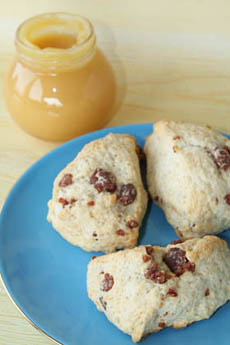
Today’s scones are quick breads, similar to American biscuits. They are traditionally made with wheat flour, sugar, baking powder or baking soda, butter, milk and eggs, and baked in the oven—both in the traditional wedge form and in round, square and diamond shapes. This recipe produces a hard, dry texture.
Traditional English scones may include raisins or currants, but are often plain, relying on jam, preserves, lemon curd or honey for added flavor—perhaps with a touch of clotted cream (see definition below). Fancy scones—with dried fruit such as cranberries and dates, nuts, orange rind, chocolate morsels and other flavorings—are best enjoyed without butter and jam.
You may have heard two different pronunciations for “scone.” Which is the authentic one? They both are! The word is pronounced “skahn” in Scotland and Northern England (rhymes with gone) and “skoan” in the south of England (rhymes with own), the pronunciation adopted by the U.S. and Canada.
Continue To Page 2: The Modern Scone & Clotted Cream
Go To The Article Index Above
Lifestyle Direct, Inc. All rights reserved. Photographs are the copyright of their respective owners.
|