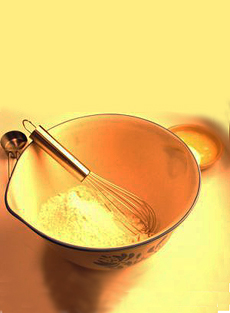
A good pancake or waffle starts with flour and a whisk. Photo by Daniel West.
September 2005
|
 |
Pancake & Waffle Glossary
What’s Up For Breakfast, Lunch & Dinner? Plenty!
Who ever thought there were so many kinds of pancakes? There are a dozen varieties in Western culture alone, and countless varieties worldwide. If you’d like to suggest additional words for inclusion, click here.
You can click on the letter of the alphabet in the bar below to get to a term
without having to scroll manually.
a b c d e f g h i j k l m n o p q r s t u v w x y z
AEBLESKIVER
A Danish pancake that has a round ball-like shape rather than a round flattened shape, like a crêpe or a traditional flatbread pancake. The aebleskiver is made with a batter that is often mixed with fruit or other fillings and poured into a pan with individual round indentations molded into it. It is a cooking utensil designed specifically for making this pancake ball. One half of the pancake bakes, and when the bottom half has turned golden brown it is rolled over manually to bake on the other side. Aebleskivers are most often served for breakfast or brunch, but they can also be filled with savory ingredients and served as an appetizer. The Aebleskiver is also known as an Ableskiver, Aebelskiver, Ebleskiver, Danish Ball Pancake, Krapfchen, Merfeille, Norwegian Puff Ball, Poffertje, and Puffer.
|
AEBLESKIVER PAN
A cooking utensil designed specifically for making the Danish pancake ball known as an aebleskiver, ebleskiver or apple dumpling. This pancake has a round ball-like shape rather than a round flattened shape, like a crêpe or a U.S. pancake. The aebleskiver is made with a batter that is often mixed with fruit or other fillings and poured into this pan with individual round indentations that are molded to form the ball shape. One half of the pancake bakes, and when the bottom half has turned golden brown it is rolled over manually to bake on the other side. Aebleskivers are most often served for breakfast or brunch, but they can also be filled with savory ingredients and served as an appetizer or main dish. The pan for aebleskivers is also referred to as a Munk pan or a Danish cake pan.
|
 |
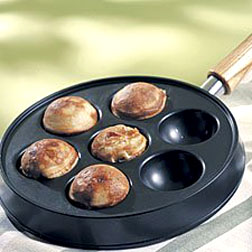
| Aebleskiver, a Danish pancake. |
 |
AREPA
A flat meal cake made of maize flour, split in half and filled with cheese, deli meats and a variety of fillings. An arepa may be eaten closed like a sandwich or dressed with toppings and eaten open-faced. Although similar to a sandwich in its presentation, it can also be eaten as a side dish, in lieu of bread.
|
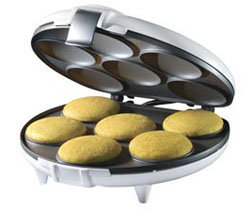
Want to make hot arepas on your countertop? Click here to purchase the Oster arepamaker.
|
BAMMY
A Jamaican pancake made from cassava root that has been grated and pressed to remove the bitter juice. Bammy is often served with fried fish and other fried foods.
|
BANNOCK
Popular in Scotland, bannock is thinner than a scone. It is a form of flat cake, baked on a griddle, and is generally made of oatmeal and takes the form of a large oatcake. However, the meaning is not universal; some Scots use the term to refer to a large wheat flour cake similar to a large thin scone. Bannocks are also quite popular in eastern Canada, especially in the Atlantic provinces.
BELGIAN WAFFLE
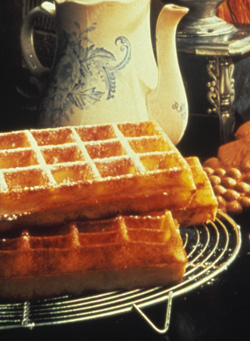
A staple Belgian breakfast and snack food, Belgian Waffles are made from a batter including yeast and beaten egg whites; this gives them a lighter texture and fluffier consistency than the typical American waffle, which tends to have baking soda or powder in the batter. Belgian waffles are square or rectangular, with deep divots throughout. They are usually covered with butter and sugar or syrups, and sometimes topped with fresh fruit.
|
 |
| Click here to purchase a gift box of Belgian Waffles. |
 |
BLINTZ or BLINTZE or BLIN (BLINI)
A crêpe-like thin pancake that may be eaten “as is,” in which case the batter may contain various add-ins, from grated potato or apple to raisins. These blini are quite common in Eastern Europe and are more solidly filled than the spongy pancakes usually eaten in North America. |
| Potato Blintzes from Kosher Depot. |
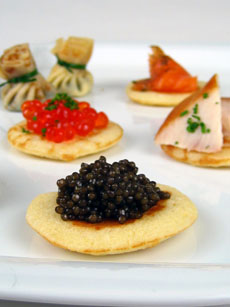
Blini may be spread with butter, bacon fat or jam, topped with caviar, and served flat, folded or rolled into a tube. They can be made in a thickness resembling American pancakes, or in thinner forms like Swedish pancakes and French crêpes. They can be made from wheat or buckwheat: buckwheat blini were created in Russia specifically to enhance caviar, and they became popular with less luxurious toppings as well. Because buckwheat requires a good deal of care to grow and process, it became a rare commodity during the difficult times of the former Soviet Union.
|
 |
Rich man’s blini, shown here crêpe-style with beluga caviar, are as delicious topped with butter or jam. To purchase these crêpe-style blini, click here. This photo and blini photo below, courtesy of Caviar Russe restaurant in New York City.
|
 |
The word blin comes from Old Slavic mlin, meaning “to mill.” Blins had a somewhat ritual significance for early Slavic peoples in pre-Christian times: with their round form, they were a symbol of the sun. They were traditionally prepared at the end of the winter to honor the rebirth of the new sun (Pancake Week, in Russian). This tradition was adopted by the Orthodox church and is carried on to the present day. Blini are also served at wakes, to commemorate the deceased. The term blintz is mostly applicable to the kind that is filled with jam, fruit, cottage cheese or other cheese, ground meat or poultry; then rolled or folded and lightly fried, sautéed or baked. They are also called nalysnyky in this form. |
| Blini in the shape of miniature pancakes, popular as hors d’oeuvres. |
BUCKWHEAT FLOUR
A gluten-free
flour made by grinding seeds of the buckwheat plant. Despite its name, buckwheat is technically a fruit, unrelated to wheat. It came to Europe from China. Buckwheat flour has a slightly tangy flavor and is often processed with the addition of wheat flour in order to neutralize the taste; but we love the full flavor of buckwheat. It is often used for making blintzes, pastas, pancakes and waffles; the Russians created buckwheat blini as a counterpoint to the saltiness of caviar. It is a lovely counterpoint with maple syrup as well. |
 |
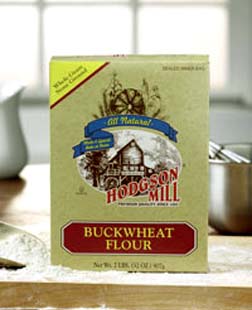
| Make your own buckwheat pancakes with gluten-free buckwheat flour. Click here to buy this top-quality stone-ground flour from one of our favorite mills. |
CACHAPA
Cachapas are made of maize in the form of masa. They are made when fresh corn is ground and then mixed into a batter of the consistency of pancakes, yet slightly thicker and lumpier. The batter is then cooked like a pancake. Cachapas are served with many toppings, but traditionally with butter or margarine and white cheese (queso blanco) on top.
|
 |
| Cachapa (photo courtesy of Wikipedia.org) |

|
CORNMEAL
Flour ground from dried maize. Steel-ground yellow cornmeal, common in the United States, has the husk and germ of the maize kernel almost completely removed. It is conserved almost indefinitely if stored in an airtight container in a cool dry place. Stone-ground cornmeal retains some of the hull and germ, lending a little more flavor and nutrition to recipes. It is more perishable, but will store longer if refrigerated. White cornmeal (mealie meal) is more traditional in Africa. It is also popular in the Southern United States for making cornbread.
|
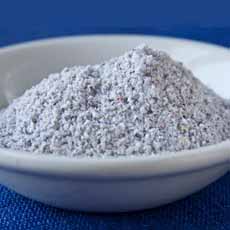
| Blue corn meal, milled from Indian blue corn, can be used instead of regular white or yellow corn meal in most recipes. Click here to buy this product. |
Blue cornmeal is made from the rarer blue corn or by adding blue food coloring to the cheaper yellow cornmeal. Yellow or blue cornmeal can also be ground to a finer consistency and sold as gluten-free flour that is used to make corn bread, muffins, pancakes, polenta, and tortillas. It has a sweet taste and is an excellent substitute for traditional wheat flour for making various breads and cakes. We also enjoy it in Indian pudding.
COULIS
A sauce made from pureed fruit or vegetables (strawberries, raspberries, and tomatoes are most commonly used). A coulis (pronounced coo-LEE) is often served over breakfast items, such as pancakes, crêpes and waffles or pancakes, or over dessert items, such as ice cream, cheesecake and soufflés.
CREMPOG
A Welsh pancake made with buttermilk.
 |
CRÊPE
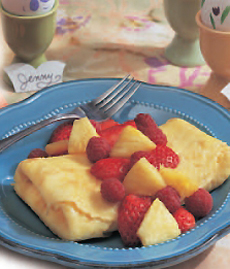
A thin pancake made from flour, eggs, milk, butter and salt. Crêpes are usually of two types: sweet crêpes made with wheat flour, and savory galettes, made with buckwheat flour. Crêpes originated from Brittany, a region in the west of France, where they are called krampouezh; their consumption is nowadays widespread in France. In Brittany, crêpes are traditionally served with apple cider. In areas of Central Europe, the dish is called palacinka (Czech and Croatian), palatschinka (Austrian German), palacsinta (Hungarian), etc.
|
| If you don’t want to make crêpes from scratch, you can buy a mix. |
CRÊPES SUZETTE
A French dessert dish consisting of sweet crêpes and a sauce of butter, sugar, orange juice, orange zest and an orange liqueur, such as Grand Marnier. The dish is typically ignited tableside and, thanks to the flame-inducing liqueur, makes for a dramatic presentation.
DOSA or DOSE or DOSAY or DOSAI or THOSAI or DOSHA
A traditional food from India that is a type of flatbread or pancake. Dosas are made from a batter of rice and lentil flour plus oil or ghee, cooked on a griddle until both sides are browned, then neatly folded. Some dosas are filled with other ingredients such as fruit or meat. Masala dosa is stuffed with mashed potatoes lightly cooked with fried onions and spices. If the onions are mixed into the batter itself, it becomes an onion dosa. Dosas can also be made from all-purpose flour.
|
 |
| Want to make Dosai at home? Click here to purchase the mix. |
FARINATA
A thin, crisp, pizza-like pancake made by stirring chickpea flour into a mixture of water and olive oil to form a loose batter, and baking it in the oven. Farinata may be seasoned with fresh rosemary, pepper and sea salt. Like pizza, it may also be topped with onions, sausages, or similar ingredients.
FLAPJACK
See Pancake.
FRENCH TOAST
A popular breakfast dish made by dipping bread slices in an egg-based mixture, which can include various other ingredients such as milk, vanilla, cinnamon, allspice and nutmeg. The dipped bread is then cooked in butter on a skillet until golden brown. French Toast is often spread with butter and served with syrup, powdered sugar, or fruit toppings.
GALETTE
A galette is a savory buckwheat crêpe, a type of pancake from Brittany. Unlike the crêpe, the galette is cooked on one side only. It is frequently garnished with meat, fish, cheese, salad or similar ingredients. One of the most popular varieties is a galette covered with grated gruyère cheese, a slice of ham and an egg, cooked on the galette. In France, this is known as a galette complète. A hot sausage wrapped in a galette (a galette-saucisse) and eaten like a hot dog is also becoming more and more popular.
|
 |
GAUFRETTE
A thin wafer cookie that has a slightly sweet flavor. Gaufrettes are baked on a special iron, similar to a waffle iron. Some are rectangular and formed into sandwiches, some are fan-shaped, and others are shaped into cones for ice cream cone. Gaufrettes are popular garnishes for ice cream or mousse desserts. |
| Photo courtesy of Albert Uster Imports. |
GRIDDLE
A flat, rimless metal pan used for cooking by dry heat. Griddles are often used to cook foods such as bacon, eggs, pancakes and hamburger patties.
|
 |
| Caphalon Contemporary Nonstick 11" Griddle. Click here to purchase this heavy-gauge beauty. |
GRIDDLE CAKE
See Pancake.
HOTCAKE
See Pancake.
INJERA or ENJERA
Injera is a pancake-like bread made out of teff flour. It is traditionally eaten in Ethiopia, Somalia (where it is also called lahoh) and Eritrea. The flour is mixed with water and allowed to ferment for a few days. It is then ready to fry into large flat pancakes. A variety of stews, and sometimes salad, are placed upon the injera for serving. Using one’s right hand, small pieces of injera are torn and used to grasp the stews and salads for eating. Injera is thus both food and plate at the same time.
JOHNNYCAKE or JONNYCAKE
Not a pancake but cornmeal bread (cornbread), usually shaped into a flat cake and baked or fried on a griddle. Believed to be taught to the Pilgrims by the Native Americans, it became a staple in New England and the upper Midwest. Today, however, the Johnnycake is largely known in the South. It has many different regional names, including ashcake, batter bread; battercake, corn cake, corn pone, hoecake, journey cake, pone and Shawnee cake.
KOUIGN AMANN
Kouign amann is a Breton cake. It is a galette, a kind of crêpe made with brioche dough, butter and sugar. The name derives from the Breton words for cake, kouign, and butter, amann. Kouign amann is a specialty of the village of Douarnenez in Finistère, where it originated in 1865.
KRUMKAKE
A Norwegian pancake made in a decorative, two-sided press (the plates look like a circular, shallow waffle iron plates with an elaborate design instead of the waffle squares). The finished pancake is molded into a tube shape, allowed to harden, then eaten plain or filled with whipped cream or other fillings, like a cannoli. Krumkake is a variation of the Italian pizzelle (see below).
LEFSE
Lefse (pronounced lef-sa) is a traditional soft Scandinavian flatbread made out of potato, milk and flour, and cooked on a griddle. There are significant regional variations in the way lefse is made and eaten, but it generally resembles a tortilla. In the middle part of Norway, a variation called tynnlefse (thin lefse) is made, which is rolled up with butter, sugar and cinnamon, and eaten as a cake. Tjukklefse or tykklefse (thick lefse) is thicker and, again, often served over coffee as a cake. Potetlefse (potato lefse) is often used in place of a hot dog bun and can be used to roll up sausages. This delight is also known as pølse med lompe in Norway, lompe being the potato lefse.
 |
MAPLE SYRUP
A sweetener made from the sap of maple trees. Maple syrup is used as a topping for breakfast foods such as pancakes and waffles, and as a sweetener for baking. In the United States, it is divided into two major grades: Grade A and Grade B. Grade A is further broken down into three subgrades: Grade A Light Amber (sometimes known as Fancy), Grade A Medium Amber, and Grade A Dark Amber. Grade B is darker and richer than Grade A Dark Amber. The grades roughly correspond to what point in the season the syrup was made. Grade A Light Amber is early-season syrup, while Grade B is late-season syrup.
|
| Infused with a variety of flavors, Moosewood Hollow maple syrups are among our favorite products. Click here for more information. |
MASALA DOSA
Masala Dosa is a South Indian tiffin dish that has become extremely popular all over India and abroad. The batter made is similar to regular Dosa batter with some additional ingredients. One variant of Masala Dosa, the Mysore Masala Dosa, described uses two types of chutneys. See Dosa.
MURTABAK
Murtabak is an Indian Muslim dish commonly found in Singapore. It is made from a thin dough filled with minced meat, usually mutton, and fried on a griddle until it turns golden brown. The fillings also include garlic and onion. Murtabak is served with slices of cucumber and onion and a bowl of curry sauce.
OATCAKE
An oatcake is a type of pancake made from oatmeal, flour and yeast, and cooked on a griddle. Oatcakes are a local delicacy in the North Staffordshire (Stoke-on-Trent) area of England, and so may be known to non-locals as a North Staffordshire oatcake or Potteries oatcake. When pre-cooked, they are a form of fast food; catering outlets in the area usually offer oatcakes with fillings such as cheese, bacon, sausage and egg.
OKONOMIYAKI
Okonomiyaki is a type of Japanese pan-fried batter cake made with various ingredients. Okonomi means “what you like” or “what you want,” and yaki means “grilled” or “cooked” (c.f., yakitori and yakisoba). So this dish’s name means “cook what you like, the way you like.” The batter is based on flour, grated yam, water or dashi, egg and shredded cabbage, and usually contains other ingredients such as green onion, meat, squid, shrimp, vegetables, kimchi, mochi and cheese. Okonomiyaki is often compared to an omelet, pizza or pancake because of the variety of ingredients it can contain. Thus it is sometimes referred to as “Japanese pizza.” It is prepared like a pancake: the batter and other ingredients are spread and fried on both sides, using either a hot plate (teppan) or a pan. The finished product is served with further toppings such as okonomiyaki sauce (similar to Worcestershire sauce but thicker and sweeter), nori, fish flakes, mayonnaise and ginger.
PALACINKA
Palacinka or palatschinka or palacsinta. See Crêpe.
|
 |
PANCAKE
A batter cake fried in a pan or on a griddle with oil or butter. Most types of pancake batter contain some kind of flour or cornmeal and a liquid ingredient, such as milk or water. In some countries, such as the United States, Canada and Egypt, pancakes contain a raising agent, such as baking soda or yeast. They are generally topped with a sweet or savory sauce or condiment such as syrup or a fruit topping. Pancakes are an ancient food; the oldest recipe in the English language dates to the 15th century. Pancakes also are known as flapjacks, griddlecakes and hotcakes.
|
| These pancakes carry the ”Excellent Source of WHOLE GRAINS“ stamp issued by the Whole Grains Council. |
PANCAKE MOLD
A metal or plastic form, similar to a cookie cutter, used to hold and shape pancake batter while it is cooking. After the batter is prepared, it is poured into the mold, which rests on the bottom of a grill or griddle. As the pancake bakes, it is formed into the shape of the mold, which may be round, square, or shaped like an animal. The molds are often used to add a festive shape to parties, special events and holidays.
|
 |
| Pancake molds are available in all shapes, from plain round to keep pancakes uniform, to animals, people, and these loving hearts. Click here to purchase. |
PANISSA
A traditional Italian food made from crumbled Farinata combined with onions, mushrooms, cheese and olive oil. Panissa is often served on its own as a snack or as a filling for sandwiches.
 |
PATTY SHELL or PASTRY CUP
A pastry baked into the shape of a bowl or wide-mouthed cup, used to hold various foods. The standard shells are often used to serve creamed seafoods, meats or vegetables; the sweeter shells, made from puff pastry, are used to serve desserts such as ice cream or fruits dishes. |
| Pastry cups like these are available at specialty food stores. |
PIKELET
In Australia and New Zealand, a pikelet is a small, thick, colonial-style pancake; In Britain it is known as a drop-scone or Scotch pancake. It is also a British regional dialect word variously denoting a crumpet or muffin.
PIZZELLE
A thin, crispy, golden brown Italian cookie made from flour, eggs, sugar, butter and flavoring, such as vanilla, anise or lemon zest. It is cooked in a special pizzelle iron, similar to a waffle iron, that has a decorative pattern, typically a snowflake, which is impressed into the cookie. The cookie can be sprinkled with powdered sugar. Unsugared when it is still soft, it can be rolled up into a cone for ice cream. |

It’s easy to make pizzelles with this VillaWare Pizzelle Maker. Click here to purchase. |
 |
POTATO PANCAKE or LATKE
Potato pancakes are thick mounds of grated potatoes seasoned with grated onions and salt and fried in butter or oil. Potato pancakes are called latkes in the Jewish tradition, but they are a European food and not specifically a Jewish one. Potato pancakes very likely originated in Eastern Europe, where they are still eaten in large numbers: there are many varieties in northeast Poland, e.g. A favorite Polish dish is placki wegierskie, potato pancakes stuffed with a thick spicy Hungarian goulash. |
| Potato Pancake (photo courtesy of Wikipedia). The best ready-to-cook, freshly-grated potato pancake mix you can buy is from Ruthie and Gussie’s. |
Potato pancakes are an important part of Jewish cuisine in the United States and Europe. They can be served any time, but by tradition they are served in the celebration of Hanukkah. They have no explicit religious significance, but Jews find it appropriate to eat foods cooked in oil during the festival that celebrates the miracle of the Temple oil. In Israel, where they are known as levivot (singular levivah), potato pancakes are familiar and well-liked, but sufganiyot (jelly doughnuts, singular sufganiyah) are considered to be more Israeli. Latkes are often eaten with sour cream, applesauce, or both. The French dish commonly known as potato galette is similar, but the sour cream is an ingredient rather than a topping. The Swedish version of potato pancakes is called raggmunk, which literally translates to hairy doughnuts (the grated potatoes making them look hairy). They are made from wheat flour, milk, egg and potatoes, and are fried just like thin pancakes. If the actual pancake batter is left out, the fried cakes of grated potatoes are called rårakor. Both kinds are enjoyed with fried bacon and/or lingonberry jam.
|
QUINOA FLOUR
While not technically a grain or a cereal, quinoa (pronounced KEEN-wah) is generally considered to be a grain crop.
Quinoa is a complete protein (equivalent to milk!) containing all the essential amino acids. It thus has a superior nutritional profile as compared to other grains, is non-allergenic and can be used in a wheat-free or gluten-free diet. The seeds are ground into a flour, which can be used for sweet and savory baking: breads, biscuits, tortillas, pancakes, cookies, crepes, muffins, etc.
|
 |
| If you'd like to try quinoa flour, click here. |
ROTI CANAI and ROTI PRATA
Roti canai or roti chennai (known as roti prata in Singapore), is a dish unique to Malaysia and Singapore. Roti means bread in Hindi and Malay. The term canai comes from channa, a mixture of boiled chickpeas in a spicy gravy from Northern India with which it was traditionally served. The dish comprises dough made from copious amounts of fat, egg, flour and water. The fat used is usually clarified butter (ghee). The entire mixture is kneaded thoroughly, flattened, oiled and folded repeatedly. It is then allowed to proof and rise, and the process is repeated. The final round of preparation consists of flattening the dough ball, coating it with oil and then cooking it on a flat iron skillet with a lot of oil. The ideal roti is flat, fluffy on the inside but crispy and flaky on the outside.
Roti prata is predominantly served with curry in Singapore, less commonly with sugar and condensed milk. Although some locals consume roti prata at any time of the day, the vast majority tend to consume it as a late-night or early-morning dish, particularly at 24-hour outlets. It is common to find shops serving roti with flavorings as varied as banana, cheese, chocolate, durian and garlic.
 |
SCALLION PANCAKE
A Chinese snack consisting of a non-leavened salty flatbread infused with oil and minced scallions (green onions). Unlike a true pancake, it is made from dough instead of batter, similar to an Indian paratha, Mediterranean pita bread, Mexican tortilla or Indian naan. |
| Scallion Pancake |
SORGHUM SYRUP
Sorghum is a genus of about 20 species of grasses, native to tropical and subtropical regions of Eastern Africa, with one species native to Mexico. The grown stalks can be boiled down into a liquid and processed into a syrup, which is used in much the same way traditional syrup is used: on breakfast dishes such as pancakes, French toast and waffles, or as a sweetener for baking.
|
 |
| Milder than molasses, sorghum syrup is great on pancakes and baked beans. Click here to purchase. |
 |
STROOPWAFEL or SYRUP WAFFLE or CARAMEL COOKIE
Dutch for “syrup waffle,” stroopwafels are cookies made from two round waffle-like wafers with a sweet syrup or caramel filling. Sometimes nuts or other flavors are added to the filling. About four inches in diameter, stroopwafels are traditionally prepared by cutting a freshly made waffle in half horizontally, spreading the filling and rejoining the two halves. Stroopwafels are an old Dutch treat, invented in Gouda in 1784. The traditional way to eat them is with a cup of coffee, tea or cocoa. Just before it is eaten, the stroopwafel is placed on top of the hot cup in order to soften it up; the filling melts, and scents of cinnamon and nutmeg are released into the air. |
Now a gourmet treat, the stroopwafel was originally a poor man’s cookie, made from old crumbs and syrup. If you have a waffle iron, click here for the recipe to bake your own.
|
SWEDISH PANCAKE
A pancake made with flour, sugar, milk, egg and butter, which cooks up very flat—not as thin as a crêpe, but much more crêpe-like than a fluffy American-style pancake. It is typically served with lingonberry sauce.
TLACOYOS
Tlacoyos are oval-shaped fried cakes made of masa. They are similar to fresh corn tortillas, but are somewhat torpedo-shaped and fatter. Sometimes tlacoyos are stuffed with refried beans, dry cheese, fava beans or other ingredients. Tlacoyos are an excellent accompaniment to soups and stews. Most traditional tlacoyos do not have lard or salt in the masa, and if not eaten immediately after they are cooked, they become very tough and dry, even if reheated. The name tlacoyo is a variation of the Nahuatl word tlatlaoyo, a name given to an antojito typical of central Mexico. A larger version of the tlacoyo is the huarache.
TORTILLA
A tortilla is not a pancake but a kind of unleavened bread made from maize corn or wheat flour. It is a staple of Mexican and Central American cuisine. The unrelated Spanish tortilla is a type of omelet.
URAD FLOUR or URID FLOUR
A flour made from black gram, a bean, or lentils ground into a powder. Native to India, this flour is used for making various Indian dishes, such as dosa crêpes and idi cakes.
WAFFLE
A batter cake made from flour, milk, oil, sugar, eggs and baking powder. The batter is poured into a waffle iron—two hot metal plates with a honeycomb pattern—and cooked until golden brown and slightly crispy. Waffles are typically served for breakfast with toppings such as butter, syrup and fruit. There are two main types of waffles: Belgian waffles (sometimes called Belgium waffles) and American or Western waffles.
- A Belgian waffle uses yeast in the batter, which yields a thicker, crisper and fluffier waffle. Belgian waffles rise higher, creating deeper wells to absorb syrup or dessert sauce.
|

A classic Belgian waffle served with strawberries and whipped cream.
|
- An American waffle uses baking powder and baking soda—a faster cooking technique.
WAFFLE IRON
An appliance used for making waffles. Though available in a wide variety of shapes and sizes, most every waffle iron consists of two iron plates, each with a honeycomb pattern, hinged together to form a unit. To make a waffle, the batter is poured into the bottom half of the heated waffle iron, the top is closed over it, and it cooks until golden brown and slightly crispy around the edges. The original waffle irons were manual, held over the stovetop to cook; the newer versions are electric. Waffle irons are now made in a variety of shapes, including square, rectangular, round, and novelty patterns from snowflakes to heart shapes to children’s characters like Mickey Mouse.
|
 |
| The Cuisinart nonstick waffle iron makes the classic round Belgian waffle shape. Click here to purchase. |
 |
 |
VillaWare Rose Bouquet Waffler. This beautiful rose pattern makes exquisite waffles for breakfast or dessert. With just a sprinkling of powdered sugar, a dab of whipped cream and a strawberry, you have an impressive finale to lunch or dinner. Add ice cream and raspberry sauce (or caramel and fudge) at your own discretion. Click here to purchase.
|
VillaWare Heart-Shaped Waffler. Start the day with a valentine: four hearts that pull apart or can be eaten as one large waffle. Click here to purchase.
|
| |
|
| |
|
A large portion of content in this glossary is courtesy of Wikipedia, the free encyclopedia.

|
 |
|
|