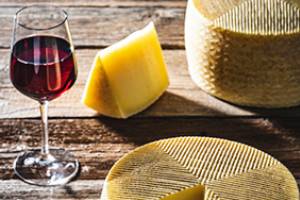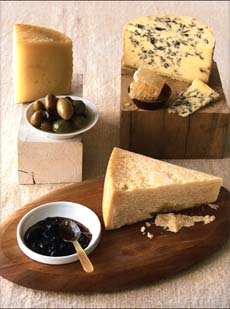
Perfect pairings from ArtisanalCheese.com: from top left, Spanish Manchego with olives, Vermont’s Bayley Hazen Blue with raw honeycomb, and Parmigiano-Reggiano from Italy with a balsamic spread.
|
CAITLIN BARRETT is a member of THE NIBBLE editorial staff. She carries a photo of her favorite cheesemaker, Rolf Beeler, in her wallet.
|
|
November 2005
Updated September 2013
|
|
THE NIBBLE Guide to Cheese Condiments
Make Your Fine Cheese Experience Even More Exciting With The Right Cheese Accompaniments
CAPSULE REPORT: What’s a “cheese condiment?” A condiment is an auxiliary food product that is used to give special flavor to another food. The word is first found in print in French around 1420, and derives from the Latin condimentum, spice. Chutney, ketchup, mustard and pickle relish are prominent examples of condiments that enhance meats. You might look at fudge sauce, marshmallow creme and sprinkles as ice cream condiments—they sure make that plain scoop of ice cream taste better. Here, we take a look at cheese condiments.
Introduction To Cheese Condiments (Accompaniments)
What is the difference between a mostarda and a mustard? Why would you put honey on cheese? Can you use the same condiments on a fresh mozzarella and an aged Gouda?
Cheese is wonderful on its own, but like pairing the right wine with the right food, cheese condiments can bring out unique aspects of both the cheese and the condiment. Similar to wine pairings, many things are taken into account when deciding what condiments fare best with which cheeses. In some cases, the best idea is to find condiments that compliment the cheese, while with others, pairing with a contrasting flavor is more exciting. For example, one could pair Italian condiments with Italian cheeses, or try to balance out the saltiness of an aged Parmigiano-Reggiano with the tart sweetness of a marmalade.
Here are some of the happy marriages we have discovered over years of cheese-tasting. Don’t limit yourself to this list, however. Feel free to experiment, and let us know when you find a winning match!
Cheese Condiment Directory
Type of Condiment /
What to Look For |
What It Is |
Pairs Best With... |
Aged Balsamics
Authentic balsamic vinegar comes are from Modena, Italy and are authenticated by the consortium.
Some of the finest are hundreds of dollars for just a few ounces and are doled out with an eyedropper.
Read more in our article on balsamic vinegar.
|
Real aged balsamic comes from a similar aging process to wines, and is nearly as drinkable. High-end varieties are aged for over 12 years. The finest are aged for 25 years or more (the greats are 40 years old or older). The higher the quality, the thicker, sweeter and more palatable it will be. Drizzle over thin slices of cheese so as not to let either flavor become overpowering.
Unfortunately, there’s a lot of fake balsamic out there: plain wine vinegar colored brown with caramel and flavored with sugar. Be sure you buy from a reliable purveyor.
|
Hard, aged cheeses like Parmigiano-Reggiano, Pecorino Romano and aged Goudas.
|
Chutneys
Look for fruit-based chutneys when pairing with cheese.
|
A mixture of fruit and spices, chutneys can have a texture that varies from a ketchup to a salsa. (There are savory chutneys as well, some fruit-based, but they are meant for meats and don’t work with cheeses.)
While many condiments that call themselves chutneys are closer to one-dimensional jams, a real chutney will set itself apart with its distinctive flavors.
|
Pair with creamy young cheeses, Fontina or mild Swiss cheeses (try a Hoch Ybrig by Rolf Beeler—worth seeking out).
Tomato chutney pairs well with sharp Cheddars.
|
Condiment Fruit Bars
ForeverCheese.com imports some interesting pressed fruit bars from Spain in flavors like chocolate, orange and date.
|
These bars, about the size of an energy bar, are dried fruit bars meant to be sliced and eaten with cheese. They can be made up of any combination of oranges, almonds, dates, plums, pumpkin or cocoa. The ingredients are pressed into bar form. |
Each bar pairs differently with different cheeses, but since most are on the sweet side, they go well with tangy young goat cheeses or salty aged cheeses. |
Extra Virgin Olive Oil
We have too many favorites here. Italian, Spanish and Greek olive oils tend to be on everyone’s list of preferred olive oils, but don’t neglect the grassy Australian Picual or some of the fruity California varieties. See our Olive Oil Section.
|
The oil that is extracted from tree-ripened olives. Extra virgin olive oil comes from the first pressing of the olive fruit (subsequent pressing produce a lighter and less flavorful oil.)
|
Fresh cheeses like mozzarella, ricotta and goat cheese act like a canvas for the complexities of a good olive oil.
|
Fruits & Nuts
Dried and fresh fruits and plain or toasted nuts are the cheese “condiments” most people have grown up with.
|
There are many classic pairings of both fruits and nuts with specific cheeses—ask your cheese monger, get a good book on cheese or do online research. Some pairings are in the next column. |
Try Feta or goat cheese with pine nuts and green apple; Asiago with almonds, apple and mango; goat cheese or Brie with walnuts, figs and strawberries. |
Honey
Think “beyond the bear” and look for infused varieties. Tea Together sells Italian infused honeys in flavors like orange, pear, truffle and eucalyptus.
|
A thick, sweet syrup produced by bees and extracted from their hives, honey is excellent on a variety of cheeses, and the “cheese condiment” most of us already have in the kitchen.
|
Honey is a delicious counterpoint with both strong and mild cheeses. Try it with strong blue cheeses like Cabrales, Roquefort, Gorgonzola and Stilton; and with fresh goat cheeses.
|
Maple Syrup
Beyond breakfast syrup, it’s delicious with cheese. |
A thick, sweet syrup made from the sap of maple trees. Be sure to use the “real thing,” not supermarket pancake syrup. |
As with honey, maple syrup is a delicious with both strong and mild cheeses. |
Melassa dei Fichi
Italy’s
Cilento National Park
is home to fig trees that produce the prized figs that are used in this condiment.
|
A compote made up of dried white Cilento figs.
|
Serve with ripe, washed rind cheeses like Cowgirl Creamery’s Red Hawk. |
Membrillo/Quince Paste
Sold at cheese counters. Some is pre-packaged; others are in loaves, and cheese mongers will slice you off as much or as little as you need.
|
Membrillo, traditionally a Spanish cheese accompaniment, is made from quince. A relative of the apple and the pear, quince is high in pectin, and the resulting paste has the consistency of a thick jelly. It has a sweet and tart taste and looks like a brick of gelatin.
|
Any salty or blue cheese pairs well with membrillo, but it works best with Spanish cheeses like Roncal, Mahón or Manchego.
|
Mostardas
There are dozens of different flavors. FormaggioKitchen.com has a nice variety.
|
An Italian specialty, mostarda is made of cooked fruits or vegetables that are marinated in a spicy, mustard oil-flavored syrup that gives the condiment its name. Mostardas can be sweet or savory and contain anything from apricots, cherries, figs or pears to balsamic vinegar, onions and sultanas. Originally mostarda was made with cooked-down grape must (the unfermented juice expressed from grapes).
|
Serve with soft Italian cheeses, like Fontina, Robiola or Taleggio; or with tangy goat cheeses.
|
Mustards
Look for French and English mustards. Both offer a good degree of heat while maintaining a level of complexity that will compliment the cheese. See our Mustard Glossary.
|
Prepared mustard is made from the seeds of the mustard plant, which are ground into a powder and then combined with wet ingredients and spices. Prepared mustard gets some of its flavor and consistency from vinegar, white wine, turmeric and sugar. Many mustards contain other ingredients like horseradish, honey, whole mustard seeds or fruit. These flavored mustards are also delicious with cheese.
|
English and Scottish mustards pair well with strong Cheddars like Gloucester.
Pair the slightly more delicate French mustards with Port Salut or the grassy Le Berger Basque.
|
Savory Jams and Jellies
Try garlic, horseradish, onion and tomato jams, jellies and conserves.
|
Similar in texture and sweetness to fruit jellies, savory jellies usually add peppers, garlic or herbs to a fruit or sugar-and-pectin mixture.
|
Serve with Brie, Camembert, young Gouda, Jarlsberg and mild Swiss cheeses.
|
Sweet Jellies, Jams, Marmalades, Fruit Butters and Conserves
Look for artisan varieties at your local farmers market or specialty store. The flavors are nearly limitless, from apricot, grape, raspberry and strawberry to more exotic jams like dragon fruit, guava, and papaya. Wine jellies are wonderful cheese condiments. See our review of Colorado Mountain Wine Jellies.
|
Here’s the difference:
- A jelly is made from a mixture of fruit juice, sugar and pectin which is cooked down until it achieves a thick consistency that holds its own shape.
- A jam contains sugar and whole pieces of fruit that are cooked down until they lose their form.
- A preserve is nearly the same as jam except the pieces of fruit are left in chunks.
- A marmalade is a preserve with citrus rinds.
- A conserve is a jam with nuts.
- A fruit butter is a mixture of fruit, sugar and spices that is cooked and mixed until completely smooth.
|
Pair:
Basil jelly with triple-crème cheeses.
Black mission fig preserve or fig jam with stronger blue cheeses.
Citrus marmalades with “stinky” washed rind cheeses like Epoisses and Livarot.
Golden raspberry jam with fresh goat cheeses.
Spiced quince preserve with Cheddar, Manchego, firm, aged cheeses and dry, salty cheeses like Parmigiano-Reggiano and aged Gouda.
Read more about these specific cheese pairings.
|
Vegemite, Marmite, Promite & Other Yeast Spreads
In the U.S., you may have to go to a specialty store that carries grocery items from the U.K. or Australia to procure these spreads, but in many parts of the world they are more common that ketchup.
|
Marmite is dark brown-colored savory spread made from the yeast that is a by-product of the brewing industry. It has a very strong, slightly salty flavor and may require repeated tasting to appreciate its strong flavor.
|
Try it with Cheddars from Northern England, like Trotters Lancashire.
|
Rounding Out the Cheese Plate
We like to serve an appropriate selection of accompaniments to our perfectly paired cheese and condiments. Here are a few standards that will make your cheese course stand out.
- Bread: Baguette, currant/raisin bread, fig cakes (pan de higo) and date cakes, nut bread, peasant bread, olive bread, semolina raisin bread.
- Crackers: Savory crackers, water crackers.
- Dried Fruits: Apricots, cherries, currants, cranberries, peaches and raisins.
- Fresh Fruit: Apple and pear slices, figs, grapes.
- Nuts: Caramelized walnuts, Marcona almonds, black walnuts.
- Olives: Serve a variety of sizes, textures and flavors.
You’ll be impressed at how well all of the items on your cheese plate play off of each other. You can make a brunch or lunch of the cheese course by adding charcuterie. Add a lively discussion of what pairs best with what and some complementary wines, and you may have an event that people will be talking about for a long time.
|