THE NIBBLE (TM) - Great Finds for Foodies (tm)


RSS feed
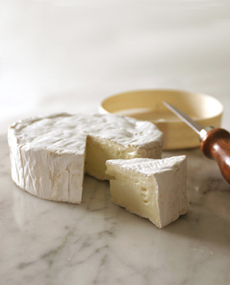
BrieCows from Normandy enjoy the ideal climate for producing great milk. The damp, mild climate and rich volcanic soil produces lush grass and herbs. Brie and other cheeses from iGourmet.com.
MENU


Cheese

Category Main Page
Articles & Reviews


Cheese-Butter-Yogurt

Category Main Page
Articles & Reviews


Main Nibbles

Main Page
Articles & Reviews Of Foods From A To Z


Product Reviews

Main Page
Food, Beverages, Books,
News & More


ABOUT THE AUTHOR

STEPHANIE ZONIS focuses on good foods and the people who produce them.


May 2007

Product Reviews / Main Nibbles / Cheese-Butter-Yogurt

Brie & Camembert:

The Classic Cheeses Never Go Out Of Style


  • Click here to read other months’ Whey To Go! columns

Welcome to Whey to Go! for May 2007. Every month, we’ll delve into a new cheese-related subject.

Ask anyone about French cheeses, and sooner or later (probably sooner) Brie and Camembert will come up in the conversation. Both are bloomy-rinded, aged (though not for very long) semi-soft fromages, with reputations for being among the crown jewels of French cheeses. The differences between the two can be subtle, especially to an untrained palate, but this is not remarkable when you consider that Brie and Camembert are made from the same exact “recipe,” a fact unknown to many. The variations in the two come about from their sizes and their different terroirs, a French word meaning something akin to “sense of place.” Often used in wine terminology, terroir accounts for the characteristics a particular geographic region imparts to a food, be it coffee, wine or cheese. But let’s take a closer look.

Origin Of Camembert

The most common legend about Camembert’s history involves a woman named Marie Harel, a farmer in the village of Camembert, in the Normandy region of France, who was hiding a priest during the French Revolution. Supposedly, Madame Harel invented Camembert in 1791, with the help of the priest she saved from the guillotine. Despite her heroics, it is more likely that Madame Harel had nothing to do with the cheese’s invention, although she may have improved Camembert with some tip passed along to her by the priest: Camembert was known to exist in the Normandy region as early as 1680. There is some speculation that Camembert may have been a blue cheese originally, and that the cheese’s characteristics changed over time until it evolved into what we know today.

To make Camembert, whole, raw milk from Norman cows is curdled with rennet, then gently hand-ladled into small, individual molds without breaking the curd. Camembert curd is customarily shaped in disks of 4.5 inches in diameter, 1.5 inches thick, about 8 ounces (250g) in weight. Five ladling passes are necessary to fill each mold; supposedly, this helps give Camembert its creamy texture. The curds are then gently leveled in the mold and the cheeses are allowed to drain for some four or five hours, after which they’re turned over for further draining. The next day, the cheeses are removed from their molds and go into a salting room, where a special “dry” salt (“sel sec,” in French) is applied to them. They are then coated with Penicillium candidum bacteria and placed on shelves to age. During the entire process, the temperature of the milk is not permitted to rise above 98.6°F (37°C). No milk powder or concentrated milk can be added. 
Camembert
Camembert del Nonno: French tradition with milk from the White Piedmontese cow. At iGourmet.com.

Camembert de Normandie, as the genuine article is called, remained a local product until the late 1800s, when a French engineer surnamed Ridel invented the thin, round, wooden boxes in which all Camemberts are now packaged. These boxes made distribution of Camembert to other regions in Europe (via the new steamboats and railway systems) much easier. Camembert’s reputation resulted in increased demand. Accordingly, production increased as well, although other countries began to produce Camembert, too. After World War II, much of Camembert production became industrialized, resulting in a bland, inferior-quality product. Finally, in the 1980s, Camembert was awarded an AOC distinction. AOC stands for “Appellation d’Origine Controlée.” This award is a guarantee that any cheese bearing it was made in a specific region using only approved methods of production. In other words, real Camembert can only be made in one area of France, via strictly-regulated procedures. Confusingly, the name “Camembert” itself is not protected, so you’ll see pasteurized milk “Camembert” sold as well as “Camembert” from both the U.S. and Italy.      

Unfortunately for American consumers, true Camembert (always made with raw milk) is simply unavailable in the U.S. Why? It must be made with raw (unpasteurized) milk, and any cheese made with raw milk must be aged at least sixty days before it can be sold in the U.S. The difficulty here is that raw milk Camembert won’t last that long. It’s aged for just two or three weeks and is at its best thirty or thirty-five days after it’s made; this stage of perfect ripeness and ideal eating quality is called “a point” (pronounced ah PWAHN) in France. Sixty-day-old Camembert would look and smell like something a chemical company was trying to hide. There are pasteurized Camemberts sold in the U.S., however. They are tasty; they just lack the range of complexity of the raw milk cheese. (Read a discussion of raw milk cheese.)

Origin Of Brie

And what about Brie? There are two Bries with AOC designations, Brie de Meaux and Brie de Melun. The Brie area is south and east of Paris, within the wider region of the Île-de-France. Supposedly, Brie has been made since at least the fifth century, although there doesn’t seem to be any documentation to support this claim. According to legend, the Emperor Charlemagne is said to have tried Brie (and instantly become a devoted fan) as early as the year 774. In 1815, the Prince de Tallyrand named Brie “Le Roi de Fromages,” The King of Cheeses. Cheese expert Steven Jenkins notes that, until the 1870 Franco-Prussian War, the plains of Brie were entirely given over to dairy cattle pastures. But the war wreaked havoc on the area’s dairy businesses, which never fully recovered. Land ownership shifted from small farmers to industry, and by 1914 only half as many cattle were being raised there, mostly for beef. Cheese production was slow to recuperate after the First World War, and by the 1950s most Brie production had also become industrialized. Like Camembert, the name of Brie is not protected, so it can appear on cheese produced in other regions and other countries, even on pasteurized impostors (Brie de Meaux, for instance, might be used as a brand name, which I regard as highly unethical). Brie de Melun is made only of raw milk and is not exported, according to Jenkins.

The process used to make Brie is unsurprisingly very similar to that used for Camembert, but Brie is made in larger wheels, ranging from about 1 to 6 pounds (500g to 3kg) in weight, 9 to 15 inches in diameter and 1 to 1.5 inches in thickness, although it also can be found in 8-ounce disks.

Camembert’s smaller size will affect it in several ways. It tends to age slightly more quickly, and the flavor of a true Camembert will be a little stronger than that of a true Brie. Gilles, a fromagier at Artisanal Premium Cheese in New York City, explains that, because of its smaller size, Camembert will lose moisture more quickly, which concentrates its flavor. 

BrieThis Brie is made in France from pasteurized milk,
in order to be sold in the U.S. Available at iGourmet.com.

Selecting A Cheese

Now that you have some background about these cheeses, let’s discuss selection. Supposing you’re lucky enough to have a good cheese retailer nearby: How do you tell a ripe Brie or Camembert from one that’s under- or overripe? Gilles of Artisanal explains that this process is “not for the novice,” although there are “very subtle signs.”

  • He declares that a very young Brie or Camembert will have a rind that is “pristinely white.” Such cheeses are liable to be chalky-textured and solid inside—in a word, underripe. This is not what you want. You are looking for that “pristinely white” rind to become mottled with a coloring that is variously described as reddish, brownish, or yellowish.
  • The Camembert Web Pages states that the rind should look like “a thin white down” and may be covered with very small red dots. But Gilles urges caution in this visual examination, as appearance depends on origin. He says that an industrially-produced Brie or Camembert might purposely have a perfectly white rind at maturation, because such a rind would appeal to the average consumer who has not been educated about cheese. Mottled rinds could well be unappealing to such a consumer, so factory Brie or Camembert rinds may simply not acquire such coloration.
  • The interior, or paste, of both Brie and Camembert should be straw-colored.
  • There are also smell and touch tests. Gilles tells me that a typical trick in France for Camembert is to turn the wooden box in which it comes upside down and remove the bottom. Take a sniff of the cheese. If it smells good, that’s a promising sign. If there is even the slightest odor of ammonia, don’t buy it! The cheese is overripe.
  • Steven Jenkins suggests a sneak peek at the cheese by slightly lifting its paper wrapping. If the rind is “ugly” or you detect that ammonia odor, the Camembert is past its prime. And overripe Brie, he maintains, will be inordinately runny, with the rind “completely falling away from the oozing cheese.”
Camembert
A ripe, runny Camembert. At iGourmet.com.
  • For a touch test, Jenkins has prospective Brie or Camembert buyers make a loose fist. Now, gently press the fleshy area between index finger and thumb, which he says “should yield to the touch like bread dough.” This, he asserts, is the feel of a perfectly ripe cheese of this type.

While Brie and Camembert are softer cheeses, Jenkins notes that many Americans have the wrong idea about the texture of the paste when the cheeses are ripe, especially where Brie is concerned.

  • Real Brie, he insists, should not have a runny interior when it is perfectly ripe. At most, you’re looking for an interior that should “bulge” or flow minimally; if the interior is truly runny, the Brie is probably overripe. Factory-produced, pasteurized-milk Brie, the only kind most people in the US know, is not generally acknowledged to be ripe until the interiors are runny, however. The lesson here seems to be “know what you’re buying.”

Enjoying Your Cheese

Once a wheel of Brie or Camembert is cut, most sources agree that the cheese won’t age any further. Although we usually fail to recognize this, cutting a wheel of cheese for the first time is a significant event in the cheese’s life. Gilles of Artisanal compares a cheese rind to human skin. When the integrity of the rind or skin is challenged, through cutting a cheese or, in the case of a person, a wound, the integrity of the interior of the cheese (or person) is also challenged. Brie and Camembert are, as might be expected, highly perishable, especially once they’re cut into. Store them in the refrigerator, but take them out a short while before you need them, if you’re not cooking with them. For a cheese board or cheese course, you want to serve Brie (or Camembert) with the chill off, as both will have much more flavor and better texture if they’re at cool room temperature. Neither cheese is a long “keeper,” even with refrigeration.

Gilles of Artisanal believes that a perfectly ripe, raw milk Brie or Camembert may have a lifespan of only two or three days. Even the pasteurized examples of these cheeses need to be consumed with some speed; one website from which you can order both suggests consumption within seven days of receipt. How about flavor? Brie and Camembert are not for dieters; both are high fat cheeses, which is part of what makes them taste good (fat is a major carrier of flavor). Steven Jenkins describes the taste of a true, raw milk Brie or Camembert as “simultaneously fried-eggy, garlicky, nutty, truffle-like, and mushroomy” and adds that both will “melt on your tongue with a sensuous feel” that factory-made cheeses cannot hope to replicate. Gilles of Artisanal comments that neither cheese should be too strong or pungent. He agrees with Jenkins’ comments about a mushroomy taste and notes that he detects almost a hay-like hint in the taste of both cheeses.

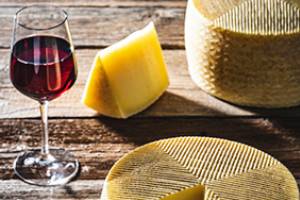
If you like to pair your cheeses with wine, Camembert and Brie are traditionally served with reds, although there is some disagreement about the type of red for the type of cheese. Steven Jenkins believes that Brie calls for a “big” red wine but prefers to match Camembert with a “Gamay or Pinot Noir.” Other sources are less specific, claiming that either cheese is a fine partner to almost any red, including Cabernets or Zinfandels. For more festive occasions, I’ve seen Camembert matched with a good Champagne. Of course, serving these cheeses with wine isn’t a must; they can be enjoyed in their own right, by themselves or with good fruits of the season.
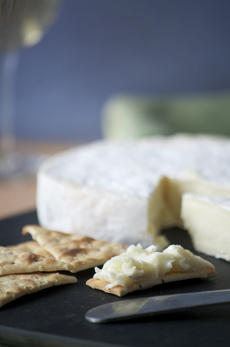
Cheese Board
Brie and apples: a delicious combination. At iGourmet.com.

Although I’d like to suggest a field trip to France for any of you interested in discovering more about genuine Brie and Camembert, I understand that budgetary and time constraints may be problematic in such an endeavor. In a case like this, a knowledgeable cheese retailer can truly be your best guide. Given that real Camembert is unavailable in the US and that the pasteurized substitutes are bland indeed, someone with experience in cheese might be able to suggest a tastier alternative. Again, if you’re looking for Brie, ask questions. By all means taste the cheese if possible. And don’t be afraid to go elsewhere if you need to. You deserve the best in cheese, whether it’s a new variety, or, like the cheeses discussed above, a true classic.

Sources:


© Copyright 2005- 2008 Lifestyle Direct, Inc. All rights reserved. Images are the copyright of their respective owners.


Spread The Word: Each icon below links to a site where you can bookmark, share and comment on this article:
Dine52    del.icio.us    ma.gnolia    Newsvine    Yahoo Myweb    BlinkList    simpy    reddit


.