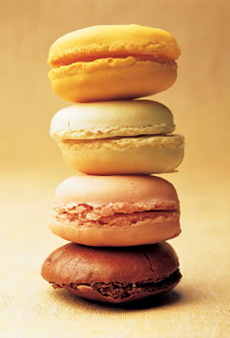
 French-style macarons from France’s great chocolatier and patissier, François Pralus. French-style macarons from France’s great chocolatier and patissier, François Pralus.
December 2006
Last Updated May 2019 |
|
The History Of Macaroons & Macarons
Created By Italian Monks, Refined By French Pâtissiers
Page 1: The Original Macaroons
CAPSULE REPORT: “Macaroon” means different things to different people, as you’ll read in this article. To some, it’s a big ball of coconut, to others, a delicate, airy meringue. Both are delicious. Here’s a history that explains how they came to be. This is Page 1 of a two-page article. Click on the black link below to visit Page 2. Macaroons can be frozen and defrosted 90 minutes before serving.
Overview
First note the difference between macaroons and macarons.
MAC-A-ROONS are the name given to the original Italian cookies and to the subsequent coconut variations, both hardy.
MAC-A-RONS are the French version, delicate meringue cookie sandwiches that can break at the slightest touch. These are the current rage in the U.S.
Go to a fine French restaurant and you may find miniature macarons among the petit-fours.* Macarons are a popular holiday treat: get a gift box of them and you’ve gotten a treat that’s delicious with a cup of fine tea. But, have you gotten French macaroons, Italian macaroons, or that tasty hybrid, coconut macaroons?
___________________
*Petit-fours is French for “small baked pastries,” although some confections that are included on the petit-fours plate are not baked. Examples include glazed or chocolate-dipped fruit, marzipan, pâte de fruits and nut clusters, among others.). There are two styles of petit-fours, glacé and sec. Petit-fours glacées or frais include filled and/or iced petit fours, miniature babas, miniature éclairs, tiny iced cakes and tartlets. Petit-fours secs include small cookies, macaroons, meringues palmiers and tuiles. The words mignardises (min-yar-DEEZ), from the French for “preciousness,” and friandises (free-yon-DEEZ), from the French for “delicate,” are often used instead of petit-fours.
_________________________
The Original Macaroons
According to at least one food historian, the earliest records for what appears to be the ingredients of the first “macaron” cookies
dates to the Renaissance, and to Arabic countries such as Syria that exported almonds†.
A confection made from sugar or honey and almond meal (ground almonds), marzipan was beloved not only for its palate pleasures, but because of its ability to be
sculpted into fanciful shapes.
It was known in Italy and
France by the early 1300s (it took almost 300 years more to arrive in Britain). It is believed to have been first seen by Europeans during the crusades, the last of which ended in 1291. No doubt, crusaders with a sweet tooth brought the concept back with them [source].
And here’s the link: Macarons are made from the same almond meal.
Macaron is the French form of maccheroni (macaroni), the Italian word for paste, i.e., a food made from a paste, like pasta is made from flour, water and egg.
Add some sugar and ground almonds, bake instead of boil, and voilà!
The First Macaroons: Almond Cookies
The first macaroons were almond meringue cookies similar to today’s amaretti, with a crisp crust and a soft interior.
They were made from egg whites and almond paste (a combination of equal parts of ground blanched almonds and sugar, mixed with egg whites—today glucose or corn syrup can be substituted). The name of the cookie comes from the Italian word for paste, maccarone (mah-kah-ROW-nay), and is also the word for pasta/macaroni and dumplings.
|
|
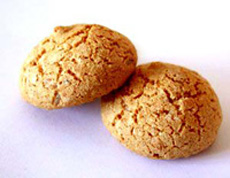
Macarons arrive in France in 1533, via Catherine de Medici. |
While origins can be murky, some culinary historians claim that that macaroons can be traced to an Italian monastery—where they were modeled after the monks’ belly buttons!
The name derives from the Italian maccarone or maccherone, itself derived from ammaccare, meaning to crush or to beat. The reference is to the crushed almonds or almond paste, which is the principal ingredient.
Macaroons—in French, macarons—came to France in 1533 with the pastry chefs of Caterina de Medici, bride of the Duke of Orléans—the future King Henri II. When you see the beautiful colors and flavors of modern macarons, note that at this point, macarons were beige-colored almond paste—delicious, but not complex like today’s offerings.
Two Benedictine nuns, Sister Marguerite Gaillot and Sister Marie-Elisabeth Morlot, seeking asylum in the town of Nancy during the French Revolution (1789-1799), paid for their housing by baking and selling the macaroon cookies, and thus became known as the “Macaron Sisters” (les soeurs macarons).
You’ll learn the difference between amaretti and French macarons on the next page.
No matter the variety, they share a common characteristic: They’re made from almond flour or coconut, and are thus gluten free!
__________________
†Today, the largest almond producers are, in order, the U.S., Spain, Italy, Iran, Morocco, Greece, Syria, Turkey, Pakistan and Lebanon.
Coconut Macaroons
Italian Jews adopted the cookie because it has no flour or leavening (the agent that raises and lightens a baked good, like yeast, baking powder and baking soda—instead, macaroons are leavened by egg whites) and can be enjoyed during the eight-day observation of Passover. It was introduced to other European Jews and became popular as a year-round sweet.
Over time, coconut was added to the ground almonds and, in certain recipes, replaced them.
And, thank goodness, someone made chocolate macaroons, and dipped the originals in chocolate, too.
|
|
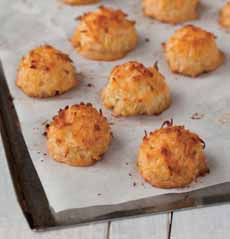
Classic coconut macaroons from Danny Macaroons.
|
Coconut macaroons are more prevalent in the U.S. and the U.K.—and they’re a lot easier to make and transport than the fragile almond meringues.
Modern macaroon makers like Danny Macaroons put some fun into it with flavors like chocolate almond, coconut almonds, peanut butter and chocolate, peanut butter and jelly, rainbow sprinkles, salted caramel, stout coconut,
Continue To Page 2: Amaretti & French, Swiss & American Macaroons
Go To The Article Index Above
|