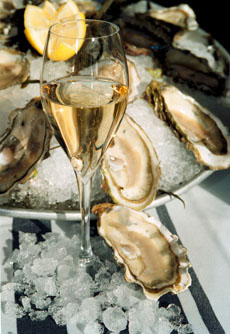
The perfect wine with oysters: Champagne! Photo courtesy Champagne Bureau.
July 2007
Last Updated April 2013
|
|
Wine And Oysters...And More
Part 9: Eating Oysters, Pairing Wine With Oysters... Finding Pearls?
CAPSULE REPORT: This is page nine of a nine-page article about the oyster. Here, eating oysters and finding the right wine (you’re not likely to find a pearl). Click on the black links below to visit other pages. Also visit our more than 50 food glossaries that focus on other favorite foods, including a 13-page Seafood Glossary.
Eating The Oysters
Fresh oysters must be alive just before consumption. There’s a simple criterion: The oyster shell must be tightly closed. Oysters that are already open are dead and must be discarded (not because of poison, as is often thought; but because when it dies, the oyster secretes an enzyme that impacts the flavor of the meat).
- Alive. Oysters are alive before they are opened. To confirm if an open oyster is dead, tap the shell: a live oyster will close its shell and is safe to eat. A dead oyster can also have a closed shell; however it will make a distinct noise when tapped and is called a “clacker.”
- Raw. Oysters are often enjoyed raw “on the half shell” (also called shooters). A very fresh oyster needs nothing—not even a squirt of lemon—to embellish its glory. No cocktail sauce, no mignonette sauce—and definitely no hot sauce. You’ll know that fresh oyster when you have the first bite. (For the sublime experience, treat yourselves to some just-harvested oysters from one of the worlds most pristine waters. Check out Willapa Oysters, a NIBBLE Top Pick Of The Week.)
- Raw Oyster Dressings. While chili sauce, cocktail sauce and mignonette sauce have been classic dressings for raw oysters, “nouvelle” oyster toppings can get creative. We enjoy milder fruit salsas (mango, peach) and for the ultimate enjoyment, caviar.
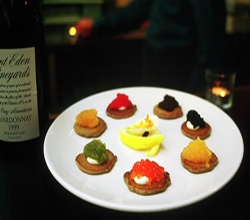 Oysters & Caviar. While sturgeon caviar can get pricey, affordable salmon caviar and flavored whitefish caviar hit the spot. One of our favorite first courses that always wows guests is “Oysters Royale,” six oysters on the half shell, with six different colored and flavored caviars we get from TsarNicoulai.com: beet-saffron, ginger, truffle and wasabi-flavored whitefish caviars, trout caviar and salmon caviar (shown in the photo atop blini, but think of them atop oysters). Photo courtesy TsarNicoulai.com. Oysters & Caviar. While sturgeon caviar can get pricey, affordable salmon caviar and flavored whitefish caviar hit the spot. One of our favorite first courses that always wows guests is “Oysters Royale,” six oysters on the half shell, with six different colored and flavored caviars we get from TsarNicoulai.com: beet-saffron, ginger, truffle and wasabi-flavored whitefish caviars, trout caviar and salmon caviar (shown in the photo atop blini, but think of them atop oysters). Photo courtesy TsarNicoulai.com. - Cooked. They can be cooked in many ways: batter-fried, broiled, grilled, steamed, added to soups and stews or prepared in special dishes like Oysters Rockefeller (broiled with a topping of herbed and seasoned bread crumbs).
- And More. Oysters also can be found canned, frozen, pickled and smoked.
- Seasonality. Fresh oysters are available year-round. The advice not to eat oysters during months spelled without an “r” does not refer to spoilage and food poisoning from eating oysters during hot summer months. Rather, it refers to the oyster’s spawning months, May, June, July and August (in the Northern Hemisphere). The meat from spawning oysters is softer, milkier and more bland than in the fall and winter. Here’s a tip to enjoy your oysters in those months: Choose oysters from the colder waters of New England and Canada. The oysters don’t spawn, although they grow large as if they were going to.*
*When oysters are fattening up, they load up on glycogen, a polysaccharide that is the principal storage form of glucose. This sugar is greatly depleted when oysters spawn, diminishing the quality of their flesh. If oysters don’t spawn, they grow plump and sweet, and can be harvested year-round,” says Michael Kirkpatrick in his article, “Duxbury Pearls: Island Creek Oysters,” in Edible Boston, Spring 2007. But, if the oysters don’t spawn, won’t the colony die out? We contacted Michael, who advises: “Oyster colonies naturally die out all the time, which is one reason why many, if not most, commercial oyster beds are re-seeded on a regular basis (another reason: to ensure a reliable harvest).” Reseeding involves obtaining oysters from hatcheries and adding them to the beds. Thanks, Michael! If you visit the Cooperstown, New York, area, visit Michael’s farm and B&B.
Wine And Oyster Pairings
Champagne and Chablis are the classic wine and oyster matches, but other dry white wines also work well. Popular pairings include:
- Chablis
- Champagne
- Chardonnay
- Dry Chenin Blanc
|
- Dry Alsatian Riesling
- Dry Sherry
- Muscadet
|
- Pinot Grigio
- Pinot Gris
- Sauvignon Blanc
|
Finding Pearls
What about finding a pearl in your oyster? All oysters (and many other bivalves) can create a pearl, which is a secretion that covers an irritation—sand or another foreign object—that finds its way into the shell. Alas, any “pearls” found in edible oysters lack the glorious luster of those from other species, and have no market value. Pearl oysters come from a different family, Pinctada. In the Ostreidae family (the edible oysters), the jewel is the succulent oyster meat. Enjoy it!
|