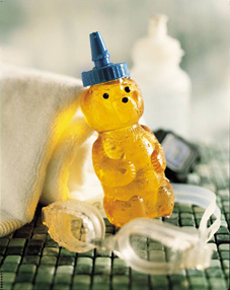
Honey Bear, though beloved, is often filled with a bland blend of honeys. Better to cultivate your palate with different varietal honeys from artisanal producers. The Honey Bear™ logo is the registered trademark of the National Honey Board. Photo courtesy of the National Honey Board.
February 2005
Updated July 2018
|
|
Honey Facts & Trivia
Fun Tidbits Of Information About The Sweet Stuff
Page 1: Overview
Honey has many dévotées. But how many of the people who spoon honey into their tea, onto muffins and pancakes, over ice cream, and mix it into recipes know much more than “it’s made by bees?” This is Page 1 of a three-page article of honey facts and trivia. Click on the black links below to visit other pages.
Honey Facts: An Overview
Why do most honeys taste the same? Even though names like “clover” and “wildflower”* conjure up pastoral images, mass-marketed honeys, like many mass-marketed foods, are blended to a common denominator of acceptability (read: mild and bland).
| |
* |
Due to mass distribution, the term wildflower has become indicative of a generic-tasting blend of honeys from various origins rather than a regional honey retaining distinctive local wildflower flavors.
|
Inexpensive honey is imported from major producing countries like Argentina and China, and blended to create a homogeneous taste. An analogy would be importing Pinot Noir and Cabernet Sauvignon and blending them to create a commonly acknowledged flavor of “wine.”
In reality, fine honeys are as gloriously different as the fruits of the vine. They differ in color and flavor depending on what flowers the honey bees draw their nectar from. Honey is very much a function of geography: many trees and shrubs are region-specific, so some honeys that are made in California could never be made in Maine.
As a result of this provenance, honeys’ colors vary widely, from clear-as-water wildfire honey to dark-as-molasses buckwheat honey. Their flavors range from mild and subtle to rich and bold. (As a general rule, lighter-colored honeys are more delicate in taste and darker-colored honeys are stronger.)
Who Produces The Honey?
If you said “the bees,” it’s a trick question. Artisan beekeepers produce 40% of domestic honey; and like other artisanal producers, keep careful control over the quality of their product.
By handing their trade from generation to generation, they ensure that we can enjoy distinctive honeys from sources like basswood (a smooth, smoky, mellow honey), saw palmetto (a robust honey with hints of citrus, and an earthy aftertaste), orange blossom (highly aromatic, with a taste and smell of an orange grove in full bloom) and tropical lehua honey (buttery with lily-like overtones).
You’ll cherish these honeys as you cherish your other fine foods. If you don’t drink generic “tea,” “coffee” and “wine,” you’ll learn to look beyond generic “honey” to the great treasures awaiting you.
No matter what kind of honey you prefer, appreciate it: It takes 2 million flowers to create one pound of honey.
-
On a collection flight from the hive, a honeybee visits between 50 and 100 flowers. Bees must visit 2 million flowers to produce one pound of honey. For that amount, a hive of bees must fly 55,000 miles.
-
Workers bees make only about 1/12 teaspoon of honey in a single lifetime. During the peak of the honey-gathering season, a strong, healthy hive will include an average population of 50,000 bees. (Source: Golden Blossom Honey)
Continue To Page 2: About The Honey Bee
Go To The Article Index Above
Lifestyle Direct, Inc. Images are copyright of their respective owners.
|