 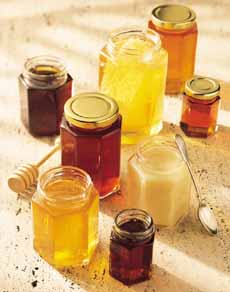
Honey flavors and colors vary widely, depending on the plants from which the pollen is gathered. Photo courtesy National Honey Board.
February 2005
Last Updated July 2018
|
|
Honey Lovers’ Facts & Trivia
Page 3: Honey Production
This is Page 3 of a three-page article. Click on the black links below to visit other pages.
Honey Production
 |
There are about 210,000 beekeepers in the United States: 95% are hobbyists with less than 25 hives, and an additional 4% are part-timers with 25 to 299 hives. Together, they manage 50% of the nation’s hives and produce 40% of the nation’s honey. An estimated 5% quit beekeeping annually due to the mite epidemic and competition from imports. Commercial beekeepers—with 300+ hives—number approximately 1,600 and produce 60% of the nation’s honey. These are generally family businesses handed down from generation to generation.
|
| |
|
The USDA estimated that there were approximately 2.59 million honey-producing colonies in 2003, based on beekeepers who managed five or more colonies. Since 1980, U.S. honey production has averaged around 200 million pounds per year. However, since 2006 colonies have been declining at the rate of about 30%/year due to weather and other conditions including Colony Collapse Disorder from the parasite Nosema ceranae (Microsporidia), that has killed many millions of bees since late 2006.
|
| |
|
Every state has honey production. The leading production states are California and North Dakota, with 30 million+ pounds; and Florida and South Dakota, with about half that amount. Bees may travel as far as 55,000 miles and visit more than two million flowers to gather enough nectar to make just a pound of honey.
|
| |
|
There are approximately 300 varieties of honey in the United States. They vary from water-clear fireweed honey to dark brown buckwheat honey. The darker the color, the more robust the flavor. Honey is primarily composed of fructose, glucose and water. It also contains other sugars as well as trace enzymes, minerals, vitamins and amino acids.
|
|
Per capita honey consumption in the U.S. is 1.1 pounds/year (sugar is 144 pounds/year!). In 2009, the U.S. produced only about 144 million pounds of the 382 million pounds of honey consumed. The remainder was imported from Argentina, Brazil, Canada and other countries. |
The Buzz About Honey
|
Honey has been used in medicine since ancient times. Before bacteria were even known, it was used as an anti-microbial agent for dressing wounds, burns and skin ulcers. Honey has virtually no moisture in it, so bacteria can’t make it spoil. It reduces odors, reduces swelling and scarring, and prevents the dressing from sticking to the healing wound.
|
| |
|
Honey has long been used as a moisturizer and a preservative. When Alexander the Great died, he was carried back to Greece in a golden coffin filled with honey.
|
|
Honey is a mixture of sugars—largely fructose and glucose—so it does not spoil. Because of its high sugar concentration (70% to 80%), it kills bacteria through the process of plasmolysis. Natural airborne yeasts cannot become active in it because the moisture content is too low. As long as the moisture content remains under 18%, virtually no organism can successfully multiply to significant amounts in honey.
|
|
Raw, unprocessed honey contains living enzymes, antioxidants, amino acids and B-complex vitamins. It’s a healthy food, a low glycemic sweetener, and is the easiest sugar for the body to absorb and use. Supermarket honeys are typically pasteurized for longer shelf life (to prevent crystallization), so they lose these nutritional assets.
|
|
Most honeys in supermarkets and restaurants taste the same because it is cheap honey is imported from China and Argentina, bought by large packers and blended, micro-filtered and pasteurized. This creates a homogenous taste without any character. Purchasing varietal honey at specialty food stores offers the opportunity to experience the different and complex flavors of fine honey. |
|
Honey doesn’t go bad. It doesn’t spoil because there’s no moisture for bacteria to feed on. In 1922, Howard Carter discovered vessels of honey, olive oil and wine in King Tut’s tomb (Tutankhamun died in 1323 B.C.E.). The olive oil and wine were long spoiled, but the honey was still completely preserved, almost liquid, with its original sweet aroma. It was edible 3,000 years later! Egypt’s nomadic beekeepers would raft their hives up and down the Nile, following the seasonal blossoms (mostly clover, cotton and orange blossoms). It was used as a sweetener, to make mead and to make medicinal ointments. Each amphora was labeled with the honey’s source, the date and location of production and the name of the person who sealed the jar. The title “sealer of the honey” was given to those who oversaw the sealing and ensured quality control. (Source: The Honey Connoisseur.) |
Go To The Article Index Above
Trivia sources: ABC to XYZ of Bee Culture (the A.I. Root Company, 1990), National Honey Board.
Lifestyle Direct, Inc. Images are copyright of their respective owners.
|

