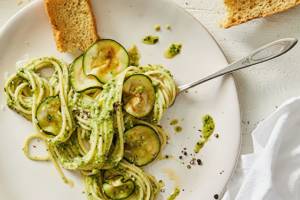
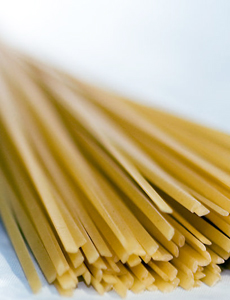
 You can easily tell the difference between linguine and spaghetti because linguine, above, is flat. Spaghetti is round. Photo by Sebastian Zurkuhl | Wikimedia.
Last Updated May 2026
|
|
Pasta Glossary ~ Types Of Pasta
Page 4: Types Of Pasta Beginning With G, I, K & L
This is the best place to learn about the types of pasta! If you enjoy this Pasta Glossary, we have a food glossary for almost every category of food, including Italian favorites like cheese, espresso, and olive oil. Plus, find reviews of our favorite brands of pasta and sauces, pasta recipes, and informative articles about pasta in our Pasta Section.
Click on a letter to go to the appropriate glossary section.
a b c d e f g h i j k l m n o p q r s t u v w x y z
This glossary is copyrighted and cannot be copied in whole or in part. You are
welcome to link to it.
GALLETTI
Another name for creste di gallo, “cocks’ combs,” galletti (gah-LEH-tee) are semicircular tubular pasta with ruffled edges. The double-ended openings make this shape perfect to pair with less dense, more liquid sauces, which are captured inside it. The ridges are good for capturing thicker sauces.
GARGANELLI
Garganelli (gahr-gahn-NELL-lee), or “quills” in Italian, are penne-style egg pasta. They can be found with and without ridges (here, the ridges are horizontal instead of vertical, as on penne rigate).
|
|
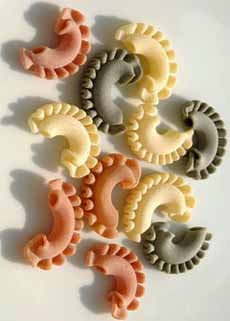
Galletti, cocks’ combs (photo © Fotolia).
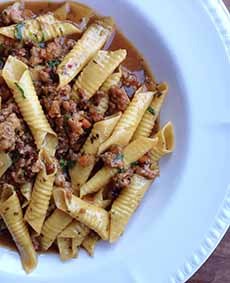
Garganelli (photo © Kindred Restaurant | Davidson, NC).
|
GEMELLI
Gemelli (juh-MELL-lee), meaning “twins,” are simply two short strands of round pasta that are twisted together. They are very versatile because they hold the sauce while retaining an al dente texture. They are popular in entrées, side dishes, baked dishes, and pasta salads, and pair well with light to moderately thick tomato sauces and cream sauces.
|
|
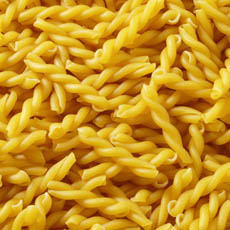
Photo of gemelli pasta courtesy of Barilla.us.
|
|
GIRASOLE
Girasole (GEE-rah-so-LAY) is the Italian word for sunflower. In pasta, the word refers to ravioli made in a sunflower shape. The girasole in the photo, from Nuovo Pasta (a NIBBLE Top Pick Of The Week), is filled with osso bucco. So, more than the shape is creative and delectable.
|
|
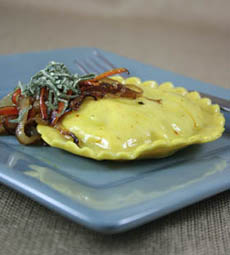
Girasole ravioli. Photo by Ryan Clark.
Read our review of Nuovo Pasta, a NIBBLE Top Pick Of The Week.
|
|
GLASS NOODLES
Glass noodles are mung bean threads, translucent, gelatin-like noodles cooked in the same manner as rice noodles (but different from them). Glass noodles are opaque when dried but become translucent when reconstituted.
They are made from starch and water. The starch can be mung bean, potato starch, sweet potato starch, tapioca, or canna (canna lily). They are usually sold in dried form, soaked to reconstitute, then used in soups, stir-fried dishes, or spring rolls.
While the Chinese word, fensi, translates as threads, note that the translation of spaghetti is similar: cords or strings.
Chinese varieties made from mung bean starch are also known in English as Chinese vermicelli, bean threads, or bean thread noodles.
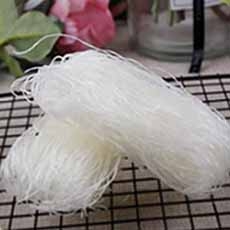
Dried glass noodles. Photo © Glass or Cellophane Noodles |Amazon).
|
|
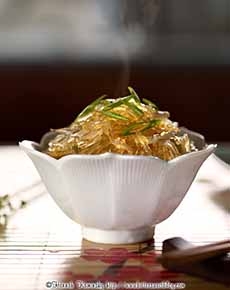
Glass noodles (photo © Hannah Kaminsky | Bittersweet Blog).
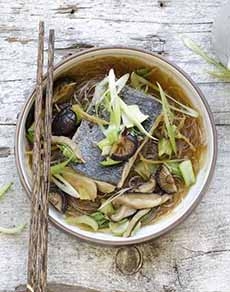
Glass noodles, shiitake mushrooms, and poached fish in broth: delicious and low in calories (photo © Sun Basket).
|
GLUTEN-FREE PASTA
Gluten-free pasta is made from gluten-free grains (corn, brown and white rice), legumes (chickpeas, lentils), and vegetables (potatoes), among others. Rice and corn are closest to traditional flours, while legumes tend to have more protein and fiber with a slightly different taste and texture. In Asia, gluten-free noodles are made from buckwheat, kelp, konjac yam root (shirataki), millet, mung bean, rice, and sweet potato.

Gluten-free mac and cheese. Here’s the recipe (photo © Taste Of Home).
|
GNOCCHI
Italian for dumplings, gnocchi (NYO-kee) can be made of flour, semolina, potatoes, or sweet potatoes, boiled or baked, and served with butter and grated Parmesan cheese or a savory sauce. Eggs or cheese can be added to the dough. Common flavorings include spinach, basil, tomato, and saffron (the latter is Sardinian-style). Gnocchi are generally shaped into little balls or ovals. The dough can also be chilled and sliced, then either baked or fried. Gnocchi are usually served as a side dish with meat or poultry. Potato dumplings have been a staple of both northern and southern Italian cooking since the early 19th century.
|
|

Gnocchi in pesto cream sauce. Here’s the recipe (both photos © DeLallo). |

Sheet pan gnocchi with sausage and peppers. Here’s the recipe.
National Gnocchi Day is celebrated globally on January 29th, while in Argentina, Paraguay, and Uruguay, National Gnocchi Day is celebrated on the 29th of every month.
GNUDI or “NAKED GNOCCHI”
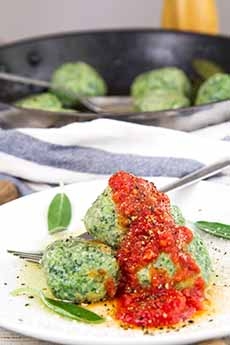
Gnudi consists of pasta filling, sautéed in butter (some people bake them) without the dough. It’s a low-carb way to enjoy the filling without the wrapper (“gnudi,” pronounced NOO-dee, means nude in Italian). A common recipe is ricotta, spinach, and Parmesan cheese. The filling is shaped into small, flattened balls.
They can be served with marinara sauce, mushroom ragoût, pan-sautéed cherry tomatoes, fresh peas, crispy pancetta, or whatever inspires you. You can cook them in herb butter or sprinkle them with fresh herbs.
Chef Scott Staples of Seattle’s Restaurant Zoë makes an all-ricotta version with a bit of cream to bind, served in a brown butter-sage sauce with truffle salt, topped with fried sage leaves.
Gnudi are referred to as “cousins” of gnocchi because both are dumpling-like, but gnocchi are typically chewy and heavy, and gnudi are delicate pillows.
The history of gnudi. |
|
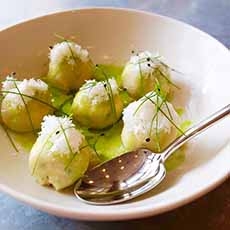
Above: Gnudi at L’Amico | New York City. Below: Spinach gnudi from Philo’s Kitchen | New York City.
|
|
GRAMIGNA
These specially cut semolina pasta twirls (grah-MEE-nya) are named after Bermuda (or couch) grass because it curls and twists like the wild, squiggly stems of the plant. It hails from the Emilia-Romagna region, particularly around Bologna and Modena. Short squiggly hollow tubes were originally handmade like all pasta, but now mostly extruded. An artisan cut, it can be found fresh and dried in Italy, but is not easy to find outside of Italy.
The classical pairing is with sausage ragù, known as gramigna alla salsiccia (photo below). Here’s the recipe.
|
|

Gramigna twirls (both photos © The Pasta Project). |

INTEGRALE
See whole wheat pasta.
|
KAMUT
Kamut® (kah-MOOT) is the manufacturer and brand name of Khorasan wheat that is available in the U.S. Khorasan is an ancient wheat, the grain of which is two times larger than modern wheat. It has a rich, nutty flavor.
As produced by Kamut®, it’s organic and whole grain—just as it was in the time of the Pharaohs.
It’s better for you than modern wheat: higher in protein and minerals, especially magnesium, selenium, and zinc. It has a higher percentage of lipids, which produce more energy in the body than wheat’s carbohydrates.
Think of Khorasan as high-energy wheat, better for athletes and anyone looking for high-energy food. No one will notice that it isn’t conventional pasta.
Here’s more about it.
|
|
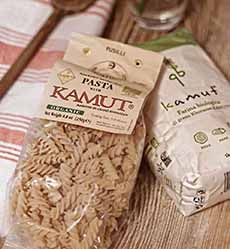
Kamut, an ancient form of wheat, is coming back as better-for-you pasta (photo © Pease, Do Tell).
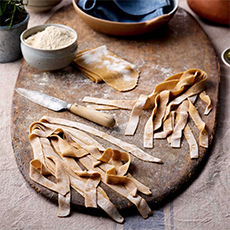
Homemade kamut fettuccine (photo © Dove’s Farm).
|
LASAGNA
|
Lasagna (la-ZAHN-yeh), the plural form of lasagna, originated in the Emilia-Romagna region of north-central Italy. The plural form is lasagne.
The wide, flat sheets of pasta were originally made by the Romans, who called them laganum. The word comes from lasanum, the Latin word for pot, i.e., the vessel in which this dish was baked.
Lasagne later came to refer to the specific layered-type baked dish we know today, with the long flat pasta sheets alternating with minced meat, cheese, and tomatoes.
|
|
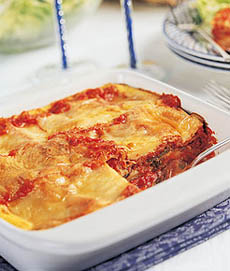
Lasagne. Photo courtesy Cabot Cheese. |
The Romans lacked tomatoes, which originated in Peru and did not come to Italy until the Spanish Conquistadors brought them back in the early 16th century. Even then, the cherry tomato, which was the “original” tomato, was considered a houseplant and not eaten until the 18th century.
The modern lasagna noodle is two inches wide, and sometimes has ruffled edges (see Lasagnotte, below). It is also made as spinach pasta.
The most popular cheeses in lasagne recipes are mozzarella and ricotta, and the sauce is often tomato sauce or béchamel. A proliferation of modern recipes includes vegetable lasagnas, “white” lasagnas, and goat cheese lasagnas.
If you regularly make lasagna with commercial sheet noodles, try making it with artisanal pasta: The rougher surface helps sauce and other ingredients cling better while constructing the layers.
National Lasagna Day is July 29th.
The history of lasagna.

Take a break from the red sauce with this scrumptious pesto lasagna. Here’s the recipe (photo © Taste Of Home).
|
LASAGNETTE
Lasagnette is a shorter version of lasagnotte (next entry).
LASAGNOTTE
Wide ribbons of pasta, like lasagna, that are typical of the Puglia region. Different variations have different edges: a wavy (frilly) cut on both sides or one side with a straight cut and the other with a wavy cut.
|
|
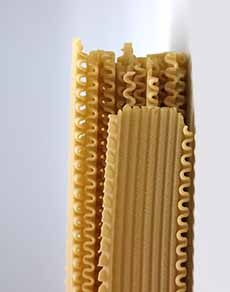
Lasagnotte (photo courtesy of Wikipedia). |
|
LIGURIA
Bordering the coast in northwestern Italy, Liguria is the third smallest of the Italian regions. It borders France to the west, Piedmont to the north, and Emilia-Romagna and Tuscany to the east. It lies on the Ligurian Sea, a part of the Tyrrhenian Sea (the northern Mediterranean Sea). The capital is Genoa, the birthplace of pesto sauce (pesto alla Genovese). Liguria is also the birthplace of linguine and trenette pasta.
|
|
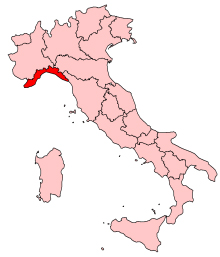
Map of Liguria courtesy of Wikipedia. |
|
LINGUINE or LINGUINI
This pasta is accurately called linguine, its Italian name, but the word became Americanized to linguini. Show you’re a food connoisseur and use the original Italian!
Originating in the Liguria region of northern Italy, linguine (lin-GWEE-nay), Italian for “little tongues,” is a narrow, flat version of round spaghetti (it is sometimes referred to as flat spaghetti). It is a narrower version of fettuccine.
Linguine is often paired with white or red clam sauce, butter and cheese, or cream sauces; but it is so versatile that it works with almost any type of pasta sauce.
Pesto al Genovese (basil, pine nuts, Pecorino cheese, extra virgin olive oil, and garlic) is popularly served with linguine; as is a sauce made of cream, peas, and prosciutto. By the way, basil pesto is also a creation of the Liguria region.
September 15th is National Linguine Day.
Check out the history of linguine. |
|
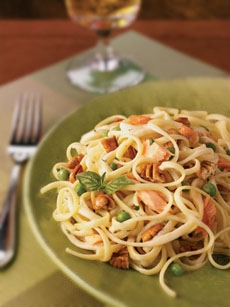
Photo courtesy of SXC.
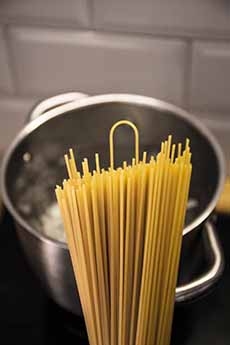
Photo courtesy of SXC. |
|
LOMBARDY
The northernmost central region in Italy, Lombardy, it lies between the Alps and the Po River valley. It borders the Italian regions of Piedmont, Emilia-Romagna, Veneto, and Trentino-South Tyrol, as well as Switzerland. The capital is Milan, the largest city in Italy. Other well-known provinces include Bergamo, Brescia, Como, Cremona, Mantua, and Pavia.
|
|
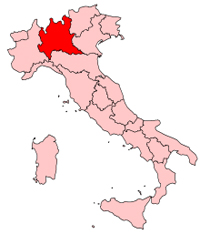
Map of Lombardy courtesy Wikimedia.
|
|
LIGURIA
Bordering the coast in northwestern Italy, Liguria is the third smallest of the Italian regions. It borders France to the west, Piedmont to the north, and Emilia-Romagna and Tuscany to the east. It lies on the Ligurian Sea, a part of the Tyrrhenian Sea (the northern Mediterranean Sea). The capital is Genoa, the birthplace of pesto sauce (pesto alla Genovese).
|
|
Map of Liguria courtesy of Wikipedia. |
|
LUMACONI or LUMACE
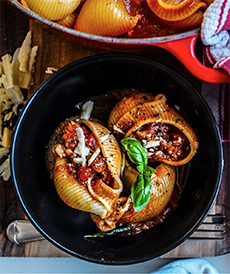
Lumaconi (loo-mah-COE-nee), also known as lumache, were named for their resemblance to the shell of a snail (in Italian “lumaca”). They are giant, basket-shaped shells that are stuffed with cheese and vegetables. The shape is ideal for traditional baked pasta recipes, as a large amount of thick and/or creamy sauce can nestle inside each shell.
Different regions claim to have created lumaconi; most historians point to the Campania region, specifically the historic pasta-making town of Gragnano near Naples. Another contender is the Piedmont region in the northwest, which was reportedly influenced by France's culinary love for snails.
Also see shelbows, a hybrid of lumache and pipe rigate, a curved, ridged tube.
|
|

Baked lumaconi with ricotta and spinach. Here’s the recipe (photo © Chewtown). |

You can see how thick sauces can flow into the shells, creating glorious bites (Gemini Photo).
© 2005-
|