THE NIBBLE (TM) - Great Finds for Foodies (tm)


RSS feed
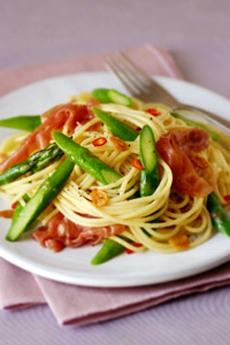
Pasta with asparagus
What does this classic Italian pasta dish with asparagus and Parma ham have to do with the Japanese concept of umami? Read all about it in this article, and enjoy the delicious umami recipe above for pasta with asparagus and Parma ham, recipe courtesy of the Umami Information Center.
MENU


Seasonings

Main Page
Articles & Reviews


Main Nibbles

Main Page
Articles & Reviews Of Foods
From A To Z


Product Reviews

Main Page
Foods, Beverages, Books,
News & More


Home Page

Link to Other Sections:
Newsletter, Marketplace,
Food Fun, Home Zone


ABOUT THE AUTHOR
KAREN HOCHMAN is Editorial Director of THE NIBBLE.


September 2006

Product Reviews / Main Nibbles / Salts & Seasonings

Sweet, Sour, Salty, Bitter And... Umami?

Umami: You’ve Been Eating It All Your Life!


CAPSULE REPORT: Just when you thought you understood the components of taste, you have to learn a new one—umami, the taste of brothiness or meatiness. It’s a real taste, scientifically proven. The challenge is, it’s not an easy one to learn: it requires some palate training to identify glutamate, or MSG, that is the fundamental taste of umami.

In junior high school science class, we learned that humans have taste receptors for sweet, sour, salty and bitter, and the “zones” on the tongue where the receptors for these flavors were found. But while the “tongue map” of taste bud receptors has since been disproved (see the Addendum for details), a fifth taste has been added, called umami, a coined Japanese word to indicate a brothy or savory taste.

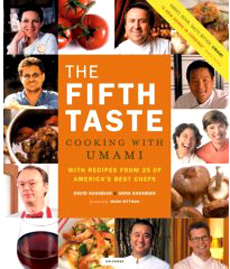
Umami, long understood in Asia, was the topic of one of last year’s hot cookbooks, The Fifth Taste, Cooking With Umami, by the food writer and chef duo of Anna Kasabian and David Kasabian. They not only explain what umami is, but show it in practice with an extensive collection of recipes. In fact, the alien-sounding umami flavor is everywhere familiar: in a ham and cheese sandwich and a pepperoni pizza. It’s a new word, but it’s an old taste—just like sweet, sour, bitter and salty.

There may be other official tastes to surface. The Chinese, for example, acknowledge pungent, a common taste in their cooking. Some question if certain flavor sensations are actually tastes, e.g. the heat of chile peppers, the coolness of mint and alcohol or the astringency of tannins.

umami
The first book to explain umami to Westerners—with 50 recipes that translate words into tastes.

These discussions are not intellectual debates but can be scientifically measured, so we’ll hear more about them in the future. But for today, let’s figure out umami.

The Umami Information Center has a website with much more extensive information and a newsletter for interested students of umami. To them we are grateful for the recipes and for much of the lovely photography in this article.

The Modern Era Of Umami

Everything old is new again. The “new” taste, umami, was identified almost 100 years ago, in 1908, by Dr. Kikunae Ikeda of Tokyo Imperial University. He had sought to scientifically identify an official fifth taste, which was recognized for centuries in dashi, the kombu- (dried seaweed, see photo below) and bonito-based Japanese fish stock. Dashi, meaning “boiled extract,” is the basis of all Japanese boiled dishes and soups.

In 1908 Dr. Ikeda succeeded in extracting glutamate (or glutamic acid, an amino acid) from kombu and discovered that it was the main active ingredient in kombu. He coined the term “umami” to describe its taste. While umami is an invented word in Japanese, the closest English equivalent is brothy or meaty, with a connotation of savory.

But foods with no meat or broth—tomatoes and parmesan cheese, for example—are loaded with the glutamate and the flavors of umami. Umami is a subtle taste that occurs naturally in many vegetables and dairy products as well as in meat, fish and seafood. The challenge is, it’s not as easily recognizable as sweet, salty, bitter and sour—at least in the Western diet.

Konbu
Kombu, a large brown algae that we call dried seaweed, is the basis of dashi, Japanese fish stock. The types of kombu used for dashi are only harvested around the island of Hokkaido in northern Japan. Photo courtesy of The Umami Information Center.

Umami is the result of the presence of glutamate plus five ribonucleotides including inosinate and guanylate. Glutamate is naturally present in some degree in most foods; inosinate and guanylate are present in many foods (inosinate is found primarily in meat, guanylate is more abundant in vegetables). Another nucleotide, adenylate, is abundant in fish and shellfish.

After identifying umami, Dr. Ikeda introduced the new seasoning monosodium glutamate, or MSG, which has a strong umami taste. It was first marketed in 1909.bouillon cube   Dr. Ikeda was later named one of Japan’s top 10 inventors by the Japanese Government Patent Office. The closest Western product, that people could identify as “brothy,” bouillon cubes, had been developed more than 25 years earlier by a Swiss flour manufacturer, Julius Magi. The bouillon cube, made from hydrolyzed plant protein was originally conceived as a nutritious vegetable protein substitute for soup-making for people who could not afford meat. But the rapid-cooking soups evolved into an important business, providing meaty (brothy) convenience and flavor-enhancement in cooking convenience to many households. Prior to Dr. Ikeda’s research years later, it was not known that the protein hydrolysates in bouillon cubes are full of glutamates—or that the flavor sensation could be described as umami.

In 1960, further scientific research revealed how combining a glutamate with an inosinate (ribonucleotides from meat) creates the perfect umami taste. The classic, brothy flavors of three major cuisines fits this profile:

  GLUTAMATE   INOSINATE
Japanese Dashi Kombu (Kelp) + Bonito Flakes
Chinese Tan

Chinese Cabbage
Chinese Leek

+ Chicken Bones
Western Bouillon Onion + Leg of Veal

Of course, this culinary “magic” was in use for 1000 years throughout the world before the science was understood, or umami had a name.

The umami taste itself blends well with other tastes to expand and round out flavors, just as the other tastes, e.g. sweet and salty (sugar and salt), are in of themselves not primary tastes. But blended with other tastes, they produce something delicious. Because umami had no name for so long, few people have been trained to recognize umami when they encounter it. Most of us don’t taste umami when eating ripe tomatoes, sun-dried tomatoes, asparagus, parmesan cheese, cured ham, mushrooms, meat or fish, the way we taste bitter and sour. It may take a generation for a typical group of diners to discuss the umami undertones of a dish, the way they might today talk about the bitter greens in a mélange of vegetables.

Ancient Umami

Although it was only in 1985 that the word “umami” became recognized internationally, and only last year that the Fifth Taste, Cooking With Umami was published to explain it in detail to English-speakers, umami has been part of Western tradition since ancient times. Beginning in Greece and began appearing in nearly every ancient Roman recipe as early as the 7th and 8th centuries B.C., garum, a fermented fish sauce, was the universal condiment to flavor food—as we today use salt. There also were a lower-quality fish sauce called liquamen and a fish paste condiment called allec, made from the sediment of the garum.

Garum was a fish sauce similar to the fish sauces used in Asian cuisines, which are equally ancient (if the Roman Empire had not toppled, we’d most likely be using garum in Western cuisine today). To make garum fish, along with their intestines and salt, were mixed together and then fermented in sealed containers. Garum originally came from Greece, and the Greek words garos or garon name the fish whose intestines were originally used in the condiment’s production†. The amber-colored garum extracted first from the fermentation process was most highly prized.

Sardines
Niboshi are small sardines that have been boiled and then dried. They are used to make a strong dashi for hearty simmered dishes. In the Roman Empire, the fresh sardines would have been fermented for garum. Photo courtesy of The Umami Information Center.

In the 1st century B.C., the Roman poet Martial considered garum made from mackerel to be the finest, that made from tuna, to be of second quality, and dismisses the liquamen made from “generic” fish. By the 1st century A.D., the noted culinary writer Marcus Gavius Apicius preferred his fish sauce from mullet; but by then distinctions have vanished, and the terms garum and liquamen are interchangeable. In the cookbook attributed to him (the oldest surviving cookbook), De Re Coquinaria (“The Art of Cooking”), almost all recipes use some form of fish sauce—not surprising ingredient, as garum was used in cooking instead of salt, as well as a table condiment.

†The sauce was generally made through the crushing and fermentation in brine of the innards of various fish such as anchovies, eel, mackerel, oysters, prawns, red mullet, salmon, sardines and tuna. The garum sauce was then mixed with wine, vinegar, pepper, oil, or water and served as a condiment with a wide variety of dishes.

Garum Factory

The ruins of a Roman garum factory in Baelo Claudia, near Tarifa, Cádiz, Spain. Spanish garum was a famous export, earning the town a measure of prestige. As popular as garum was, garum factories were unpopular: the smell given off during the fermentation of the fish sauce production was so powerful that the making of garum gradually became outlawed in densely populated areas. The process was not one of “rotting fish,” but a fermentation of enzymic proteolysis, similar to beer, vinegar, cheese, or yogurt. Photograph by Marina Amador, courtesy of Wikipedia.

The use of garum died out along with the Roman Empire, but fermented fish products survive in Western cuisine in the form of anchovy paste, our modern allec; and Worcestershire sauce—a fermentation of anchovies, onions, shallots, cloves, garlic, vinegar, molasses, chili peppers, soy sauce, pepper, tamarinds, corn syrup and water—which actually derived from the British occupation of India. And garum does survive in the ancient fish sauces of Asia, which appear to have a very similar method of production: Vietnamese nuoc nam, Thai nam pla and Cambodian tuk trey, Burma’s ngan-pya-yem, Laos’s nam pa and Philippines’ patis and bagoong.‡ Other relatives include the Malaysian shrimp paste belachan and a similar product in Myanmar called nga-pi.

‡Garum added extra fish intestines, or might have been made wholly of fish intestines; modern fish sauces don’t add extra intestines, only those present in the fish that are fermented. For more information on garum, read this treatise from the University of Chicago.

Foods With Umami


Before we look at the umami-rich foods in our everyday diet, let’s take a look at these not-so-everyday umami-rich foods:

  • Foods made from fermented beans or grains: soy sauce, miso sauce, jeogal
  • Foods made from fermented seafood: anchovy and cod roe paste in Scandinavia, the Asian fish sauces noted above

But unless you eat a diet rich in Asian foods or Scandinavian fish pastes, you don’t eat most of these often. Before we look at how the concept of umami translates into everyday Western foods, here’s a bit of a pep talk:

It’s easy to understand sweet, salty, bitter or sour when you taste it—it jumps out at you. Umami is more vague. While all fruit and candy, for example, exhibit some sweetness, not all cheeses or vegetables will shout “umami.” A tomato is meaty, celery is not. The meatiness of a lamb shank or a beef stew easily says “umami”; a delicate poached chicken breast doesn’t make the same kind of statement. You’re looking for glutamate, the flavor of MSG. It requires some palate training, like learning to recognize the tannin and acid components of wine.

Condiments

Bouillon cubes, ketchup, MSG, steak sauce and Worcestershire sauce are glutamate-laden food-enhancers. In Australia, glutamate-dense yeast extracts like Vegemite and Marmite are spread on buttered bread and eaten the way we enjoy peanut butter. You’ll read more about some of them in the sections below.

Dairy Products

Cow’s, goat’s and sheep’s milk are rich in glutamates. When the milk is cultured and aged to produce cheese, the glutamic acid is further liberated, with a corresponding boost in flavor.

  • That’s why more aged cheeses— cheddar, emmental, gruyère, parmesan, romano, e.g.—are used as seasoning cheeses, grated over or stirred into other dishes, or used as toppings to add savory flavor.
  • Other cheeses, such as the mold-cured blues, lend distinctive glutamate-rich flavors.
  • While cultured dairy products such as yogurt and sour cream are used in many Western cuisines, they are a less concentrated source of glutamate than aged cheese. But their flavor is enhanced by the unique tang of lactic acid, and they are a traditional umami food.

Parmesan Cheese
The small white crystals on the surface of a piece of parmesan cheese are glutamate, crystals which are formed during maturation.

Photo of cheese and of tomato above courtesy of The Umami Information Center.

Cured Pork Products

Bacon, ham, ham hocks, salt pork, sausages and other cured pork products are fundamentals in the umami arsenal. By themselves or as additions to beans, stews, soups, potatoes, rice dishes and other foods, most Western cuisines use some kind of sausage. Each country or region has a specialty: think English country sausages, French charcuterie, Italian pepperoni, German wursts, Polish kielbasa and Spanish chorizo.

  • Cured pork products are part of our daily life, from bacon, ham or sausage with breakfast to ham, bologna or salami sandwich at lunch to a dinner ham, sausages in a pasta sauce or a pepperoni pizza.
  • Sausage has been embraced in American regional cooking, from southern collard greens with smoked ham hocks, German-style potato salad with bacon, Creole jambalaya and Cuban black beans with ham.

Fish

AnchoviesWhile garum died out with the Roman empire, it lives on in the West, most noticeably in the form of anchovies and anchovy paste.

  • Anchovies are extremely popular in southern Italy, Sicily and southern France as a flavor-enhancer in sauces and with meat, vegetables, and pasta, pizza, salads and hors d’oeuvres. In paste form it is added to sauces, salad dressings and spreads like anchovy butter. It is a component of condiment such as Worcestershire and steak sauces. (The top-quality white anchovies sown at the right area treat for anchovy-lovers. Click here for more information.)
  • Anchovy paste and other fish pastes like cod roe paste are basics in Scandinavian cuisine.
  • Dried shrimp is used in soups, stews and mixed rice dishes in Central and South American and the Caribbean to provide a fuller, richer flavor.
  • The intense, meaty seafood broths—bouillabaisse, gumbo, sopa de mariscos, et al—are the closest Western equivalent to a Japanese dashi, full of sea-based glutamates.

Meats

Beef stock is a classic example of umami. The flesh and bones, boiled with vegetables, herbs and spices, form the basis of great sauces, stocks and soups.

  • Stocks can be made from veal, chicken and other meats as well. Strained and clarified, they makes broth or bouillon (from the French bouilli, boiled).
  • These glutamate-rich liquids also can be reduced into concentrates, from glace de viande to commercially bottled concentrates (Bovril, e.g.).
  • A cheeseburger with tomato and ketchup provides three sources of umami: meaty beef, aged cheddar, perhaps a slice of tomato and lots of tomato ketchup.
  • Pork is as equally full of glutamic acid as other meats, but is most known as an umami agent in its cured form.


Mushrooms

Earthy-flavored mushrooms vary by type in glutamate content, but most contain substantial amounts. The highest content is owned by the shiitake, Japan’s most popular mushroom.

When mushrooms are dried, their guanylate content increases, further boosting their umami flavor. The liquid from re-hydrated dried mushrooms is very rich in umami and is widely used to make dashi and other stock.


Tomatoes

Shiitake mushrooms

Photo of shiitake mushrooms courtesy of The Umami Information Center.

One hardly thinks “umami” when thinking of the tomato; but a true, farm-raised tomato has a “beefy” flavor that comes from a heavy concentration of glutamates. Delicious by itself, it is used in condiment form (ketchup) and as a paste to enhance soups, stews and sauces.

While the tomato is indigenous to Peru and Ecuador*, it has taken root the world over.

  • Ketchup, one of the most ubiquitous tomato-based foods, originated in Southeast Asia; kecap is the Indonesian word for soy sauce. When kecap was brought back to England by sailors, it was remade with local ingredients such as walnuts and mushrooms; when it traveled to America the condiment was remade with the local tomato.
Tomatoes
Tomato. Photo courtesy of The Umami Information Center.
  • Tomato sauce on pasta with parmesan cheese is a double-umami hit. A pizza with tomato sauce, cheese and pepperoni, sausage, mushrooms or anchovies is a triple or a perhaps a home run, depending on the number of toppings one chooses.

*Called tomatl by the native Americans), the tomato was brought to Spain by Christopher Columbus and later by Hernando Cortès, and then to Italy where they earned the name pomi d’oro, or golden apple, because the original varieties were yellow. It was originally used for medicinal purposes and had a reputation for being poisonous; but it was assumed for years to be poisonous in Italy, where it was grown as a decorative plant. Eventually the peasant classes discovered that it could be eaten when food was scarce. This eventually (and thankfully!) developed into the famed Italian cuisine of tomato dishes: by the 18th century the tomato had become an indispensable ingredient of Italian cuisine. Across the sea, by 1799, it was being used to make catsup in New Orleans. In the U.K., Worcestershire sauce was made from tomatoes and other vegetables, and this was eventually exported to America, along with tomato sauce and paste, where a variety of processed foods such as ketchup and chili sauce were produced. Today, tomatoes are one of the most widely produced vegetables on the planet and their umami taste is appreciated all over the world.

Glutamate Content Chart

Glutamate content in the natural forms of these foods:

Category

mg/100g

  mg/100g   mg/100g
Beef 107 Mackerel 215 Sea Bream 215
Bonito 285 Mushroom (Enokitake) 21.8 Seaweed, Nori 1378
Bonito (Dried) 26 Mushroom (Shiitake-Fresh) 67 Seaweed, Wakame 8.62
Carrots

33

Mushroom (Shiitake-Dried)   Soybean

66

Cabbage (Chinese)

100

Parmesan Cheese 1200 Squid


146


Chicken 76 Oyster 137 Sweet Potato 60
Clam 41 Pork 122 Tomato 140
Cod 44 Prawn 43 Tomato Juice 260
Green Tea 668 Potato 102 Truffle 8.5
Kombu (Seaweed) 2204 Sardine 280 Tuna 188
    Sardine (Dried) 50    


Recipes From The Umami Information Center


Dozen of delectable recipes await at UmamiInfo.com. Here’s one to whet your appetite.

Scallop And Bacon Salad

There are intense umami flavors in scallops, crispy bacon and parmesan cheese, not to mention a delightful melange of textures.

Serves 4

Scallop and Bacon SaladIngredients

  • 3 ounces arugula leaves (or other favorite
    salad green)
  • 1 ounce block parmesan cheese
  • 2-ounce slab of bacon
  • 8 scallops
  • 1 tablespoon olive oil
  • 2 tablespoon white wine vinegar
  • 1 teaspoon mustard powder (e.g.
    Colman’s)
  • 3.4 ounces half and half
  • Salt and pepper
  • Sugar to taste

Directions

  • Wash the arugula leaves and set aside.
  • Using a peeler, cut half the parmesan cheese into shavings for use as a garnish. Grate the remainder.
  • Cut the bacon into thick matchstick shapes around 1/4" square, and fry until crisp to make lardons.
  • Next make the dressing. Whisk together the white wine vinegar and mustard powder in a bowl, and add the cream. Mix again, and then add the grated parmesan cheese.
  • Season the dressing with salt and sugar to taste. Add a little water if the consistency is too thick.
  • Heat the olive oil in a pan. Season the scallops with salt and pepper and add to the pan. Fry until browned on both sides.
  • Finally, arrange the arugula on a serving dish, scatter over the parmesan shavings and bacon, place the scallops on top and drizzle over the dressing.

More Recipes

For more information on umami, including recipes for every season, visit the Umami Information Center.

Shown: Roast Duck and Grape Red Curry.

Note: Some ingredients are written in the metric system (grams, e.g.) and need to be converted; but the Roast Duck is totally readable by Americans.


Thai Roast Duck

Learn More About Umami

The Fifth Taste Umami The World


The Fifth Taste: Cooking With
Umami
, by Anna Kasabian and
David Kasabian. The book that introduced America to umami. Not only will you learn it all... you’ll be able to cook it all as well. Full of fun and creative recipes for all cooking levels, and
concepts of umami that will bring new perspectives to everything in your current repertoire. Click here for more information or to purchase.

The Fifth Taste of Human
Being Umami the World
, by
Yoko Takechi. A 72-page book about the history and usage of umami in both Eastern and Western cuisine, giving many varied examples of its sources in nature, as well as similarities and differences in its usage around the world. Click here for more information or to purchase.


Addendum: Taste Bud “Tongue Map”

Here is the back-story on the tongue map, which identifies specific regions of the tongue as having the taste bud receptors for sweet, salty, bitter and sour. The original article was published in the Public Library of Science, a peer-reviewed journal. This information comes from “Cracking The Code” by Jane Bradbury, published in the March 2004 edition. You can read the complete article here.

  • In 1901, the concept of the tongue map originated in research published by D.P. Hanig, a German scientist. He set out to measure the relative sensitivity on the tongue for the four known basic tastes. Based on the subjective responses of volunteers, he concluded that sensitivity to the four tastes varied, with sweet sensations peaking in the tip of the tongue, salty sensations behind the tip, sour at the sides, and bitter at the back. That was the extent of his paper.
  • Tongue MapIn 1942, Edwin Boring, a noted psychology historian at Harvard University, took Hanig’s raw data and calculated real numbers for the levels of sensitivity. The modern tongue-map was born (an example is shown at the right). While Boring’s numbers simply denoted relative sensitivities, they were plotted on a graph such that other scientists assumed areas of lower sensitivity indicated no sensitivity in those areas. Subsequent generations of school children were taught the science of the tongue map.
  • In 1974, a scientist named Virginia Collings re-examined Hanig’s work. She agreed with his main point, that there were variations in sensitivity to the four basic tastes around the tongue. But she found that the variations were small and insignificant: that all tastes can be detected anywhere there are taste receptors. The receptors exist around the tongue, on the soft palate at back roof of the mouth and even in the epiglottis, the flap that blocks food from the windpipe.
  • Subsequent research has revealed that taste bud seems to contain 50 to 100 receptors for each taste. While the tongue map is an “oversimplification” (if not downright inaccurate), textbooks continue to print it.


© Copyright 2005- 2008 Lifestyle Direct, Inc. All rights reserved. Images are the copyright of their respective owners.


Zagat

iGourmet


Gevalia


Spread The Word: Each icon below links to a site where you can bookmark, share and comment on this article:
Dine52    del.icio.us    ma.gnolia    Newsvine    Yahoo Myweb    BlinkList    simpy    reddit


.