THE NIBBLE (TM) - Great Finds for Foodies (tm)


RSS feed
potato chips
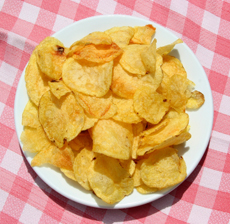
Potato chips, which were invented in Saratoga, New York are more American than apple pie, which came here from Europe.
MENU


Snacks

Category Main Page
Articles & Reviews


Main Nibbles

Main Page
Articles & Reviews of Foods From A to Z


Product Reviews

Main Page
Food, Beverages, Books,
News & More


May 2005

Product Reviews / Main Nibbles / Snacks

A History of the Potato Chip

America’s Favorite Snack Food Began As An Insult Returned


While much of history comprises many people doing singular things, in certain cases one or two people seem to do an awful lot. Some days, it seems that everything we enjoy was invented by the ancient Chinese and/or abetted by Thomas Jefferson. Thus, we have Thomas Jefferson perfecting ice cream recipes (originally created, as fruit ice by the Chinese), Jefferson returning from Europe with the first pasta machine (pasta, too, invented by the Chinese), and at the same time bringing the recipe for French fries, called “potatoes fried in the French manner” (as far as we know, the Chinese have had absolutely nothing to do with the potato).

From that elegant dining room in Monticello in 1789, French-style fried potatoes spread quickly and far. The style of the time was a thick-cut fry and not the slender julienne frites of today.

According to the Snack Food Association, the potato chip was born a generation later, on August 24, 1853 in another elegant dining room: this one, at the fashionable Moon Lake Lodge in Saratoga, New York. A testy older diner, Commodore Cornelius Vanderbilt*, sent his food back to the kitchen, complaining that the fried potatoes were not sliced thin enough and were too soggy.

*At that time the Commodore was a steamboat magnate. He later created the New York Central Railroad system and became the wealthiest man in America. Chef George Crum was a Native American from the Huron tribe, which was indigenous to the Saratoga area. See more information about Crum in the next footnote.

The cook, George Crum†, cut and fried a thinner batch, but these, too, were rejected. Equally testy, Crum decided to fight back by slicing the potatoes wafer-thin, frying them to a crisp in boiling oil and over-salting them. They were too crisp to eat: they could not be pierced with a fork without shattering—and no gentleman of the day would have dreamed of picking up food with his fingers at the dining table.

But Crum’s fit of pique was rewarded with compliments to the chef: the Commodore loved the “crunch potato slices.” Other diners requested the potatoes (“I’ll have what he’s having”), which began to appear on the menu as Saratoga Chips, a house specialty. Soon they were packaged and sold, first locally, then throughout the New England area. “Saratoga Chips” became a hit and Crum eventually opened his own restaurant across the lake, featuring them. There is an old photo of a gift box, much like a box of salt water taffy, with an engraving of what may be Crum’s lodge and the words “The Original Saratoga Chips, Saratoga Specialties, Saratoga, N.Y.”

†C. R. Gibbs, in the 1975 book, The Afro-American Inventor (Washington, D.C.: Gibbs), describes Crum as “part Indian, part black, a former guide in the Adirondacks, and in his own way a rather colorful figure in this area.” Gibbs ascribes to him an “irascible nature.” A 1941 source called him “a tough old codger who had once been an Indian trapper” and mentioned five wives, who supplied labor when he opened his own restaurant at the south end of the lake.

  George Crum
Cornelius Vanderbilt
Chef George Crum,
at top, the inadvertent
inventor of the potato
chip. Immediately above
is Commodore Cornelius
Vanderbilt, his
inadvertent muse.

More Moments in Chip History

For several decades after their creation in upstate New York through the early part of the twentieth century, Saratoga Chips were largely a side dish served in the Northeast, at restaurants and special occasion dinners. William Tappendon of Cleveland is credited with being the first to sell potato chips to grocery stores, in 1895. He began making chips in his kitchen and then turned his barn into the world’s first potato chip factory.

  • The early 1900s saw the development of several large factories for the mass production of potato chips. Companies large and small sprang up all over the country: Leonminster Potato Chip Co.‡ (later Tri-Sum) in Leonminster, Massachusetts (1908); Mikesell’s Potato Chips‡ in Dayton, Ohio (1910); George Dentzler in Houston, Texas (1910); Dan Dee Pretzel and Potato Chip Company‡ in Cleveland, Ohio (1913). Through the 1920s, new chip factories included Num Num in Cleveland, Ohio (1918); Blue Bell in Illinois (1919); Wise Delicatessen Company‡ in Berwick, Pennsylvania (1921); Hanover Home Brand Potato Chips (later Utz‡) in Hanover, Pennsylvania (1921); Magic Food Co. (later Golden Flake‡) in Birmingham, Alabama (1921); Moore’s‡ in Bristol, Virginia (1924); and Scudder’s‡ in Monterey Park, California (1926). Even today, with two huge national brands (Lay’s and Wise) consumers remain very loyal to their regional brands.
  • In 1921 potato chips were introduced to England; but because the Brits already used the word “chips” for what we call french fries (i.e., fish and chips), they chose the word “crisps” instead.

‡Still in business today, some under a different name or ownership.

Why the burst of growth in the 1920s? Aside from the popularity of the chips themselves, it was low-level technology. Potatoes had been tediously peeled and sliced by hand. In the early 1920s, the mechanical potato peeler was invented—the same type of gadget most of us use to peel potatoes today. This paved the way for potato chips to grow from a small specialty item to a top-selling snack food.

  • According to the Snack Food Association, potato chips did not become a mainstream snack food until the invention of the sealed bag. Prior to then, potato chips were stored in glass display cases or in barrels; the chips at the bottom of the barrel were often stale and damp. In 1926, the next big step forward occurred. Laura Scudder, the California chip manufacturer, invented the moisture-resistant potato chip bag by ironing together two pieces of wax paper. Every evening, her women employees took home sheets of wax paper and ironed them into bags. The next day, workers would pack chips into the bags, seal the tops with warm irons and deliver them to retailers. This created a seal and kept the chips fresh until opened. Her product, Scuds (in the days before missiles, it was a play on spuds and her surname), was the first to be sold in airtight sacks. Around the same time, cellophane began to appear, and a few years later, glassine. In 1933, the first pre-print waxed glassine bag debuted and provided a place for brand identification and advertising. Bagged chips meant self-service: no clerk was required to measure and weigh the chips.
  • Potato chips were fried in small kettles (today’s gourmet “kettle chips” are a return to the thicker, small batch style made with better ingredients, i.e., before mass production took over). The continuous fryer was invented in 1929, creating tremendous economies of scale and driving most of the small, kettle-cookers out of business.
  • In 1932, 24-year-old Herman W. Lay began as a route salesman for the Barrett Food Products Company, an Atlanta manufacturer of Gardner's Potato Chips. Two years later he founded the H.W. Lay Distributing Company, distributing for the Barrett Food Products Company; three years later he had 25 employees and had begun producing his own line of snack foods, building a business and a brand that would become synonymous with America’s favorite salty snack. By 1937, Lay’s potato chips had become the first successfully marketed national brand of chips. In September 1961, H.W. Lay & Company merged with The Frito Company, creating the largest-selling snack food company in the United States, Frito-Lay, Inc. (In June 1965, Frito-Lay and Pepsi-Colo merged to become PepsiCo.)

Pass the Salt

  Herman W. Lay
Herman W. Lay
at the top of his
game.

Surprisingly, the commercial potato chip remained unseasoned until the 1950’s. Salt was supplied in a sealed packet inside the chip bag—not what we would call user-friendly today. Then, Thomas Hutchinson, the owner of a Irish potato chip (or crisp, as they’re known in Great Britain) company called Tayto** pioneered a technology to add seasoning directly to the chip. The world’s first seasoned potato chips were Cheese and Onion and Salt ‘n’ Vinegar.

**Evidently there were two different companies in Ireland called Tayto. Some sources give attribution for the invention of the seasoning to Joe Murphy of the other Tayto.

This innovation caused an overnight sensation in the food industry, with the heads of some of the biggest potato chip companies in the United States bee-lining to the tiny Tayto tater company to examine the product and to negotiate rights to the new technology. When eventually, the Tayto company was sold, it made the owner and the small family group who had changed the face of potato chip manufacture very wealthy. Companies worldwide sought to buy the rights to Tayto's technique.

That Tayto Crisps innovation changed the very nature of the potato chip. Later potato chip manufacturers added natural and artificial seasonings to potato chips, with varying degrees of success. Today’s specialty manufacturers make upwards of a dozen different delicious flavors of chips. The first two flavored chips in the U.S. were most Sour Cream and Onion and Barbecue, which remain the most popular flavors along with cheese-seasoned chips. Tayto endures as Ireland’s largest manufacturer of chips, and still makes the original Cheese and Onion and Salt ‘n’ Vinegar...as well as Ready Salted, Smoky Bacon, Spring Onion, Barbecue Beef, Prawn Cocktail, Wuster Sauce, and Roast Chicken.†

American chip manufacturers are no slouches when it comes to fun flavors. Click here to see the flavors of some of our favorite gourmet chips.

†A classic of American “Trailer park cuisine” is the Potato Chip Sandwich, two slices of white bread spread with mayonnaise and heaped with potato chips. The top slice of bread is pressed down hard until all the potato chips are crushed. Imagine the nuances that Barbecue Beef or Roast Chicken chips would add to the potato chip sandwich


Chip Flag

A flag made of potato chips, celebrating the 150th anniversary of America’s favorite snack in 2003. Photo courtesy of the Snack Food Association.


Full Circle

After largely disappearing into the snack food realm, potato chips have re-emerged in the finest dining establishments—where they delight well-heeled diners as much as they delighted Cornelius Vanderbilt.

If you’re not getting freshly-made, hot potato chips at your favorite dining spots—or if you feel like taking out the mandoline and making some delicious snacks yourself—click here for a recipe. And think about George Crum and the Commodore.


Spuds & Snacks    

The Potato 1001 Snacks 101 Things To Do With A Potato
The Potato: Read why the spud has been an unassuming history maker. Click here for more information. 1001 Snacks: Enjoy the recipe for the potato chips and the 1000 others. Click here for more information. 101 Things To Do With A Potato: Each year you consume 140 pounds of potatoes—broaden your horizons with these recipes. Click here for more information.


Commence Snacking

Mandoline Waring Fryer  
Cuisinart Mandoline Slicer: Make razor thin potato chips everyday, at home. Click here for more information. Waring Professional Deep Fryer: Fry your potato chip to crispy perfection. Click here for more information.  


© Copyright 2005- 2008 Lifestyle Direct, Inc. All rights reserved.  Images are the copyright of their respective owners.


Spread The Word: Each icon below links to a site where you can bookmark, share and comment on this article:
Dine52    del.icio.us    ma.gnolia    Newsvine    Yahoo Myweb    BlinkList    simpy    reddit


.