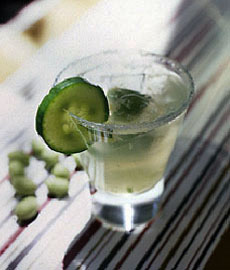
 A shot of sake, rimmed with salt, Margarita-style and garnished with fresh cucumber. Photo courtesy Riingo.com.
October 2005
Last Updated September 2025
|
|
Product Reviews / Main Nibbles / Wine
Saké Glossary
Page 4: Terms & Definitions S ~ Z
This is Page 4 of the four-page Saké Glossary—that’s saké, correctly spelled with an accented “e” and pronounced SAH-keh, and not saki, or SAH-kee. Click on the black links below to visit other pages.
Click on a letter to get to the appropriate glossary page:
a b c d e f g h i j k l m n o p q r s t u v w x y z
This glossary is protected by copyright and cannot be reproduced
in whole or in part without written permission.
|
Sakabayashi: The word means “cedar grove”; a cedar ball is hung outside the door of the brewery to let customers know that the newly-brewed saké is ready for sale. Saké can be brewed only during the cool winter weather, as it needs to be fermented for a long time at a low temperature. In the old days, people bought saké directly from breweries—there were few stores that sold it directly. With today’s broad distribution, a sakabayashi has no practical meaning; but brewers hang one when the new saké is ready, in ceremonial celebration.
|
|
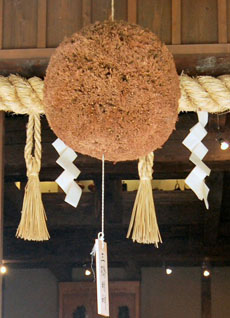
The cedar ball signifies that the newly-brewed saké is ready. Photo courtesy Moippai.com. |
Sakamai: The strain of rice grown for saké. It has a much higher starch content than normal table rice. A method called San’ou, which means three-yellow, produces the strongest, hardiest rice. The rice is withered and “yellowed” three times: first as seedlings, then in the rice paddy by starving the rice, and finally, when it is reaped, it dries and yellows for the third time.
|
Saké (SAH-keh): A fermented and brewed alcoholic beverage made from rice, ranging from 4% alcohol to 21% alcohol. (Photo of saké bottles at right courtesy of Tenranzan Japanese Saké.)
Sakémaker: A person who makes saké, equivalent to a winemaker. The lead sakémaker is called the chief sakémaker. In Japan, the chief sakémaker is called a tohji. A sakémaker is equivalent to a winemaker.
|
|
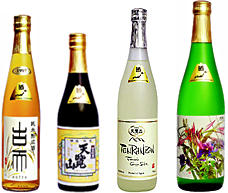
A selection of saké bottles. Photo courtesy Tenranzan. |
Sakémaster: A saké educator who can knowledgeably educate people about saké. A sakémaster is equivalent to a wine sommelier.
|
Sakéry or Sakagura or Kura: The place where saké is produced, analogous to a brewery or a winery. In the U.S., it has been called a brewery, winery, and distillery. By Federal law, each saké producer in the United States is required to have a brewery license. Each state government agency that regulates saké treats it like a wine, which requires the producer to have a winery license.
|
|
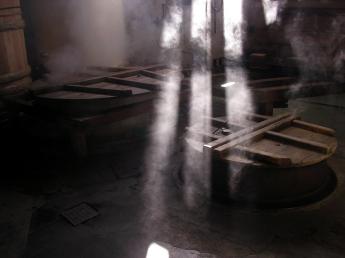
A sakéry. Photo by Sean Okihiro | SXC. |
Ninety-four percent of all sakés that are made in Japan have distilled alcohol added to them (honjozo), so when they are imported into the United States, they are classified as a spirit. Thus, saké is a beer on the federal level, a wine on the state level, and a spirit when imported from Japan with added distilled alcohol.
Photo:
Saké Meter Value (SMV) or Nihonshu-Do: The measure of specific gravity, or density, of saké. A dry saké has a positive SMV; a sweet saké has a negative SMV. The larger the number, either positive or negative, the drier or sweeter the saké is.
|
Seishu: An older Japanese term for refined saké, separating it from the less refined saké that was made in China in earlier times. Japanese sakéries often refer to saké as “nihon-shu,” which literally means “Japanese saké.”
Seimai Buai: “Degree of milling,” the percentage of rice milled away, which is part of what determines the category of saké. Sometimes the number appears on the label (e.g., 70 indicates 70%); but in most cases, this is not mandatory.
Shu: The suffix for saké.
Shochu: A distilled spirit made from rice, barley, and/or sweet potato. It is a neutral spirit like vodka, but much smoother. Shochu is now more popular in Japan than saké. It is about 25% percent alcohol, higher than wine (12%-15%) but less alcoholic than vodka, gin, and rum (40%). It is a good mixer; a Yuzu Martini, for example, is made with shochu and yuzu liqueur. Like vodka and saké, it can be infused with fruits, herbs, and spices.
|
|
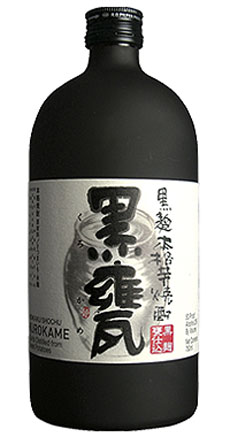
Shochu made from sweet potatoes. Photo courtesy Takarasake.com. |
Sugidama: A ball of woven green cedar boughs used to measure aging. When the ball turns brown, the saké is ready. The balls are also popularly used as decor in modern Japanese homes.
|
Taru: A traditional celebratory saké cask or barrel. As saké is used in many Shinto ceremonies, people donate large barrels of saké to shrines and temples. (Photo at right.)
Tokubetsu: Saké brewed in a special manner with high quality rice and extra care.
Tohji or Toji: A sakémaker. Equivalent to a winemaker or brewmaster. Saké-making is much more complex than winemaking; saké quality is 80% toji and 20% rice, while wine quality is 80% grapes and 20% winemaker-dependent. Skills and techniques are handed down from generation to generation.
|
|
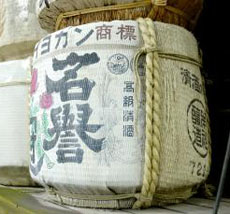
A taru, or celebratory saké cask. Photo by Michael Lammerse | SXC. |
Varietal: A particular strain of saké rice. Analogous to grape varietals. Some fine rice varietals are yamadanishiki, mutsuhomare, gohyaku-mangoku, myamanishiki, and yumeakari. As with wines, saké varietals can be blended. The same varietals used to make saké are not used for eating: they have much less protein than eating rice.
Yamada Nishiki: A specific rice cultivar used to make the finest sake. It is often called “the king of sake rice.” In English, it is also written as one word: Yamadanishiki.
Go To Page Index Above
|