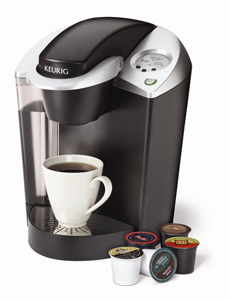
Invasion of the Pod Machines
Keurig & Tassimo Single-Serve Coffee Machines
Brewed Coffee Quality at Faster-Than-Instant-Coffee Speed
Hot sellers: do they belong in your kitchen?
Try to buy a coffee maker these days and it’s like buying a car: you can spend four months with a spreadsheet trying to figure out the options. Choose one of the new single-serve machines—they brew one cup of coffee at a time using pre-filled coffee “pods”—and there’s less variety. But the stakes are higher. Similar to printer toner cartridges, you are locked in to a particular brand of pods that fits only the machine you choose.* Unlike toner cartridges, which just come in black or color and do a relatively indistinguishable job of printing on paper, the brands of pods vary widely. Some have very limited options, others are more broad in the number of roasts they offer (dark roast, medium roast, decaf, and hazelnut, e.g.)—and how good the brews taste. If you are just looking for a convenient, quick cup of coffee, none of this will matter to you. If you really notice what your coffee tastes like, it will.
*Most machines can use pods with coffees from different coffee roasters, that are manufactured to their specs. However, the choices are still limited.
Having previously reviewed the inexpensive Senseo single-serve machine from Philips, we spent several months using two in the space at more than twice the price.
- Keurig, a producer of office coffee machines, introduced a line of smaller machines for home use.
- Tassimo was developed by Kraft Foods, owners of Gevalia Coffee (the actual machine is made by Saeco, a manufacturer of high-end and professional coffee and cappuccino makers. It is distributed and serviced by consumer electronics specialist Braun.
Keurig is derived from the Dutch word for excellence, Tassimo from the Italian word for cup. Both have been selling well in Europe for some time.
Summary
Single-serve machines are ideal for those who seek speed and convenience and don’t mind the higher cost per cup of coffee. The coffee is average to good, but never rises to the level of “great”: serious coffee drinkers will prefer their brew ground from fresh beans.
- The Tassimo is an interesting piece of engineering** and is flying off the shelves this holiday season (it held a position between #80 and #87 among all of Amazon’s kitchen and housewares products during the weeks prior to Christmas). Sales have been abetted by an advertising campaign that promises to “brew the perfect cup.” It doesn’t, however: you would not mistake its output for anything from a coffee chain or a quality eating establishment. But if you want an easy way to make cappuccino and latte at home, this is it.
- Overall we prefer the Keurig, both in sturdiness (from its heritage as a a heavy-duty office machine) and perhaps more important, for the quality of its coffee. And, it is virtually no-maintenance: the Tassimo requires regular cleaning or clumps of residue from any milk beverages you make end up in the bottom of your cup.
**A bar code reader on each pod tells the mechanism inside the machine what kind of beverage is being brewed, so it provides exactly the right amount of water for espresso, latte, regular coffee, tea, or hot chocolate; and you can adjust the machine for a stronger or weaker brew.
- Neither system is for conservationists: the coffee is vacuum-packed into plastic pods and after brewing each cup, there is a plastic cup to throw away. If you’re using just one cup a day, it probably won’t bother you. Make 10 cups a day, and the plastic piles up.
- For this reason and the fact that superior coffees are now available for the Senseo (which uses biodegradable filter-paper pods), we net out in favor of that single-serve system if you just want plain coffee. Plus, the system costs less than half the price to buy and keep stocked.
|
At right, the five different beverages brewed by the Tassimo: cappuccino, latte, coffee, tea, and hot chocolate. Forget making tea in it: tea needs to be steeped, not shot through with water for 30 seconds.
|
We do want to say that both the Keurig and Tassimo systems have their place in America’s homes, small offices and dorms; and that some of our visitors who saw us use them and drank their coffee loved them and ran out to buy them. They tended to be people who only want one cup of coffee to start their day, loved the no-fuss, no-mess convenience of a quick-brewed cup, and loved the freedom from needing to have fresh-ground coffee on hand.
While we enjoyed those same benefits, the palates among us would only be satisfied by better-quality beans. The coffee produced by the pods ranges from average to good, but none of it is a great cup of coffee. Keurig sells an adapter that allowed us to use our own ground beans, but that defeated the purpose: we could have easily measured our own beans into the Melitta cone or French press that we already own, with no need to cede precious counter space to a large, expensive single-serve machine.
A detailed analysis follows.
What’s Your Objective?
Consider a single-serve coffee brewing system if you:
- Need a very quick cup, e.g. in
the morning rush.
- Hate to make coffee and would
rather pay more for the
convenience.
- Hate to clean up grounds.
- Are in a dorm, small office, or
other situation where the 55¢
a cup (black) costs less, and/or
is more convenient, than
buying coffee.
- Only need one or two cups at
a time.
- Are content with a regular cup and don’t need a large mug (the machine’s output is 6 ounces of liquid for an 8-ounce cup).
|
- Don’t mind being “married” to a
pod system (you’re limited to
the coffees the manufacturer
offers).
- Don’t mind managing your pod
inventory (you can buy a pound
of coffee anywhere when you run out.
- Aren’t planning to use it for tea (tea needs to be steeped for 3 to 5 minutes to extract the flavor from the leaves). The teas produced by the systems were flavorless.
|
The primary benefits of single-serve systems are that they’re super-fast—you’ll have your coffee in thirty seconds (Keurig) or a minute (Tassimo). There’s not much prep work. You can keep the water reservoir filled for three days†. Just pop a fresh pod in the holder, put a cup under the spout and push the button: your caffeine fix is there. The only clean-up is tossing out the plastic pod. It couldn’t be easier: a six-year-old could operate the system. There’s nothing complicated or dangerous; there’s no scalding water or hot plate (the boiling elements are tucked inside the machines).
†Purists might fill the reservoir with fresh water each time, but we found that with these pod systems, we couldn’t detect a difference.
The two biggest drawbacks for those who enjoy coffee on a regular basis are the cost-per-cup and the quality of the brew.
Cost. Each cup of coffee requires a fresh pod; 18 pods are $8.98 (Tassimo) and $9.98 (Keurig). Thus, the cup of coffee produced is 50¢ or 55¢ a cup, without milk and sugar. This is double the cost of buying a pound of very good coffee (there are 40 eight-ounce cups to the pound: $9/lb. coffee equals 23¢/cup, $11/lb. coffee equals 28¢/cup). The Tassimo makes cappuccino and latte using a second pod of shelf-stable milk (“creamer”): 10 pods each of espresso and creamer are $9.98, or $1.00 a cup (more of a bargain given the total ease of production and the cost on the open market).
Taste. The brewed coffees are not of similar quality. Keurig’s offerings are superior.
- Coffee. While we have enjoyed some of Gevalia’s regular coffees from the bag, the coffee produced by the Gevalia pods in the Tassimo machine are just O.K. The regular coffee (Singular Blend) tastes like it has been sitting on the hot plate; the decaf version is a weak brew that also tastes burned. The espresso is “O.K. for Americans” but would never pass muster among true espresso-lovers. The latte and cappuccino creamers make those beverages taste as if they were made with powdered skim milk, and they probably are: the ingredients listed are “part-skim milk, water, sugar, salt, sodium citrate [used for both flavor and as a preservative] and natural flavor”). Using the creamer pods also mandates frequent cleaning of the machine (more about that below). Kraft, producers of Maxwell House, also sells Maxwell House pods for the Tassimo which we did not try (at 18 for $6.49 they are less expensive than the Gevalia); as well as two brands from Europe we did not try, Carte Noire and Kenco. These can be ordered individually or in a continuity plan from the Tassimo.com website.
We far preferred the Keurig system’s Green Mountain and Timothy’s coffees, which taste like the quality coffee we brew at home. Though we don’t use either of those brands, we have previously had their brewed (non-pod) coffee and enjoy it.
- Tea. Tea pods are available, but the tea made in both machines is dreadful. It is a disservice to both the consumer and the tea to make tea in this kind of system. Tea needs to be steeped for several minutes to extract the flavor from the leaves: forcing water through leaves for thirty seconds does not make a palatable brew. The tea we drink daily, Twinings Earl Grey, was unrecognizable and undrinkable when made with a Tassimo pod; similarly, no one wanted to drink the Celestial Seasonings teas made with the Keurig system.
- Cocoa. “Hot chocolate” is available with the Tassimo system. That is a misnomer: it is a Suchard chocolate syrup that, when mixed with water by the machine, turns into something vaguely chocolate-like without any richness or chocolate character. Adding our own milk gave it some body, but did not create any intensity or mask the chocolate syrup taste. Instant cocoa packets from Nestlé or Swiss Miss, mixed with hot water, make a better cup of cocoa.
If the analysis above seems unduly harsh toward the Tassimo beverages, it is because THE NIBBLE™ is a specialty food magazine reviewing top-quality products for people who understand fine food. Kraft is a company that specializes in mass-marketing supermarket brands to Middle America. There is a clear dividing line between the target markets. However, the Tassimo is not marketed as a Kraft product: it is marketed as a luxury product, at the top of the price scale for single-serve units, and promises to make “the perfect cup.” People who have more refined palates will find that the beverages it produces do not compare favorably with what they are accustomed to. A college kid receiving a gift of one may think it’s the next great invention after the iPod.
Both brands have some plusses and minuses in common:
| Plusses |
Minuses |
- Brewed coffee in a minute or less
- Minimal clean-up*, no mess
- Ease of operation
|
- Cost per serving
- Non-biodegradable plastic waste
- The pods take up a lot of room: 18
pods take almost the space of a box
of 100 tea bags, yet they must
be accommodated adjacent to
the machine (see paragraph below)
- Can’t enjoy the aroma of fresh-
brewed coffee
- Terrible for tea—don’t even
bother
|
*The small pod must be tossed away
In addition to the footprint for your coffeemaker, you need an adjoining space for the pods. We drink a lot of coffee, switching among six varieties. This meant having the boxes of all the pods sitting on the counter next to the machine—quite an unattractive stack. Keurig sells a cute carousel (at the right) and some industrial-looking racking systems. After you tear off the glossy wrapping of the Tassimo pods, you get two industrial-looking pod carriers. Neither company has figured out what the facial tissue folks have—that you need to make the pod box look very attractive because in many cases, it’s going to be sitting next to their attractive machine in someone’s attractive kitchen. Of course, you can dump your pods into a Baccarat bowl or other fashionable receptacle, but you still need space.
 |
 |
 |
 |
A box of 18 pods . Shown, a box of Timothy’s K-cups, or pods, for the Keurig system.
|
|
The pods take up space. During the testing period, we had 6 boxes of pods on the counter at all times: Green Mountain Coffee’s French Roast, Sumatra, French Vanilla, Hazelnut, and two decafs.
|
|
Another point to consider: some advertising has touted the Tassimo as “great for groups.” Hardly! These systems are called single serve for a reason. Unless you’re in a situation where you can’t brew a regular pot of coffee, don’t look at these machines as a solution to making six or eight cups at a time. The charm of making one cup becomes annoyingly repetitive.
Here’s a side-by-side comparison of the machines:
| |
Braun Tassimo TA1400 |
Keurig B-50 |
| Single-Cup Brewing System |
 |
 |
| Price†† |
$169.99 |
$149.95 |
| Size |
10" x 15" x 16" |
13" x 10" x 13-1/4" |
| Reservoir |
32 Ounces |
48 Ounces |
| Pod |
Proprietary “T-Cup” or disc |
Proprietary “K-Cup” |
| Speed |
Up to a minute |
30 seconds |
| Coffee |
Gevalia |
Green Mountain, Timothy’s, Van Houtte, Gloria Jean’s , Diedrich |
| Pod Price† |
18 cups/$8.99
10 cappuccino or latte/
$9.99 |
18 cups/$9.99 |
Additional
Beverages |
Twinings Earl Grey Tea, Suchard Hot Chocolate |
Bigelow, Celestial Seasonings Teas |
| Simplicity |
Idiot-proof (only one big button) |
You have to know which button to press (a visitor might have to ask) |
| Plusses |
- Makes cappuccino &
latte with milk pods
- Snap-in carbon filter
for the water tank
- Pods don’t drip
- Variable height cup
stand
|
|
| Minuses |
- Flimsy: ours already
has problems and
we worry about how
it will hold up over
time, or in an
environment with
heavy-handed users
- Requires frequent
cleaning if milk pods
are used
- There is some water
drain-off during
brewing: catch cup
must be emptied every
few days (depending
on level of use)
- The lid of the water
reservoir falls in easily
when trying to re-cap
the reservoir after
filling (but then it stays
in place)
|
- Pods are punctured on the
bottom during brewing and
can drip slightly en route
to the waste basket
|
| Warranty |
2-Year Limited |
1-Year Limited |
| |
|
|
††Approximate; prices will vary
Cleaning
- Keurig. The Keurig is very low maintenance: just toss out the pod. Some pods will drip slightly because of the puncture on the bottom; but perhaps we were spoiled by the no-drip Senseo pods we used for several months prior to testing the Keurig.
- Tassimo. The Tassimo represents more of a challenge. Because it can switch from coffee to milk-based lattes and cappuccinos to hot chocolate, you are advised to rinse the puncture mechanism between uses. After the tenth cup of latte, we found gobs of coagulated milk product at the bottom of each successive cup we brewed. We cleaned the brew mechanism, but that had no impact. We then read the manual, which suggested that we “flush the inside of the machine between drinks.” This means that for every cup brewed, we should “brew” a plain up of water to flush out the pipes! Could that possibly be? We phoned customer service and were told that we might want to do so after every five cups. We probably had made twenty cups of assorted beverages before the problem arose...but with this system, just be aware that you trade off the chore of cleaning up coffee grounds for the chore of flushing the machine.
- While we complained about cleaning the Tassimo, after we stopped using it, we really missed drinking the five cappuccinos and lattes a day that necessitated the frequent cleaning. They weren’t Starbuck’s best, but they were the best we were going to get in our home; and a lot less expensive (and more convenient) than running out to a coffee shop).
Both machines suggest descaling every three months, which should be done with all frequently-used coffeemakers to eliminate the mineral build-up in the water tank.
What Would We Do?
In our office, we enjoy the quick convenience and neatness of the machines. If someone gave us a Keurig, we would use it, although we wouldn’t run out to spend $150 on another large appliance in our limited-space kitchen. As stated earlier, our fondness remains for the smaller-footprint, less expensive, paper-pod Senseo. Otherwise, for a single cup of excellent coffee, one can’t beat the time-honored Melitta cone and filter, or a small French press (see below).
We love cappuccinos and lattes, spend too much money on them at coffee emporia, don’t want to own a cumbersome $900 espresso/cappuccino machine, and would have loved for the Tassimo to be our home solution. Alas, we couldn’t learn to love the powdered-milk flavor of the Tassimo brews, even at the bargain price of $1.00 a cup. But then, we’re food writers and we’re picky. We know that many people will love the ease and convenience of these machines, and the ability to have several foamy cappuccinos a day without ever leaving the house.
|