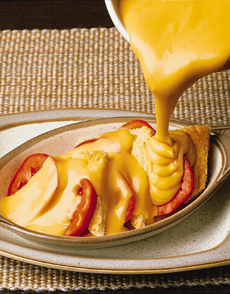
 Welsh rabbit (recipe below). Photo courtesy Wisconsin Milk Marketing Board.
|
STEPHANIE ZONIS focuses on good foods and the people who produce them.
|
|
March 2006
Last Updated September 2014
|
|
Melting Cheeses For Fondue, Cheese Sauce & More
Page 2: Cheese Sauces, Fondue & Welsh Rabbit
This is Part 2 of a three-part article on melting cheeses. Click on the black links below to read the other parts.
Cheese Sauces
Sauces made with cheeses seem to present a special challenge to many people. How to prevent ending up with a casserole full of a separated, unappetizing mess? Again, pay attention to your melting technique.
- Don’t just cut the cheese into large hunks, place it in the microwave and hope for the best. Shred, grate, or chop the cheese finely. Place your ingredients into a heavy-bottomed saucepan, then use a low heat to melt the cheeses. It is very helpful here to stir constantly, especially with a whisk.
- I’ve read that stirring in a zigzag pattern is better than stirring in a circular motion, and I’ve read that you must always stir a sauce in the same direction. Over time, I’ve tried both, but I’ve also tried stirring in a circular motion in one direction, then switching to the other direction in the middle of cooking. I’ve seen no differences, so I’m not sure that stirring pattern makes a difference as long as you don’t allow the melting cheese to settle in any area on the bottom of the pot.
Fondue, Welsh Rabbit & More
People have been gobbling up melted cheese for a very long time. Fondue, the best-known of Swiss dishes, is probably of peasant origin, but no one knows for how long traveling herders had been combining cheese with wine in their cooking pots and dipping bread into the mixture. Similarly, quesadillas, a Mexican tradition, have been eaten for longer than anyone can say.
Rabbit, Not Rarebit
The once-famous Welsh rabbit (please don’t call it “rarebit”) is a very old formulation. There isn’t much agreement on how Welsh rabbit might have gotten its name, but my favorite story is that sharp cheese melted into ale or beer, served over crisp toast, was a substitute for meat when the men had been unsuccessful in their hunting that day. It was left to the women to fix a meal, and I wouldn’t doubt, some clever woman came up with the name.
Welsh Rabbit Recipe
Welsh rabbit is similar to fondue, except that the melted cheese is poured over toast instead of dipping bread chunks into a pot of melted cheese. Serves 2.
Ingredients
- 2 tablespoons butter
- 2 tablespoons all-purpose flour
- 1/3 cup milk
- 1/2 cup beer or ale
- 1 teaspoon dry mustard
- 1/4 teaspoon each cayenne pepper and
paprika
- 1 teaspoon Worcestershire sauce
- 1-1/2 cups sharp Cheddar,* shredded
- 1 egg yolk
- 4 slices bread for toast
- Optional: sliced tomato
- Optional garnishes: fresh snipped
chives or thyme
|
|
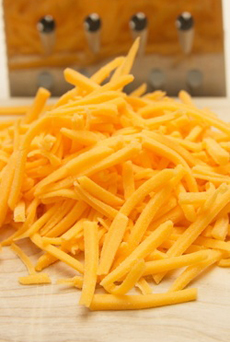
Grated Cheddar. Photo © Dbvirago | Dreamstime.
|
*You can use any semi-hard cheese, or a blend. Like fondue, Welsh rabbit is a great way to use up scraps of cheese.
Preparation
1. PREPARE TOAST. We like rye toast or whole grain toast because of the added flavor; but use whatever bread you have.
2. MAKE ROUX. Melt butter in a sauce pan over low heat; whisk in flour until smooth and simmer roux for two minutes.
3. ADD LIQUIDS. Whisk in milk, then beer. You can use leftover beer: The effervescence cooks out. The more flavorful the beer, the better the dish.
4. ADD SEASONINGS. Add cayenne, mustard and paprika one at a time, whisking until smooth. Add Worcestershire sauce and whisk to combine.
5. ADD CHEESE. Whisk in Cheddar, 20% at a time, and blend until smooth.
6. ADD YOLK. Remove pan from flame; whisk in egg yolk for extra richness and body.
7. PLATE. Place two pieces of toast on each plate. Top with tomato slices. Pour cheese sauce over toast. Garnish with herbs.
Who needs a real rabbit: This “poor man’s supper” is delicious!
Pizza
The ancestor the pizza we know and love today—melted cheese on bread—was probably being enjoyed by the Etruscans, Greeks or Phoenicians as early as the 700s—B.C.E. (Tomato sauce didn’t arrive until the 1800s.) Clearly, much of the world has had a love affair with melted cheese for many hundreds of years.
Food history aside, a melted cheese dish on a blustery, cold day is as satisfying for the soul as it is for the appetite. With a little care, melting your cheese can be a simple matter and one that yields ideal results every time.
Continue To Page 3: Gruyère
Go To Article Index Above
Lifestyle Direct, Inc. All rights reserved. Images are the copyright of their respective owners.
|