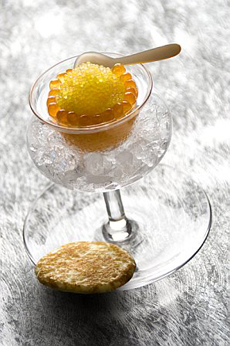
 A “caviar sundae” with salmon caviar, or ikura, surrouding a mound of golden whitefish caviar. Photo by Richard Hellyer courtesy CollinsCaviar.com.
May 2005
Last updated March 2026
|
|
Caviar Glossary
Page 5: Ikura & Other Terms With I, J & K
This is Page 5 of a ten-page glossary. If you’d like to suggest additional words for inclusion or think we should consider other definitions than those we have provided, use the Contact Us link on this page. You may also enjoy one of our 60+ other food glossaries.
Click on a letter to get to the appropriate glossary page.
a b c d e f g h i j k l m n o p q r s t u v w x y z
This material is copyrighted and cannot be reproduced in whole or in part
without written permission.
IKROJ
Pronounced EEK-ruh (with a rolled “r”), the Russian word for caviar or roe of any kind.
IKURA
The Japanese variation on the Russian ikroj In Japanese restaurants, ikura refers specifically to salmon caviar. Other caviars used in Japanese cuisine include capelin roe (in Japanese, masago) and flying fish roe (in Japanese, tobiko).
|
|
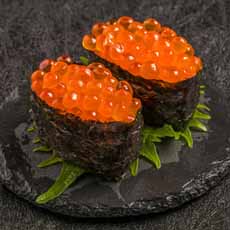
Salmon caviar is called ikura in Japanese. Photo Norikko | Fotolia. |
INFUSED CAVIAR
Some caviar producers infuse whitefish roe with a variety of flavors, including beet, Cajun spices, citron, ginger, jalapeño, mango (shown in the photo), saffron, and wasabi. Tsar Nicoulai of San Francisco and Collins Caviar of Chicago are two such producers.
IMPERIAL CAVIAR
Caviar from some Caspian osetra has a golden hue (and in some rare instances is totally gold in color). See golden osetra caviar.
|
|
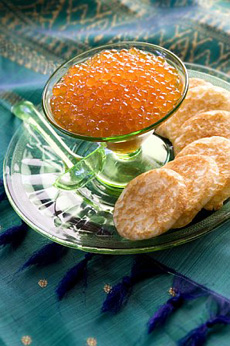
Salmon caviar infused with the flavors of Southern India: red Curry, coriander, and grilled onion. Photo courtesy CollinsCaviar.com. |
IRANIAN CAVIAR
Caviar that’s harvested and fished from sturgeon species off the coast of Iran in the Caspian Sea, primarily the southwest shores, where the water is cooler and possibly cleaner. It is of equal quality as Russian caviar, as both are produced from the same species of sturgeon from the same waters. Iranian sturgeon species are Beluga, Osetra, and Sevruga. The Sterlet was once plentiful, but now it is rarely found in the wild.
|
|
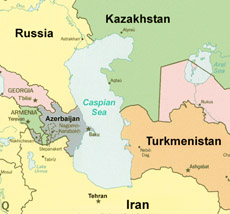
Iran borders the southern end of the Caspian Sea. |
KALUGA STURGEON CAVIAR
The Kaluga sturgeon (Huso dauricus), also known as River Beluga, is a large predatory sturgeon that lives in the Amur-Heilong River basin, the largest river basin in northeast Asia. The river’s source is the Mongolian Plateau; it flows east through Mongolia, China, and Russia, and emerges at the Songhua River headwaters in North Korea.
|
|
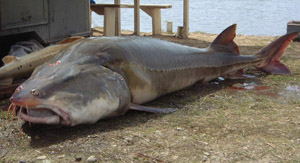
The Kaluga sturgeon—a big girl. Photo courtesy Amur-Heilong.net. |
The Kaluga is perhaps the second largest freshwater fish in the world, with the largest cited at 2,205 pounds and 18.6 feet in length. This is smaller than the Beluga sturgeon (the largest of which can grow up to 3,300 pounds and 30 feet in length), but substantially larger than any other sturgeon.
Unlike other large sturgeon, which are saltwater fish that spawn each fall and spring in freshwater rivers, the Kaluga lives in fresh river water in its juvenile years. When the kaluga was first caught by the scientific community in 1974, it was noted to be a different species in the Huso genus—the genus of the Beluga (Huso huso). See River Beluga Caviar.
KALUGA-AMUR STURGEON HYBRID
The Kaluga Hybrid (Huso dauricus × Acipenser schrenckii) is a popular hybrid caviar produced by crossing the Kaluga sturgeon with the Amur (or Shrenckii) sturgeon. It is prized for its large, firm beads and a flavor profile that mimics the rare Beluga—creamy, buttery, and mild—but with the faster maturation and sustainability of farmed sturgeon. Often sold under various proprietary brand names (such as Petrossian's Daurenki or others' River Beluga).
Both of these sturgeons, Acipenser schrenckii, known as the Amur sturgeon, and Huso dauricus are sturgeon named native to the Amur River (Heilong River) in Northeast Asia, forming the natural border between the Russian Far East and Northeast China. This joint habitat has enabled cross-breeding to occur naturally in the wild, not just in aquaculture.
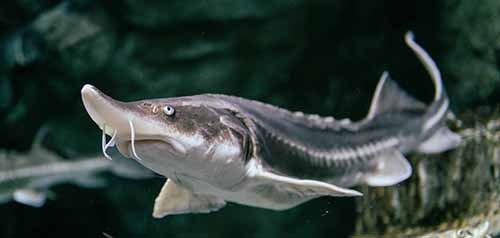
The Amur sturgeon, Acipenser schrenckii (photo © Parviz Hajizada | Pexels).
KARASUMI
See mullet roe.
KETA ROE or KETA RED CAVIAR
The roe of the Keta salmon (Oncorhynchus keta). The eggs are slightly larger than Alaska salmon caviar, and the color is very bright, ranging from red to pale orange. The fish has a mild flavor. Keta caviar originated in Russia in the early 1800s. Keta are also found wild in Alaska, where they are also called Chum and Silverbrite, plus Chub, Calico Salmon, and Dog Salmon (due to their large, sharp teeth and the hooked nose of the male salmon.
KOSHER CAVIAR
Caviar that is prepared in conformance with Jewish dietary laws and certified kosher.
|
|
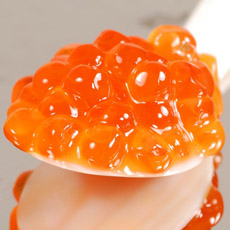
Caviar from the Keta salmon, a Russian variety. Photo courtesy CaviarCaviar.com. |
Continue To Next Page: Caviar Terms With L To O
Go To The Article Index Above
Lifestyle Direct, Inc. All rights reserved. Images are the copyright of their individual owners.
|