May 2005
Last Updated March 2026
|
|
Caviar Glossary
Page 1: What Is Caviar? Learn All About It Here, Beginning With Caviar Terms With A
CAPSULE REPORT: If you had trouble understanding the differences between Beluga, Osetra, and Sevruga in the old days...the world of caviar has gotten much more complex. Here’s some help to figure it out. By the way, sturgeon caviar, one of the world’s most expensive luxury foods, was originally a staple of Russia’s impoverished peasants! If you’d like to suggest additional words for inclusion or think we should consider other definitions than those we have provided, use the Contact Us link on this page. You may also enjoy one of our many other food glossaries. This is Page 1 of a ten-page glossary. Use the navigation bar below to visit other pages.
Click on a letter to go to the appropriate glossary page.
a b c d e f g h i j k l m n o p q r s t u v w x y z
This material is copyrighted and cannot be reproduced in whole or in part
without written permission. You are welcome to link to it.
ACIPENSERIDAE
The biological family that includes some 26 species of fish, including the genera Acipenser (Atlantic, Baerii, Lake, Osetra, Sevruga, Siberian, White, and other sturgeon), Huso (Beluga and Keluga sturgeon), Scaphirhynchus (Alabama, Pallid, and Shovelnose [Hackleback] sturgeons, all native to North America), and Pseudoscaphirhynchus (three species in West Central Asia, including Syr-darya Shovelnose, Amu-dar Shovelnose, and False Shovelnose sturgeons). See sturgeon.
Historically, almost all “classic” sturgeons (Russian, Persian, Siberian, etc.) were placed in Acipenser. Under the newer taxonomy, many of those have moved into the Huso or Sinosturi genera.
Older literature and many trade names still use Acipenser broadly for most sturgeons.
The "True" Acipenser, the European Sea Sturgeon (Acipenser sturio), is f functionally extinct in the wild for the commercial market.
Siberian Sturgeon (Huso baerii — formerly Acipenser baerii) is widely farmed.
The Russian Sturgeon (Huso gueldenstaedtii, formerly Acipenser gueldenstaedtii), is osetra/ossetra caviar. It is critically endangered in the wild, but is farmed extensively.
As of the 2025/2026 revisions, many species traditionally labeled as Acipenser (including the Siberian and Russian sturgeons) have been moved to the genus Huso. This change reflects their closer genetic relationship to the Beluga than to the "True" Atlantic sturgeons. When shopping, look for the species name (e.g., H. gueldenstaedtii) to ensure you are getting the specific variety of caviar you desire.
Two protected species from the North American Atlantic sturgeon collapse are now absent from the modern caviar trade. They are important historically, as examples of how unregulated caviar demand can erase a fishery within a few decades:
The Atlantic Sturgeon, Acipenser oxyrinchus, was wiped out by overfishing in the early 1920s. When it appears at all, it is usually in tiny quantities within research or restoration programs. The eggs were medium‑grained, dark, and robustly briny—more like a “workhorse” caviar than a luxury beluga and osetra.
The Gulf Sturgeon, Acipenser desotoi, is a southern cousin of the Atlantic sturgeon, native to rivers of the Gulf of Mexico (e.g., Suwannee, Apalachicola). It never had the same large‑scale, international caviar trade, but exploitation and habitat loss pushed it into serious decline before it could become a “name” fish. It is now listed and managed as a threatened/endangered species in U.S. waters. As a result, you will not see “Gulf sturgeon caviar” on the legitimate market. Any eggs produced today are effectively off‑limits to commerce.
Taxonomic Note: As of the 2025/2026 revisions, many species traditionally labeled as Acipenser (including the Siberian and Russian sturgeons) have been moved to the genus Huso. This change reflects their closer genetic relationship to the Beluga than to the "True" Atlantic sturgeons. When shopping, look for the species name (e.g., H. gueldenstaedtii) to ensure you are getting the specific variety of caviar you desire.Taxonomic Note: As of the 2025/2026 revisions, many species traditionally labeled as Acipenser (including the Siberian and Russian sturgeons) have been moved to the genus Huso. This change reflects their closer genetic relationship to the Beluga than to the "True" Atlantic sturgeons. When shopping, look for the species name (e.g., H. gueldenstaedtii) to ensure you are getting the specific variety of caviar you desire.
ALGAE
See flavor.
ALMAS CAVIAR
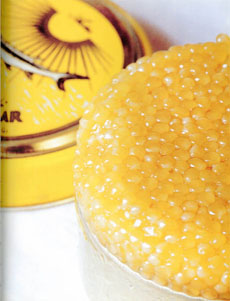
The world’s most expensive caviar, Almas, means “diamond” in Persian. The rarest caviar in the world comes from Osetra sturgeons, aged 70 years or older. The chances of finding (1) an albino sturgeon that is (2) more than 70 years old are remote; hence, for those who have the cash, it’s a once-in-a-lifetime experience that is worth eternal caviar bragging rights. The closest we have ever gotten to Almas is a photo. Why 70 years old? The older the fish, the more creamy, subtly flavored, and lighter the eggs. It’s more than $44,000 a kilo, if you could get it—more expensive than gold.
|
|
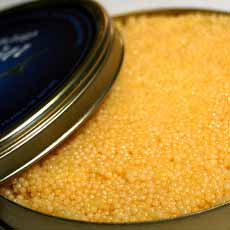
Even the richest people on earth may not be able to get hold of golden Almas caviar. Photo courtesy AlmasCaviar.com. |
ALMAS ARA CAVIAR
Almas Ara caviar is a brand of sturgeon caviar that is farmed in Spain, using the indigenous Acipenser naccarii sturgeon.
ALVERTA CAVIAR
Alverta caviar comes from white sturgeon (Acipenser transmontanus). This species is native to the Pacific coast of North America and is primarily found in rivers along the West Coast, including the Columbia and Sacramento Rivers. White sturgeon caviar is known for its smooth, buttery flavor and medium to large pearls, often compared to high-quality Ossetra caviar.
|
|

Alverta caviar comes from a river sturgeon of the western U.S. (photo © Petrossian). |
AMERICAN BLACK CAVIAR
American black caviar is another term for bowfin (choupique) caviar. It comes from an archaic freshwater bony fish that produces black roe that resembles sturgeon roe. The caviar roe is brownish to jet black in color, very firm, and has a mildly tangy and earthy flavor. See also bowfin caviar.
|
|
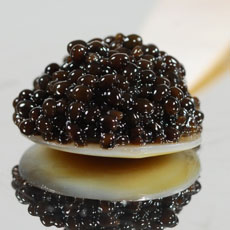
Bowfin caviar. Photo courtesy BackyardGardener.com. |
AMERICAN CAVIARS
In the 19th century, America, with several indigenous species of sturgeon, was one of the world’s largest caviar producers. Overfishing depleted the supply, and the government wisely ended commercial fishing. American caviar has again risen to fill the increasing void created by overfishing in the Caspian Sea, which has put the Beluga, Osetra, and Sevruga sturgeons on the World Wildlife Foundation’s Endangered Species List. Today, white sturgeon and hackleback sturgeon are farmed in freshwater lakes or tanks in the Pacific Northwest, California and the South, using environmentally conscious and sustainable practices.
|
|
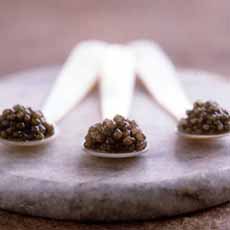
American caviar sampler: sturgeon, hackleback, and bowfin. Photo courtesy Russ & Daughters. |
This has made the U.S. a player again on the world caviar scene. American caviar or roe species can include sturgeon caviar, hackleback caviar, paddlefish caviar, salmon caviar, trout caviar, whitefish caviar, and lumpfish caviar. Some consider American sturgeon caviar close to the Russian and Iranian Osetra caviars in taste and texture, although others rank it closer to Sevruga caviar. Whatever, it’s an approximation: Nothing equals the splendor of the greatest Caspian caviar, although we’ve had some farmed white sturgeon from Idaho (Transmontanus rex), Israeli Osetra (the Russian sturgeon) and Uruguayan Baerii (Acipenser baerii, the Siberian sturgeon) that get pretty close. See American Sturgeon Caviar, below.
AMERICAN GOLDEN CAVIAR
See golden whitefish caviar.
AMERICAN STURGEON CAVIAR or CALIFORNIA OSETRA CAVIAR
There are about 26 species of sturgeon in the Acpenseridae family, some of which are native to the United States. These include the Wild Atlantic Sturgeon (Acipenser oxyrinchus oxyrinchus) found along the Southeast Atlantic coast (the fishing of which is regulated), the Lake Sturgeon of the Midwest (Acipenser fulvescens), the Shovelnose Sturgeon (Scaphirhynchus platorynchus) of the Tennessee River (whose caviar is sold as Hackleback), and the American White Sturgeon of the Pacific Northwest (Acipenser transmontanus), which is farmed extensively in California. In fact, Acipenser transmontanus is the most common American sturgeon, known to reach a maximum weight of approximately 1,800 pounds and a length of about 20 feet. The eggs of the Wild Atlantic Sturgeon tend to be less firm than Caspian or American-farmed caviar. The American White Sturgeon is most comparable in taste to Caspian osetra, and is sometimes called California Osetra.
It takes four years to determine the sex of a sturgeon, and eight years until the sturgeon begins to produce roe (some species take longer). The two largest sturgeon farmers in the U.S. are Stolt Sea Farms in Elverta, California, which is owned by the Stolt Sea Farm Group of Norway and markets its caviar under the Sterling name, and Tsar Nicoulai, a family-run operation in San Francisco that sells its California Estate Osetra brand as well as other products.
|
|
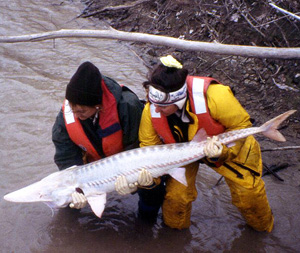
The Pallid Sturgeon, Scaphirynchus albus. Photo courtesy U.S. Fish & Wildlife Service. |
Petrossian sells a private brand, Transmontanus, which is packed for them by Stolt. The three species of American sturgeon from the Scaphirhynchus family are currently endangered: the Alabama sturgeon (Scaphirhynchus suttkusi), Pallid sturgeon (Scaphirhynchus albus), and the Shovelnose sturgeon (Scaphirhynchus platorynchus). The American species include:
- White sturgeon (Acipenser transmontanus) is one of the most well-known and commonly farmed sturgeon in the U.S., especially for caviar production.
- Atlantic sturgeon (Acipenser oxyrinchus) is found along the East Coast.
- Lake sturgeon (Acipenser fulvescens) is native to the Great Lakes and the Mississippi River Basin.
- Shortnose sturgeon (Acipenser brevirostrum), another East Coast species, though much rarer.
AMIA CALVA
The taxonomy name for the bowfin, an ancient American bony fish that produces a hearty black caviar. It is not related to the sturgeon.
ANADROMOUS
A saltwater fish that moves to freshwater to spawn. The sturgeon is anadromous, moving to freshwater rivers to spawn. One of the reasons for the near extinction of the Caspian sturgeon is the damming of the rivers leading into the Caspian Sea, depriving the sturgeon of their spawning grounds. (The others include pollution, overfishing, both legally and via poaching.)
AQUACULTURE
The farming of fish. This can take place in indoor or outdoor pools, or in penned areas of rivers.
|
ASETRA or GOLDEN IRANIAN ASETRA CAVIAR
Golden Iranian Asetra (the Iranian variation of the spelling of Osetra), typically from the south Caspian Sea bordering Iran, is traditionally reserved for the Shahs of Iran. Iranian Asetra has a deep and complex flavor: It is a very sophisticated caviar. It is dark to light gray with a large bead. It can also be golden in hue: then, it is known as Golden Iranian Asetra. Its deep and complex flavor adds to its allure. It is even more valuable due to the pristine environment along the Iranian coastline.
|
|
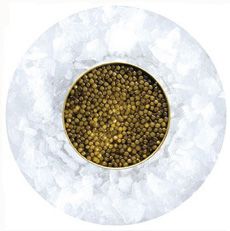
Golden Iranian Asetra, a.k.a. osetra. Photo courtesy CaviarCaviar.com. |
The water and air are still clean (unpolluted) and provide the sturgeon with an ecological balance. This is in stark contrast to conditions in the Soviet coastal regions of the Caspian Sea, 746 miles away. See also Golden Osetra caviar and Imperial Osetra caviar.
Lifestyle Direct, Inc. All rights reserved. Images are the copyright of their individual owners.
|