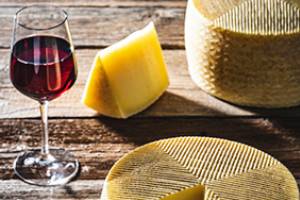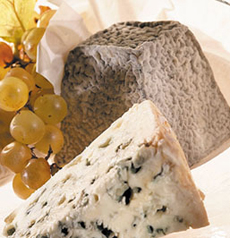
In 1411, Charles VI of France gave sole rights to the aging of Roquefort cheese to the village of Roquefort-sur-Soulzon. To this day, all Roquefort must be aged in the caves there in order to be called Roquefort. Photo courtesy of Bonneterre.
February 2005
Updated September 2009
|
|
Important Moments In Food History
For Food Trivia Buffs
The Food Reference Website is a resource you should know, painstakingly maintained by food historian James Ehler. There is much to learn there; today, our educational path veers to culinary history. Did the café, that most Parisian of concepts, originate in...Constantinople? Was Nostradamus a better cookbook writer than prognosticator?
Check out Chef Ehler’s fantastic compendium of facts, and prepare to stump your friends at your next café gathering.
You can move to the era of your choice by clicking on the dates below; or by continuing at the bottom of each page.
The reporting stops three years before the launching of THE NIBBLE newsletter and five years before TheNibble.com online magazine...but the next installment from Chef Ehler is due soon.
6000 B.C.E. - 1799 C.E.
While food trends and new creations happen today with alacrity, in an almost 7000-year span, a lot of feasting and inventing took place: we just don’t have written records. During this period the Chinese invented pasta and sorbet, great wines and cheeses were perfected, and pâté de foie gras was created in Strasbourg!
- 6000 B.C.E. Lima beans are being cultivated in Peru.
- 776 B.C.E. The first Olympic champion listed in the records is a cook, Coroebus of Elis, who wins the sprint race.
- 372 B.C.E. Theophrastus is born, an important Greek naturalist philosopher who studied with Aristotle. He wrote many treatises on plants, only two of which survive.
- 350 B.C.E. Archestratus writes “Hedypatheia” (Pleasant Living), one of the earliest cookbooks, mentioned by Athenaeus.
- 287 B.C.E. Theophrastus dies.
- 255 B.C.E. The term. “Don’t upset the apple cart” is first used by Roman playwright Plautus in his play, “Epiducus.”
- 2nd Century B.C.E. Athenaeus, a Greek gourmet, writes “Deipnosophistai” (The Learned Banquet), a dialogue between two banqueters who discuss food and recipes over a period of several days.
- 23 C.E. Pliny The Elder is born, Roman author of the 37 volume “Natural History.” A digest and compilation of more than 2,000 ancient books from nearly 500 authors, Pliny included material whether it was accurate or not, thus leaving an invaluable record of ancient theories on subjects ranging from astronomy to zoology.
- 100 C.E. The world’s oldest surviving cookbook, De Re Coquinaria (“On Cookery”), is attributed to a Roman, Apicius.
- 100. The first mechanical dough mixer is supposedly invented in the 1st century C.E. by Marcus Virgilius Euryasaces, a freed slave. It “consisted of a large stone basin in which wooden paddles, powered by a horse or donkey walking in circles, kneaded the dough mixture of flour, leaven, and water.” (Encyclopedia Britannica)
- 408. The Visigoths attack Rome and demand 3,000 pounds of pepper as part of the city’s ransom.
- 900. Fish are being farm-raised in China.
- 1135. King Henry I of England (1068-1135) dies, supposedly from indigestion caused by eating moray eel.
|
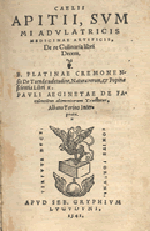
There were three Roman gastronomes
named Apicius—but the famed cookbook
was composed by none of them. It was
the work of a later writer, one Coelius or
Caelius, who linked his own name with
that of Apicius in order to promote his
work. Photo courtesy of Kansas State
University. Click here for more information. |
- 1200. Okra, native to tropical areas of Africa, is being cultivated in Egypt.
- 1272. King Edward I of England (1239-1307, ruled 1272-1307) has a coronation feast that includes 278 bacon hogs, 450 pigs, 440 oxen, 430 sheep and 22,600 hens and capons.
- 1300. Huou, chef at the court of Kublai Khan (1215-1294) writes “The Important Things to Know About Eating and Drinking.” This is a collection of recipes (mainly soups) and household advice.
- 1375. “Le Viandier” is written by Guillaume Tirel, chef to France’s Charles V and Charles VI. The cookbook was influential on French cuisine and important to food historians as a detailed reference on the medieval cuisine of northern France.
- 1390 (ca). The oldest surviving cookbook in English is written, “The Forme of Cury.”
- 1411. Charles VI of France gives sole rights to the aging of Roquefort cheese to the village of Roquefort-sur-Soulzon; all Roquefort still must be aged in its caves today.
- 1444. Any merchant caught selling adulterated saffron in Bavaria is burned alive.
- 1498. Hieronymus Bock dies, a German botanist who helped the transition from medieval beliefs to modern science.
- 1508. William Turner born, English naturalist known as the “Father of English Botany.” His best known work is “A New Herball.”
- 1516. Duke Wilhelm IV of Bavaria decrees that beer can only be brewed from barley malt, hops and water. This Rheinheitsgebot (purity law) is the world’s first consumer protection law.
- 1550. Supposedly, the first café in the world opens in Constantinople.
- 1555. Nostradamus (1503-1566) publishes his best-known book of prophecies, “Centuries Astrologiques.” However, in this same year he also publishes “Excellent er Moult Utile Opuscule a tous necessaire qui desirent avoir connaissance de plusieurs exquises recettes” (“An excellent and most useful little work essential to all who wish to become acquainted with some exquisite recipes”).
- 1600. The blood orange is believed to have developed by natural mutation in Sicily.
- 1607. The Carthusian monks in the French Alps are supposedly given the secret formula for Chartreuse liqueur by the Marechal d’Estrees.
- 1610. The 1610 Community Regulations of Kracow, Poland stated that bagels were to be given as a gift to women in childbirth.
- 1616. Nicholas Culpeper is born (d. 1654), an herbalist, who wrote the pseudoscientific “A Physicall Directory” in 1649. It listed plants and their supposed healing properties based on the plants resemblance to the human body parts.
- 1627. The last remaining ancestor of all modern domestic cattle, an auroch, is killed by a poacher in 1627 on a reserve near Warsaw, Poland.
- 1652. “Le Cuisinier François” is published by François Pierre La Varenne, the founding text of modern French cuisine that broke with the Italian traditions that had revolutionized medieval French cookery in the 16th century.
- 1659-1681. The celebration of Christmas is banned in Boston. The pilgrims believed it to be a decadent celebration.
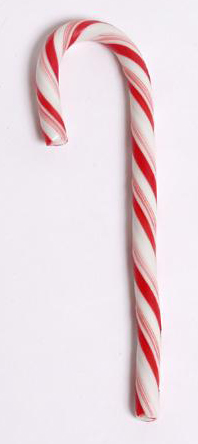 |
- 1670. At Cologne Cathedral, the choirmaster makes sugar sticks to give to the young singers in the choir, to keep them occupied during the Living Crèche ceremony: the first candy canes.
- 1673. The White Horse Tavern in Rhode Island is built. It is the oldest operating tavern in the United States.
- 1674. Jethro Tull is born and becomes an English agriculturalist and inventor whose ideas are instrumental in the development of modern English agriculture. One of his inventions is a horse-drawn seed planting drill (1701) that sows three even rows of seeds at once.
- 1676. The Compagnie de Limonadiers is formed in Paris. The vendors sell lemonade from tanks they carried on their backs: the first soft drinks.
- 1679. Denis Papin, a French physicist invented the pressure cooker, which he called “Papin’s Digester.” (d. 1712)
- 1690. The first shipment of bananas arrives in the colonies at Salem, Massachusetts.
|
| 1670: The first candy canes. Photo by M. Connors, courtesy of MorgueFile.com. |
- 1716. James Lind is born, a Scottish physician who recommended that fresh citrus fruit and lemon juice be included in the seamen’s diet to eliminate scurvy. The Dutch had been doing this for almost two hundred years.
- 1719. The first potato is planted in the United States was planted in Londonderry Common Field, New Hampshire.
- 1720. Invention of meringue is attributed to a Swiss pastry chef named Gasparini.
- 1742. “The Compleat Housewife, or Accomplish’d Gentlewoman's Companion” is the first cookbook published in America, in Williamsburg, Virginia.
- 1745. The secret formula for Drambuie liqueur is given to the Mackinnon family by Prince Charles Edward.
- 1747. “Art of Cookery” by Hanna Glasse is published, one of the most important references for culinary practice in England and America during the late 18th century early 19th century. It still available in print as a reference text.
- 1747. The oldest cattle ranch in the U.S. is started at Montauk on Long Island, New York.
- 1755. Josiah Spode is born; the inventor of fine bone China.
- 1765. The very first pâté de foie gras (goose liver paste) is said to have been created in Strasbourg in 1765 by a Norman chef named Jean-Joseph Close (although the technique for producing foie gras goes back as far as ancient Egypt).
- 1765. M. Boulanger opens the first restaurant, by that name, in Paris. It is an informal establishment; his specialty is soup.
- 1766. Louis, Marquis de Cussy is born, a French gastronome and friend of Grimod de la Reyniere, who stated that Cussy had invented 366 different ways to prepare chicken. Cussy wrote “Les Classiques de la Table.”
- 1773. Benjamin Delessert is born, a French industrialist who developed the first successful process to extract sugar from sugar beets.
- 1782. Antoine Beauvilliers, a leading culinary writer and gastronomic authority opens the first luxury restaurant, La Grande Taverne de Londres, in Paris. Interestingly, for the city which was to become known as the culinary capital of the world, the restaurant is named “The Great Tavern Of London.” Beauvilliers later wrote what became a standard cookbook, “L’Art du cuisinier,” in 1814.
- 1785. Oliver Evans of Newport, Delaware invents the automatic flour-milling machinery that revolutionizes the industry.
- 1789. Thomas Jefferson brings a pasta making machine with him when he returns to America after serving as ambassador to France.
- 1790. Marie, Vicomte de Botherel, is born. In 1839, he installs kitchens on buses in Paris suburbs: the first restaurant cars.
- 1790. Marie Harel is credited with developing Camembert cheese in Normandy.
- 1799. Eliza Acton is born. She later writes the first cookbook for the housewife, rather than for the professional chef.
|
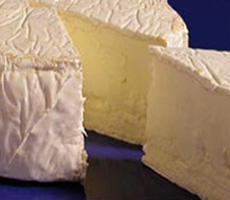 Camembert. Photo courtesy of Old Chatham Sheepherding Company. Learn more about Camembert. Camembert. Photo courtesy of Old Chatham Sheepherding Company. Learn more about Camembert. |
- 1799. Joseph-Louis Proust, a French chemist, extracts sugar from grapes, and proves it identical to sugar extracted from honey.
Historical material © James T. Ehler 1990 - 2005. All rights reserved. Additional material
© Copyright 2005-
2026
Lifestyle Direct Direct, Inc. All rights reserved. Images are the copyright of their respective owners. |
|