Advertisement
THE NIBBLE (TM) - Great Finds for Foodies (tm)
  Sign Up | Contact Us | Email To A Friend  
       
RSS feed What’s This?


Media Kit


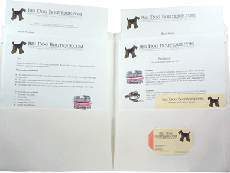
A basic media kit. Photo courtesy of BigDogBoutique.com.

MENU


Manufacturers & Retailers

Main Page


Contact Us

Main Page


Home Page

Link to Other Sections:
Newsletter, Product Reviews,
Marketplace, Food Fun,
Home Zone


MEET THE AUTHOR

KAREN HOCHMAN, Editorial Director of THE NIBBLE™, sees more than 1,000 media kits a year. She wishes she could share a copy of these best practices to some of their creators.


June 2005


Home / Manufacturers & Retailers


Media Kit Components

A Basic Media Kit, Online and Off, Can Help Your Business


Overview

A standard media kit is not difficult to compile: it contains basic information about your company—information you know well. Traditionally media kits hold printed materials within a folder (the standard 9" x 12" size is most commonly used). They are mailed to the press and other interested parties, and are distributed at product launch parties, trade shows, conferences, investment symposia, and other events.

In the digital era, media kits are often sent out electronically and downloaded from websites; but you’ll still need a paper version. Even though some trendy companies in some industries distribute their physical media kit only on CD-ROM, that medium should be seen as incremental. Some readers may prefer the convenience, but not everyone is glued to their CD-ROM drives. To maximize your chance of press attention, nothing beats a piece of paper in the hands of a multi-tasking journalist or editor.

A good media kit can help your company:

  • Obtain media coverage.
  • Generate sales from both current and potential customers.
  • Inform and interest potential investors and strategic partners.

Its purpose is to support your brand, educate readers and generate further interest. It is neither a direct sales vehicle nor a hard sell vehicle: the tone is informative, not self-aggrandizing. But the right information, and the right positioning of your product vis-à-vis others in the field, can lead to the interest that generates immediate and ongoing sales—and stakes out an important position for you in your industry segment.


Components

A media kit is a marketing vehicle, and should reflect your brand throughout.

  • Cover. The cover of the folder, CD-ROM, or other carrier* should bear your name, logo, and tag line. No matter how well-known your company is, the cover should have a positioning statement indicating who the company is and what products/services it provides. While companies in the chips have custom-designed folders, it is a time-honored tradition to use stock color paper folders with pockets. (Many journalists toss the folders anyway, because they take up too much room in the files.) Fashionable these days are the clear poly folders and poly envelopes available everywhere in clear and colors. They save you the need to affix labels because your first page will show through and do the announcing for you.

*Jewelry companies have been known to deliver their media kits in a jewelry box; apparel companies in a duffel bag. You can be as imaginative as your budget allows, as long as it’s appropriate for your product.

The folder or other medium should contain the following:

  • Corporate Backgrounder. A history and summary of the company (one page or less).
  • Executive Biographies. Bios of key company executives. It’s nice to include photos with the bios, but not essential. (You don’t need to include glossies these days: reporters will call for jpgs if they need them.)
  • Recent News Releases. Information about your products, company growth, new executives, etc.
  • Recent Media Coverage. Copies of favorable articles, reviews, and other press coverage the company and its products have received. (Be selective: less is more. As your press clippings grow, weed out the lesser ones; it puts more focus on keep the better ones.)
  • Product Information. Brochures, line sheets, etc.
  • Samples. Some products lend themselves to enclosures, e.g. a single shrink-wrapped cookie or a jerky stick. As long as your product will survive in transit, include it. Not only is it informative, it makes your press kit fun. Otherwise, consider a separate sheet or cover letter inviting the recipient to contact you for samples.
  • Company Information. Summary of any upcoming events, appearances at trade shows, company and customer newsletters.
  • Contact Information. Generally the business card of the key media contact. In a smaller company, this can be the owner; in a midsize company it can be the head of marketing or sales. Larger companies and some smaller ones have dedicated public relations directors and/or external media representatives (public relations agencies).

To make your printed materials more interesting, look at reasonably-priced quality paper stocks available by the ream. You can used colored paper stock (whatever paper you choose, be sure the print is easily readable). Even if you can’t afford a custom-designed and custom-printed press kit, you can create something just as exciting with imagination and taste. Just as with a wardrobe selection, coordinate your folder and paper to your business card for a pulled-together look.

  • TIP: If this isn’t your strong suit, call the art department at your local college and ask a graphic design professor to recommend two of his/her best students to create a press kit look for you. Give each a $50 project fee plus $25 for materials to produce as many ideas as they like—you’ll be amazed what they come up with. Be sure to discuss up-front what the components and total cost of the final kit should be. Afterwards, they may be available to help you create and assemble the kits.


Online Media Kits

After you’ve finalized your kit components, turn each one into a downloadable PDF in the Media Center or Press link on your website. This section should have a user-friendly index page listing all of the contents (you can simply adapt the bulleted list and descriptors above), plus an Image Gallery—jpgs of your products. Be sure to name your jpgs by the product name, e.g., Blue Glass Platter, and not just V1046-28 (i.e. the item number, which is meaningless to the press).

Images

The more product images you can supply, the better.

One of the most important things you can do is hire a gifted product photographer. Not only is good photography important for your brand overall: having magazine-quality photos can make the difference in getting covered by small and mid-size media that don’t have the time and resources to take original photography. Some image tips:

  • Don’t scrimp on photography. The picture is what sells your product when the live product isn’t in front of the buyer. Find a photographer who can make your product shots look worthy of Gourmet and House and Garden. He/she doesn’t have to be famous or old, just good. Not only are you more likely to get picked up by the press—you’ll sell more to retailers, too. We see too many beautiful lines whose line sheet photos are so dull and uninteresting that the products seem to be from another company. Trade shows are hectic—buyers may just grab a line sheet as they’re racing somewhere. We would never know, pulling some sheets from our stacks of show materials, that these were the gorgeous cookies, plates, or whatever that we wanted to follow up on.
  • Provide romance shots. In addition to package shots and plain product shots, you need several romance shots—your product propped in an appealing consumer setting (e.g., cookies on a plate with a cup of coffee). These, rather than package shots, are very important for consumer coverage.
  • Unlock your images. If you are going to distribute a CD-ROM of images, make them downloadable. While we are sensitive to copyright, appreciate that some manufacturers want to know to whom they are releasing their images, and acknowledge that the images may be locked on your website, if we are going to take the time to load and open images on a CD you gave us, we expect to be able to use them. Given the easily available software that grabs even locked images from websites, you are not protecting your images from violators; only making things more difficult for time-strapped editors. Otherwise, save us the time of opening your CDs and just give us a hard copy sheet of images with instructions to call you; or tell us to look at the images on your website.


CD-ROMs

CDs can be a wonderful medium for journalists: they’re much easier to store than a fat press kit and they can hold lots of usable images. But many journalists still like the convenience of reviewing a pile of material without being glued to a computer. Understand your audience: we’re food and lifestyle writers, not the digerati press. While CDs have their good points, they are also more time-consuming to load, open and read than flipping through paper information.

Avoid these two common mistakes when handing CDs to the press:

  • Label your CDs. A surprising number of unlabeled CDs are distributed, requiring journalists to insert them just to know what’s on them. Or, they just say “Winter 2006 Line”—but don’t identify whose. You can’t toss an unlabled CD into a folder and assume it will stay together with your other material—things separate easily. Be sure to label your CD-ROMs at a minimum with your company name; see other wish-list information below.
  • It’s easy to create a label. Purchase CD-ROM labels at any stationer and create labels with your company logo, name, tag line, positioning statement (the same information as on the press kit cover), plus URL. Also helpful are a contact person (or at least, the general phone number and e-mail), date, and contents of the CD. At a minimum, stick any kind of label (e.g., a file folder label) with your company and URL onto it. If you don’t have time for labels, write your company name and URL with a Sharpie. Don’t think this hand-written solution looks worse than leaving the CD unlabeled: it is much more professional than having no label at all. (We are actually surprised at how many Sharpie-labeled CDs there are, given the labor to hand-write versus the ease of, and better appearance gained from, printing out a sheet of labels on the computer.)
  • Use CDs appropriately. We receive a large number of CDs that contain only a simple press release. This is not a good use of the CD medium, the sender’s time and money, or the journalist’s time to load and open the CD.


Follow-Up

Media kits should be updated each quarter with new articles, news releases, product information and jpgs, etc. You can take this opportunity to e-mail your media contact list with a brief note announcing any news and letting them know the updated kit is available on your website. Invite them to e-mail you or call if they’d like a hard copy mailed to them.


We wish you good media coverage!


© Copyright 2005-2008 Lifestyle Direct, Inc. All rights reserved. Images are the copyright of their respective owners.


.