THE NIBBLE (TM) - Great Finds for Foodies (tm)


RSS feed
(What’s this?)

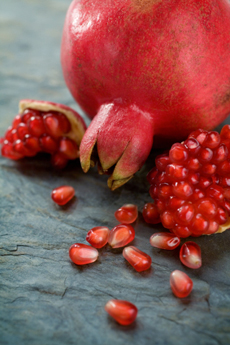
Pomegranate The “crown” end of the pomegranate, plus the arils, sacs that hold the juice and the seeds. Photo by Kelly Cline | IST.

MENU


Juice

Category Main Page
Articles & Reviews


Beverages

Category Main Page
Articles & Reviews


Main Nibbles

Articles & Reviews Of Foods
From A To Z


ABOUT THE AUTHOR


ALISSA DICKER is a freelance writer and cooking teacher in New York City.


February 2008

Main Nibbles / Beverages / Juices

Pomegranate Primer

A Super Survey: Pomegranates, Superfruit & Juice


CAPSULE REPORT: The pomegranate is an ancient fruit, originating in Persia. It has been cultivated in the Mediterranean region for several thousand years. Remains dating back to 1000 B.C.E. have been found in Armenia. Yet, the pom was an oddity in the U.S. It was an exotic fruit enjoyed largely by immigrants and Americans who learned to enjoy them abroad—until the debut of POM Wonderful juice, and the subsequent announcement of high antioxidant values and potential anti-carcinogenic properties. Suddenly, everyone wanted pomegranate, and the flavor appeared in everything from ice cream to salad dressing. In juice, brand after brand proliferated to meet America’s desire for healthy, high-antioxidant food. Intrepid taster Alissa Dicker tasted all she could get her hands on—more than 50 juices, although only the top 19 have been recommended. They include 100% pure pom juices plus blends with other juices (blueberry, cranberry, etc.), as well as brands that are certified kosher or organic. Read her tasting notes in Part II of this article. But start by learning a bit about the superfruit.

Part I: The Pomegranate

Part II

With the constant talk of superfoods in the media, hundreds of new pomegranate beverages entering the market each year, and celebrities like Oprah declaring “pom-tinis” their signature cocktail, it’s easy to forget that the American infatuation with all things pomegranate began only recently. 

Marketing campaigns by POM Wonderful are largely responsible for the boom in pomegranate juice’s popularity. The San Joaquin Valley, California-based company, which owns half of the state’s commercial pomegranate acreage, has been growing, picking, juicing its own pomegranates, and cleverly bottling its product since September 2002. POM was the first refrigerated 100% pomegranate juice on the market, and has set the benchmark in the pomegranate juice industry. In addition to advertising, POM has sponsored $23 million in well-publicized studies on the health benefits of drinking pomegranate juice.

Pomegranates & Health

Pom Wonderful
The category originator, POM Wonderful, in its signature, unmistakable bottle.

The studies suggest that the juice may lower cholesterol, improve blood flow, aid in erectile function, and even slow the growth of prostate cancer. Pomegranate juice is praised for its high levels of antioxidants, called polyphenols. Antioxidants are believed to fight off free radicals, which can cause cellular damage and disease. According to a recent study published in the Journal of Agriculture and Food Chemistry, pomegranate juice contains higher and more potent polyphenol levels than any other beverage, including red wine, Concord grape juice, and even other superfoods like blueberry and açaí.*

*NOTE:  These medical tests have been conducted exclusively with the POM Wonderful variety of pomegranate.

Wishing to “cheat death,” as one POM ad states, consumers have embraced pomegranate juice. Sensing this growing demand, more and more companies have introduced pomegranate juices into the market. Product Scan Online, a database of new products, reports that around 350 new pomegranate beverages were introduced in 2006 alone. If that doesn’t cheat death, it can certainly fill the shelves of a small boutique.

A Proliferation Of Pom

Browsing the libraries of pomegranate juices in our local Whole Foods Market, Food Emporium, Morton Williams, and Trader Joe’s supermarkets, we began to wonder how the products compared. Just looking at the jars, we saw that color and viscosity differed. Were all poms created equal? Were some juices best suited for straight drinking while others might be better for cooking? Toward that end, would the acidity levels vary? Would one make the perfect gin cocktail?     

After sampling dozens of juices and, perhaps, becoming somewhat healthier (albeit a bit loopy from all that sugar—pomegranates are naturally high in it), we found that the juices span a spectrum of flavors that may suit any number of uses as well as personal tastes. While POM Wonderful, for example, presents a rich, full-bodied and well-balanced juice (sweet, with a slightly bitter finish), other juices offer light and fruity playfulness, utterly drinkable juiciness, and even the sweet sensibility of gourmet fruit punch. In addition to 100% pomegranate juices, we tasted a number of pomegranate juice blends; for clarity, we’ve reviewed the two categories separately. You’ll see the tasting notes in Part II of this article.

About The Pomegranate

The pomegranate (Punica garantum), from the Middle French pome garnete, which means, “seeded apple,” is the fruit of a shrubby tree believed to have originated in Persia (modern-day Iran). One of the world’s oldest cultivated fruits (it was domesticated as many as 5,000 years ago and grew wild long before that), the pomegranate has a long history in the arid and semi-arid regions from the Mediterranean east through Asia.

Pomegranate
Growing, not yet ripe. Photo by Alex Ringer | SXC.

The pomegranate has been mentioned in biblical tales, and some debate exists regarding whether it was a pomegranate, not an apple, that enticed Eve in the Garden of Eden. The fruit received mention in the writings of Homer, as well as in Greek mythology: It was a pomegranate that tempted Persephone while in the underworld with Hades.  Many cultures consider it to be a symbol of fertility, health and prosperity. 

The round fruit, which has a spiky, flared crown, can be as small as an orange or as large as a grapefruit, depending on variety.  Pomegranates have shiny, leathery skin, which can be anything from deep brick red to yellow. The beautiful whole fruits are often used as decorations.

Inside, the fruit consists of around 800 crunchy seeds† surrounded by juice sacs (these are called arils), which are suspended in membranes. Arils (see the photo below) can be vivid ruby red, pale pink or even white, depending on the particular variety of pomegranate. Pomegranates preferred for eating contain large arils filled with a sweet, refreshing and slightly tart juice. The many varieties of the fruit differ in terms of sweetness and juice-to-seed ratio. Some can be extremely astringent or even sour; seedless and soft-seeded varieties exist as well. 

†You will read in a variety of sources that there are 840 arils. Are there exactly 840 arils in every pomegranate, we asked? According to some sources, this is true for at least three different varieties of pomegranate. Author Alissa Dicker offered to buy a few pomegranates to verify this herself, but we considered it above and beyond the call of duty, and declined her offer. Instead, she called the experts at POM Wonderful, who have counted the arils and found that the number of arils does vary. Not surprisingly, the smaller varieties have fewer. — The Editors

American Pomegranates

Spanish sailors are credited with bringing the fruit to Florida, sometime around the 16th century. Today, nearly all of America’s commercial crop come from California’s San Joaquin Valley, where pomegranates are harvested, by hand, from August through December. Most American pomegranates are of the variety called Wonderful, which has large, sweet, juicy, red arils and a dark red rind. Pomegranate concentrate is also imported from the Middle East, from a different variety, which causes the juice to taste somewhat different—just as a Valencia orange and a Seville orange produce juice with somewhat different flavor notes.

Arils & Juice

Arils, which burst open when bitten, can be eaten as they are (see below for Pomegranate Arilshow to release them from the fruit) or used in other preparations. For both flavor and color, they make lovely additions to fruit salads; a great topping for yogurt, cereal, and mixed salads; a tart and satisfying garnish for meats and fish, dips, and desserts. A medium pomegranate (about 9 ounces) will yield approximately three-quarters cup of arils.

Photo of arils by Alaina Cherup | SXC.

Eating pomegranate seeds can be a messy endeavor (the methods discussed below should help make it a little neater), and some people grapple over whether to spit out the seed inside each aril (we always eat them—that crunch packs loads of fiber—but our editor spits them out; it’s a matter of personal preference).  This may partly explain why the fruit is often pressed into juice.

Pomegranate juice is drunk as it is, or used to make pomegranate syrup, molasses, sorbet, and jelly. Also, it can be fermented into a kind of wine. The juice is cooked with walnuts and poultry to make a traditional Persian stew called fesenjan. True grenadine is the product of pomegranate juice cooked with sugar syrup, although most of what’s found in today’s Shirley Temple is synthetic.  

Pomegranate
A pomegranate peeled to reveal the arils. Photo by Rosi Maslarska | SXC.


How To Peel A Pomegranate

When you bring your first pomegranate home, your immediate reaction may be to cut it in half, like an orange. Use this technique, instead:

  • Cut off the crown. Score the pomegranate’s skin into sections following the lines of the membrane in the exposed part of the fruit (the pattern is similar to that of an orange).
  • Place the scored fruit in a bowl of water and carefully pull apart the sections. Roll the arils off the membranes with your fingers. Discard the skin. Arils will sink to the bottom of the bowl while any membrane pieces will float.
  • Remove any floating membrane then strain out the arils. The arils are now ready to be eaten.

Storing Pomegranates

Pomegranates are picked ripe, and will not ripen further. Whole pomegranates will keep at room temperature, away from direct sunlight, for several days. Alternatively, they can be sealed in a plastic bag and refrigerated for up to three months. When buying pomegranates, select ones that are heavy for their size, with thin, tough, unbroken skin. Arils that have been separated can be kept refrigerated up to three days in a sealed plastic bag or frozen up to six months.

Pomegranates
If someone sends you a box of pomegranates, put them in a plastic bag in the refrigerator. Photo by Michael Cuffe | SXC.

Now, we’re ready to move on to Part II, which includes:

  • Reviews of more than 20 pomegranate juices
  • Making your own pomegranate juice
CONTINUE TO PART II:
JUICE REVIEWS


Recent Articles From Our NutriNibbles™ News Feed:

Subscribing notifies you whenever there are
new additions to the NutriNibbles™ section.


Subscribe to THE NIBBLE™ NutriNibbles™ by Email


© Copyright 2005-2008 Lifestyle Direct, Inc. All rights reserved. Images are the copyright of their respective owners.


Spread The Word: Each icon below links to a site where you can bookmark, share and comment on this article:
Dine52    del.icio.us    ma.gnolia    Newsvine    Yahoo Myweb    BlinkList    simpy    reddit


.