Advertisement
THE NIBBLE (TM) - Great Finds for Foodies (tm)
  Sign Up | Contact Us | Email To A Friend  
       
RSS feed What’s This?


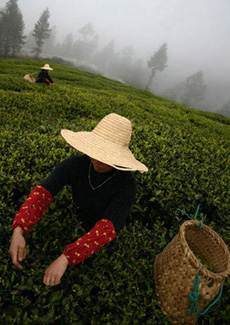
White Tea Harvesting Harvesting white tea. Photo courtesy of Rishi Tea.

MENU


Teas

Category Main Page
Articles & Reviews


Beverages

Category Main Page
Articles & Reviews


Main Nibbles

Main Page
Articles & Reviews Of Foods
From A To Z


Product Reviews

Main Page
Foods, Beverages, Books,
News & More


August 2005
Updated October 2007

Product Reviews / Main Nibbles / Beverages


Information About Tea: Essential Tea Facts

A Cupful About One of the World’s Most Popular Beverages


CAPSULE REPORT: About half of the American population drinks tea, although surprisingly, most of it, 85%, is iced and in bottles. In 2006, Americans drank more than 2.25 billion gallons of tea, 83% black and 16% green. While tea is the second most-drunk beverage in the world after water, it’s number 5 in the U.S., though growing thanks to research indicating what the Chinese have espoused for 5,000 years: It’s a “health drink.” This article has a wide range of facts sure to please tea lovers.

Black Tea vs. Green Tea vs. White Tea

All tea comes from the Camellia sinensis plant: it is the processing after plucking that determines which of four categories the tea falls into:

  • Black tea is substantially oxidized in a process that takes from two weeks to one month. Black tea is further classified as either made in the orthodox method or CTC (Crush, Tear, Curl), a production method developed about 1932. Unblended black teas are also identified by the estate they come from, their year and the flush (first, second or autumn). Orthodox and CTC teas are further graded according to the post-production leaf quality by the Orange Pekoe system, a size grading.
  • Oolong oxidation is two to three days—somewhere between the standards for green tea and black tea.
  • Green tea is oxidized very briefly by application of heat—either with steam, a traditional Japanese method; or by drying on hot pans, the traditional Chinese method. The tea is processed within one to two days of harvesting.
  • White tea undergoes no oxidation.

Most Teas are Blends

Most loose teas and almost all teas in teabags are blends. Because tea from the same estate will taste different in different harvests, the aim of blending is to ensure a consistent taste from season to season so the customer can rely on the product. Blending is also done for price purposes: more expensive, tastier tea may cover the inferior taste of cheaper tea. Examples of blends include:

  • Breakfast tea: Generally a blend of different black teas that are robust and full-bodied, and go well with milk. Well-known blends are English Breakfast and Irish Breakfast. Afternoon blends are lighter. Both blends are popular in the British Isles.
  • Jasmine tea: Jasmine flowers are spread on the leaves while oxidizing, and in some blends are are left in the tea as a decoration. Many other flowers, including roses and other fragrant blooms, are used as flavorings.
  • Earl Grey tea: A mix of black teas, flavored and scented with essence of the bergamot orange.
  • Spiced tea: The most famous is Indian chai, flavored with sweet spices such as ginger, cardamom, cinnamon, black pepper, and clove. Indian bay leaf and sometimes nutmeg are common in southern Asia and the Middle East.
  • Touareg tea: A strong green tea made with nana mint, prepared in desert areas of North Africa and the Middle East.
  • Jagertee: A tea infused with rum.
  • Gen Mai Cha (genmaicha): A Japanese green tea mixed with toasted rice.

The Word Tea

The Chinese character for tea is pronounced very differently in the various Chinese dialects. Two pronunciations have made their way into other languages around the world. One is te, which comes from the Minnan dialect spoken around the port of Xiamen (Amoy). The other is cha, from the Cantonese dialect spoken around the ports of Guangzhou (Canton) and Hong Kong, and in the Mandarin dialect of northern China. A third prominent pronunciation in China is zu, used in the Wu dialect spoken around Shanghai.

  • Languages that have te derivatives include Armenian, Danish, Dutch, English (tea), Finnish, Estonian (tee), French, German (tee), Hebrew (te or tei), Hungarian, Icelandic, Indonesian, Italian (tè), Latvian, Malay, Norwegian, Polish (herbata from Latin herba the), Singhalese, Spanish (té), Swedish (te), Tamil (thè), Yiddish, and scientific Latin.
  • Those that use cha derivatives include Albanian, Arabic, Bulgarian, Croatian, Czech, Greek, Hindi, Japanese, Korean, Nepali, Persian, Portuguese, Romanian, Russian, Serbian, Slovene, Swahili, Thai, Tibetan, Turkish, Ukrainian and Vietnamese.
  • It is tempting to try to relate the usage of the two different words with the route that was used to deliver tea to the particular cultures, but it does not track. For example, most British trade went through Canton, which uses the word cha, while Brits use the word tea.
  • There are some small exceptions. In Dublin, cha is sometimes used for tea, and char was a common slang term for tea throughout British Empire and Commonwealth military forces in the 19th and 20th centuries, crossing over into civilian usage.
  • In most of South America, any tea is referred to as mate. A stimulant beverage, yerba mate, was consumed there long before tea arrived. It may be the only place in which a word unrelated to tea is used to describe the beverage.

Antioxidants & Health

All tea has antioxidants, but the more processed the tea is, the less the concentration. Thus, along the continuum, white tea has the most, followed by green, oolong and black. However, most experts agree that it’s the amount of tea that you drink, not the color, that will yield the greatest health benefits. Eight cups a day is the recommend amount.

Health benefits have been attributed to tea, especially green tea, which is much of what has been drunk in China and Japan, for its 5,000-year history. However, scientific studies of the compounds in tea began less than 30 years ago; most have been conducted in the past five years. While research shows that prostate cancer, for example, is less common in countries where people drink a lot of green tea, the majority of the studies are lab studies as opposed to studies on human populations. Will drinking tea help you? At the very least, it won’t hurt.

While green tea has gotten a lot of press because it has higher levels of catechins—compounds with antioxidant activity—than black tea, and has been the focus of more research studies, experts like Dr. Hasan Mukhtar, a researcher in the field and vice chair of dermatology at the University of Wisconsin-Madison, feel that black tea is at least as beneficial. See our article on antioxidant foods for more information.

Flavor and Aroma Terminology

Bakey: An unpleasant taste caused by firing leaf at too high a temperature. Not as strong a flavor as burnt.

Biscuity: A pleasant characteristic, often associated with Assam teas.  See also Malty.

Bite: The astringent pucker from tannins that is characteristic of black tea.

Body: The strength of the liquor combined with its viscosity (weight on the tongue). Body may be full, light, etc.

Brassy: An unpleasant tang caused by under-withering.

Bright: A clean, crisp, sparkling attribute characteristic of all fine teas. The opposite of dull.

Brisk: Lively, not flat.

Complex: The harmonious melange of different flavors characteristic of the very finest teas.

Dull: Muddy looking liquor, the opposite of bright; flat-tasting.

Flat: Soft, flabby-bodied tea lacking bite and briskness.

Fruity: A piquant quality characteristic of good Oolongs, some Keemuns. Not meant to be descriptive of fruit teas.

Gone Off: Tea that’s been spoiled by improper storage or packing, is stale, or is simply past its prime.

Malty: A subtle underlying flavour often characteristic of Assam.

Peak: The high point of the tasting experience when, after the liquor has entered the mouth, its body, flavour, and astringency make themselves fully felt. Green and Oolong teas do not peak: their qualities are fully revealed immediately.

Pointy: A liquor is said to have point if it shows a property, e.g., briskness or fine fragrance.

Pungent: Astringent. This is what gives a tea its bite.

Stewed or Stewy: A poorly fired tea that gives soft liquor without point. This is also descriptive of tea that has been brewed too long and has become bitter.

Tarry: A smoky flavor characteristic of Lapsang Souchong.

Thin: Lacking body and/or color.

Weedy: A pejorative term when descriptive of thin, cabbagey black teas. However, green teas with vegetal aromas and flavors may be called weedy in positive terms, which include simple herbaceousness to scents of new-mown hay.

Winey: A positive term when descriptive of a mellow quality that fine Darjeelings or Keemuns acquire when aged six months to a year or more. Also can be used pejoratively to describe over-fermented tea.

Brush Up On Your Tea Etiquette

Serendipitea Tea Companion Book of Green Tea
Serendipitea—A Guide to the Varieties, Origins, and Rituals of Tea, by Tomislav Podreka. Investigate how tea has pleased the world for 5000 years. Click here for more information.

The Tea Companion: A Connoisseur’s Guide, by Jane Pettibrew. An authoritative guide to understanding, purchasing, and serving the world's finest teas is beautifully illustrated with full-color photographs of a variety of tea leaves and herbs, as well as their countries of origin. Click here for more information.

The Book of Green Tea, All there is to know about green tea: where it grows, how it's processed, its history and lore, how to drink and cook with it, and how to use it for beauty and health purposes. Click here for more information.

Tea Is Served

  Personal Tea Infuser Set Stainless Steel Tea Kettle
  Personal Tea Infuser Set: It's all about the flavor—one cup at a time. Click here for more information. Stainless Steel Tea Kettle: Calaphon construction meets museum-quality design in this modern tea kettle. Click here for more information.

© Lifestyle Direct, Inc. 2005-2008. All rights reserved. Images are the copyright of their respective owners.


.