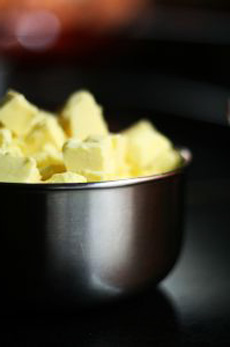
A bowl of butter (photo by Kasey Albano | SXC).
May 2005
Last Updated November 2025
|
|
Different Types Of Butter: A Butter Glossary
Terms & Definitions A & B
Who would have imagined there were so many terms about butter! If you’d like to suggest others, use the Contact Us link on this page. This is Page 1 of a seven-page glossary. Click on the black links below to visit other pages. And see our many other food glossaries to learn more about your favorite foods.
The history of butter.
The year’s 5+ butter holidays.
ANNATTO SEED (ACHIOTE)
Also known as achiote seed, annatto seed is used as a coloring agent in butter and margarine, as well as in cheese and other foods.
ANCHOVY BUTTER
Butter blended with mashed anchovies. It is used as a savory spread on sandwiches and canapes and to add richness to other dishes (e.g., salmon and poultry).
|
|
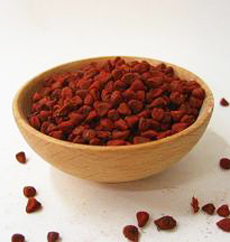
Annatto seed (photo © Latin Merchant.com).
|
APPLE BUTTER, PEAR BUTTER, ETC.
A fruit butter, such as apple butter or prune butter, is fruit purée or pulp combined with sugar, lemon juice, and spices, slowly cooked down to a smooth consistency. The “butter” refers to its spreadability; there is no actual butter or dairy product in it.
BERCY BUTTER
Bercy is a compound butter made by combining softened butter with a reduction of dry white wine, shallots, lemon juice, marrow, parsley, salt, and pepper. It originated in the Bercy neighborhood of Paris and is often served with steak, but can also be used for other broiled or grilled meats—fish, chicken—or in other dishes. Often, a pat of the compound butter is placed atop the protein, where it slowly melts from the heat of the cooked food. When melted into a sauce first, it is known as Bercy sauce.
BEURRE
Pronounced burr, the French word for butter.
|
|
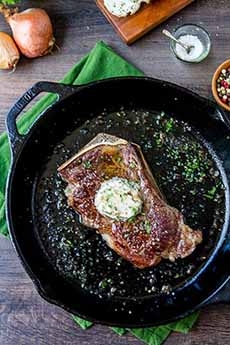
A pat of Bercy butter atop a steak. Here’s the recipe (photo © A Communal Table).
|
BEURRE BLANC
A classic French sauce made of wine, vinegar, and shallot reduction, into which chunks of cold butter are whisked until the sauce is thick and smooth. Beurre blanc, which means “white butter” in French, is served with poultry, seafood, vegetables, and eggs.
|
|
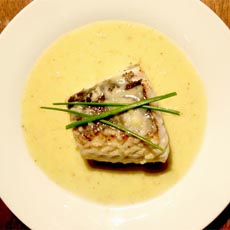
Cod in beurre blanc sauce (photo © Circle Of Misse).
|
BEURRE DE BARATTE
Churned butter in the traditional French “baratte” (churn) style, the butter is hand-churned in a wooden butter churn and hand-molded. The cream used is often left to rest for up to 24 hours, which helps develop a rich, almost lactic-like flavor. The deep yellow color is a natural outgrowth of grazing on grass.
Its rich flavor makes it perfect for spreading on bread, but it’s also prized by chefs for use in cooking—to enrich sauces, pastries, and other dishes where a high-quality butter is needed.
BEURRE COMPOSÉ
See compound butter.
|
|
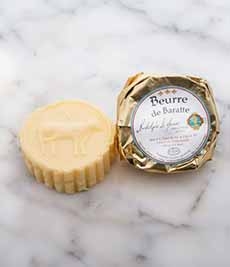
Beurre de baratte from Rodolphe Le Meunier is considered among the best. The milk is from Normandy (photo © Fresca Italia).
|
BEURRE MANIÉ
French for kneaded butter, this is a paste made of softened butter and flour, usually in equal parts, that is used to thicken sauces.
BEURRE MONTÉ
Beurre monté is not a sauce, but a method of infusing meats and fish with the flavor of butter. Solid butter is an emulsification of butter fat, water, and milk solids; beurre monté is a way to manipulate the emulsification into liquid form. A few drops of water and chunks of butter are whisked over a moderate heat to melt the butter and keep it emulsified—a solid, creamy sauce. Foods are cooked in it, meats are rested in it, and sauces are made with it.
BEURRE NOIR
French for black butter, the butter is cooked over low heat until it turns dark brown, not black. It is usually flavored with vinegar or lemon juice, capers, and parsley and served as a sauce with eggs, fish, and sometimes vegetables. One of the most famous classic dishes is calves’ brains in black butter (a dish, alas, that is not served much these days since the spread of Mad Cow Disease).
The difference between beurre noir and beurre noisette is the cooking time and the addition of an acid to the former. Both start as brown butter, but beurre noisette is cooked to a light brown color with a hazelnut aroma, while beurre noir is cooked longer until it is a very dark brown, and then an acid such as vinegar or lemon juice is added
|
|
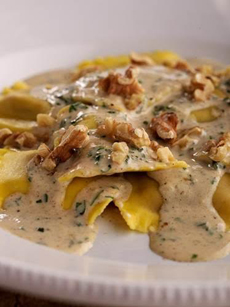
Ravioli with a beurre noir sauce and walnuts (photo © David Venable | QVC).
|
Check out this article: brown butter vs. black butter.
BEURRE NOISETTE or BROWN
BUTTER
French for hazelnut butter, it is butter cooked in the manner of beurre noir, until it turns the golden brown color of hazelnuts. It is a popular way to sauté and sauce meat, poultry, fish, and fruit, and also serves as a sauce for pasta and vegetables. Here’s the history of brown butter.
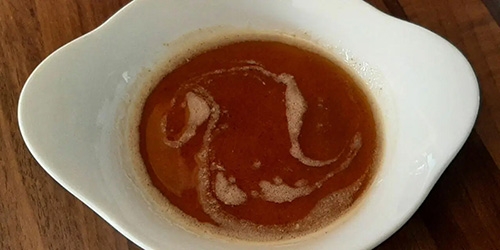
Here’s the recipe for beurre noisette (photo © The Best Recipes).
BEURRE ROUGE
Beurre rouge (red butter) substitutes red wine and vinegar for the white wine and vinegar in beurre blanc. Whereas beurre blanc is typically served with lighter proteins like poached fish and chicken, beurre rouge’s heartier flavor profile makes it ideal for red meats (beef, duck, lamb) and game meats (boar, venison, and other game). It also works with full-flavored fish like salmon or tuna, and with mushroom dishes.
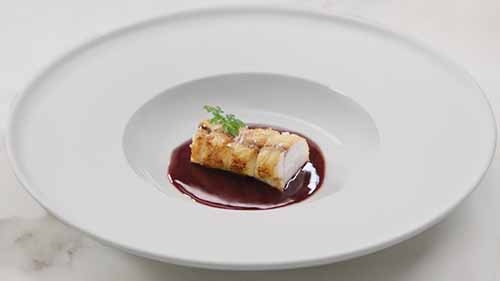
Here’s Chef Thomas Keller’s beurre rouge recipe (photo © Master Class).
BREAK
When heating a butter sauce, this is the point when fat solids separate from the rest of the sauce. A broken sauce is not desirable as it detracts from the creamy texture. A butter with lower moisture breaks less. European-style butter, while desirable for baking, is not optimal for sauces.
BROWN BUTTER
See beurre noisette, above.
BUTTER
A food product made exclusively from milk or cream or both, with or without common salt, containing not less than 80% by weight of milkfat (butterfat). Butter is made by churning the milk or cream until it solidifies. The texture is a result of working/kneading during processing at appropriate temperatures, to establish a fat crystalline network that results in desired smoothness (compare butter with melted and recrystallized butter). Butter is used as a spread, a cooking fat, or a baking ingredient. Unsalted butter is preferred over salted butter because it permits greater leeway in seasoning recipes to taste. Butter will keep, well wrapped, for one month in the refrigerator or for up to six months in the freezer. See more butter tips.
Here’s the history of butter.
BUTTER BOAT
A glazed ceramic, covered crock, more oblong in shape than a standard rectangular butter dish, that is used to keep butter at room temperature. Water is added to the base; the unit keeps butter fresh, soft, and spreadable for 30 days without refrigeration.
BUTTER CALORIES
One cup of butter contains 1628 calories, 1628 from fat. There are 0.1g of sugar and 1.9g of protein. One tablespoon of butter contains 102 calories, 102 from fat. There are 0g of sugar and 0.1g of protein. A one-inch-square pat of butter, 5g, has 36 calories.
|
|
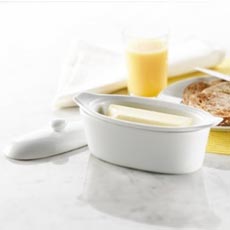
A butter boat keeps butter at room temperature, soft and spreadable (photo © Trudeau USA).
|
BUTTER CHEESE or BUTTERKÄSE
Butter cheese is a mild, semisoft cow’s milk cheese, aged for one month. It has a buttery taste and a creamy texture, and is often served with beer and ale, as a table cheese and a melting cheese—try it on a baked potato instead of butter and sour cream. Originating in Germany, it is made in the U.S. as well. And, it’s lactose-free!
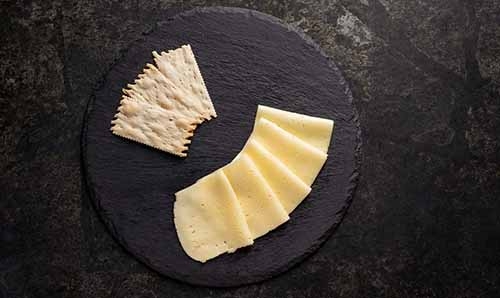
Butterkäse from Bauer, a German producer (photo © German Deli).
BUTTERCREAM or BUTTER CREAM
A light, uncooked frosting made of butter, sugar, and egg yolks, and sometimes milk or light cream, that is used to fill and frost cakes and pastries.
BUTTER CURLER
A utensil about six inches long with a serrated hook at one end; the hook is drawn down the length of a stick of butter to make butter curls.
BUTTERFAT or MILK FAT
These are the fatty particles in milk that are separated out during churning to make cream and subsequently butter. The higher the milk fat content, the creamier, richer, and more caloric the milk, cream, ice cream, etc.
BUTTER KNIFE
Smaller than a dinner knife with a rounded tip and a blunt edge, used to easily spread butter on breadstuffs.
|
|
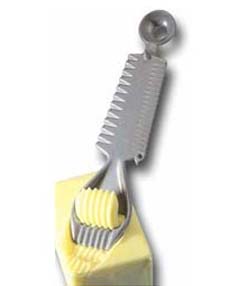
A butter curler pulls the butter into textured curls (photo © courtesy Westmark Kitchen Utensils).
|
BUTTER KNIFE & BUTTER SPREADER
These are two different utensils, but most Americans use the wrong names when referring to them. The confusion starts because we refer to the smaller knife in a flatware set as the “butter knife,” when it’s actually a butter server.
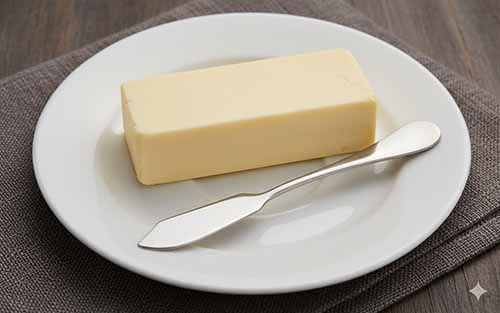
A butter spreader is smaller than a dinner knife, with a rounded tip and a blunt edge, so that it can easily spread butter. It is an individual utensil, part of a flatware place setting.
A butter knife, on the other hand, is a serving utensil usually placed on a communal butter plate. It has a pointed tip and is used to cut and move a pat of butter from a central dish onto one’s plate. It is not used for spreading directly onto one’s bread.
|
|
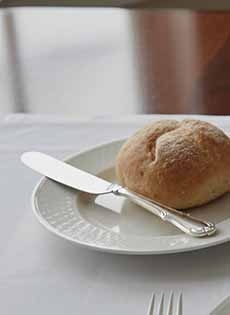
This is not a butter knife. It’s a butter spreader (A.I. photo).
|
This is a butter knife (Gemini Photo).
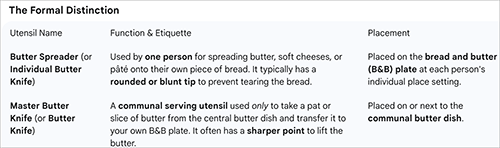
The key rule of etiquette: Never use the communal butter knife to spread butter on your bread, as this would contaminate the communal butter supply with crumbs. Use it to serve the butter to your plate, then switch to your butter spreader to spread it on your bread.
BUTTER OIL or ANHYDROUS
BUTTER OIL
Also known as anhydrous butterfat, this is butter from which the water has been removed by gently heating to break the emulsion, followed by centrifugation to remove the milk serum from the fat fraction. The butterfat content of the remaining butter oil is more than 99%. It is similar to ghee and is commonly used in very hot countries where there is no refrigeration, as well as an ingredient in commercial production.
BUTTER PADDLE
A short, flat wooden paddle that was originally used in the churning process. Today, two paddles can be used to roll textured balls of butter for elegant dining.
Roll a cube of butter between the two paddles until it forms a ball. A plate of butter balls is an elegant touch to a formal dinner table
|
|
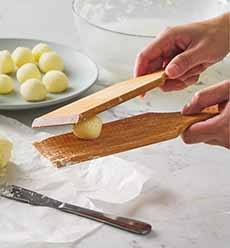
Use the paddles to make textured balls of butter (photo © Lee Valley Tools).
|
BUTTERMILK
In earlier times, the tangy, butter-flecked liquid was left over after whole milk had been churned to make butter. Today’s buttermilk is a cultured form made by adding lactic-acid bacteria to low-fat or nonfat milk.
BUTTER MOLD
A decorative mold in ceramic, metal, wood, or plastic that is used to form butter into fancy shapes (hearts, stars, circles) and press designs into the surface of the butter. Some create 3D molds (such as lambs and chickens). Molds are filled with softened butter; the butter is chilled and removed from the mold.
|
|
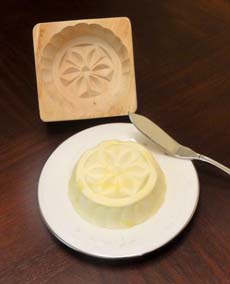
An old-fashioned wood butter mold, available at Poland By Mail.
|
BUTTER SAUCE
A butter sauce, made from equal proportions of butter and flour, and stirred until the flour dissolves into the butter. This is the basis for classic French white sauces. Melt an ounce of butter, add an ounce of flour, bring to a boil, stirring constantly, and add eight ounces of water and 1/8 teaspoon salt. To make white sauce, substitute milk or cream for the water; substitute veal or chicken stock for béchamel sauce; substitute eggs for hollandaise sauce; substitute eggs and mushrooms for velouté or allemande sauce; substitute white wine for poulette sauce.
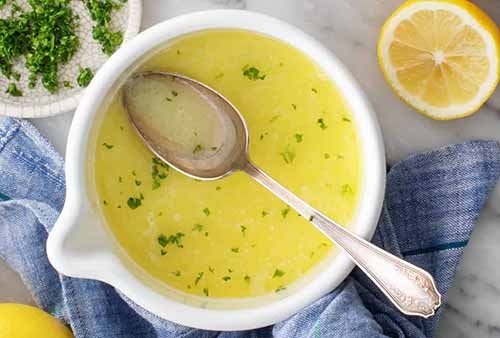
Butter sauce can be plain or seasoned. Here’s the recipe for this lemon and parsley butter sauce (photo © Love and Lemons).
Some content courtesy of Cornell University School of Agriculture, Wisconsin Milk Marketing Board, U.S. Department of Agriculture.
|