Advertisement
THE NIBBLE (TM) - Great Finds for Foodies (tm)
  Sign Up | Contact Us | Email To A Friend  
       
RSS feed What’s This?


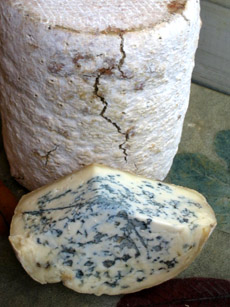
Bayley HazenBorn in the U.S.A.: Bayley Hazen Blue is made by Andy and Mateo Keehler in the style of the classic British Stilton but with its own distinct recipe. The Keehlers learned their craft at Colston-Bassett in Nottinghamshire. Click here for more information.
MENU


Cheese

Category Main Page
Articles & Reviews


Cheese-Butter-Yogurt

Category Main Page
Articles & Reviews


Main Nibbles

Main Page
Articles & Reviews of Foods From A to Z


Product Reviews

Main Page
Food, Beverages, Books,
News & More


ABOUT THE AUTHOR


STEPHANIE ZONIS focuses on good foods and the people who produce them.


December 2005

Product Reviews / Main Nibbles / Cheese-Butter-Yogurt

Blue Cheese

Whey To Go ~ December 2005

In Praise of the Blues


These aren’t the blues of B. B. King, nor are they the notorious holiday blues. I refer, of course, to blue cheeses. As a kid, there was no way I would voluntarily have eaten cheese with mold in it. But sometime during the period when I was discovering that foods such as asparagus and mushrooms were actually edible, my tastes in cheese changed, too. Now, I adore a good blue cheese. While I’ll go to great lengths to acquire such a product, I’d like to deny a story that I once smuggled an outstanding raw milk blue out of the U.K. into the U.S. (As it happens, that story is completely true, but I’d still like to deny it, because I’m not sure it was the brightest thing I’ve ever done.)

Blue cheeses, once the closely-guarded secrets of fine cheesemakers in Europe, have begun to spring up in the U.S. They’re now made all over this country, in fact. That’s a little surprising, when you consider that blues are a particularly complex type of cheese to produce. It’s easy for the levels of both salt and mold in a blue cheese to go haywire, and even planned mold growth inside a blue causes radical change in the pH of the product, as well as alterations in the fats and proteins. Also, most blue cheeses are pierced with thin metal skewers, a process often called “punching” or “needling.” Piercing allows oxygen to enter the interior of the cheese, and that oxygen is necessary for proper mold growth. However, it also allows for the potential of unwanted molds and spores. This was best expressed by Tom Johnson, cheesemaker and co-owner of Bingham Hill Cheese Company in Colorado, when he noted that making blue cheese is a process “inherently flawed,” because “You’re taking a perfectly good cheese and poking holes in it, thus opening it up to whatever is in the atmosphere.” Aging is especially critical for blue cheeses, as well. Most begin the maturing process in a curing room, an area warmer than the aging facility. The relative warmth of the curing room helps to promote mold growth, but if a cheese is left in this environment for too long, it may dehydrate, lose butterfat, or have the mold growth run wild—or, alternatively, die out. With all of these variables, it’s easy to understand why blue cheese can be tricky to produce.

Blue cheese begins, of course, with milk. The milk is usually homogenized, then heated. After this, starter culture, salt, rennet, and mold are added. The most commonly used mold is Penicillium roqueforti. Once curds form, they’re cut and allowed to set. When the curds and whey separate, the whey is drained and the curds are placed into a cheese form. After further draining of the whey, the wheels of cheese are removed from their forms and have salt rubbed on their exteriors over the course of a few days (this firms the rind and promotes yet more draining of whey). The cheese wheels are then “punched” to allow in that vital oxygen.

PiercingPiercing or punching a Stilton. Photo courtesy of Stilton.com.

The cheeses are ripened further and turned frequently (especially during the early stages of the maturing process) to encourage even mold veining in the cheese wheel. Incidentally, “blue” cheeses don’t always have mold that’s blue. It may appear green, blue-green, or even a bluish black.

Is there a most important step or component in the making of a great blue cheese? Come now, did you really expect a single answer to this question, with blue cheeses being made from Massachusetts to Texas and Vermont to California?

Curd formation
Curd formation. Photo courtesy of Stilton.com.

Some producers of blues believe that the key to a great blue lies in using a great milk. Others will tell you it’s all in the curd. Curd formation is especially important in blue cheese. If the curd knits together in the cheese form too tightly, the interior of the cheese won’t have the proper environment for mold growth. On the other hand, curds that are too loosely knit together in the cheese form won’t provide good passages for sufficient veining and will cause the texture of the cheese to suffer. Others, such as Dawn Morin-Boucher, owner of Green Mountain Blue Cheese, say the trick to blue cheese is knowing when to pierce the cheese wheel, how many holes to open in it, and when to move the cheese from the curing room to the aging facility. Almost everyone who produces blue cheese has his or her own theory here, which helps to account for the wide variety of blues produced in the U.S.

The unceasing battle between producers of raw (unpasteurized) milk cheeses and those who begin the process with pasteurized milk naturally extends to blue cheeses. There are cheesemakers who insist that pasteurized milk cheeses can never match the flavor of those made from raw milk, just as there are those who assert that pasteurized milk cheeses can be just as flavorful as those produced from raw milk and have the added benefit of fewer health risks.

Is it possible to contract a food-borne illness from eating a cheese made with unpasteurized milk? Yes. And if you do, you may get very sick, especially if you’re immune-compromised to begin with. Does this happen often? The data collected by the Centers for Disease Control in Atlanta show that, between 1990 and 1997 (the most recent year for which I found statistics), foods such as beef, chicken, shellfish, and vegetables were all responsible for more outbreaks of food-borne illness than were all types of cheeses, including those made from raw milk. As with many things in life, this is a choice for each consumer to make individually. But be warned you may find some very vocal proponents on each side!

But let’s get down to brass tacks: what about taste? Aren’t all blues sharp and salty? I don’t think so. A blue cheese will be saltier and have a tangier taste than, say, a cream cheese or a Cheddar, but not all blues are intense. If you’re just starting out with blue cheeses, you might want to try a milder example of this craft. As usual, a knowledgeable retailer is your best bet here, and a good cheesemonger will have no hesitation in allowing you to try a blue cheese before you buy it. If there’s no good retailer in your area, turn to the internet. Fine merchants such as Murray’s Cheese, Ideal Cheese, or Formaggio Kitchen will offer multiple varieties of blues (as well as other cheeses). You won’t be able to sample the cheese before purchasing it, but you should be able to find a good description and have any questions answered.

A little research and a few samples will hopefully have you singing the praises of the blues, as I do. Happy tasting!

Get ideas on hosting a cheese tasting party,
where you and your guests can taste half a dozen or more different cheeses.

Companies of the Month: Blue, Blue and More Blue!

So tightly am I in the grip of blue cheese enthusiasm that one company will not suffice this month. I’m passing along information for a few who I think make solidly good blues. By the way, that cheese I smuggled into the U.S. was called “Picos de Europa”; I was told it was Spanish. I’ve since read it is also called “Valdeon,” but I’ve tried Valdeon here, and it wasn’t the same cheese. If you know where I can find Picos de Europa, please e-mail me at: sdziadwm at nac.net!

Berkshire BlueBerkshire Blue is available online from iGourmet and Formaggio Kitchen.

Berkshire Cheese Makers. Michael Miller makes almost all of the company’s cheese, called Berkshire Blue. It isn’t too pungent or salty; Miller is known for having low levels of both acid and salt in his cheese. Berkshire Blue is one of my favorite blues in this country. It’s on the creamy side, with a milder blue taste than many, yet it’s very full-flavored and you absolutely know it’s a blue cheese.

Point Reyes Farmstead Cheese Company. Makers of Original Blue, the Giacomini clan in California swear by their local environment, insisting that they couldn’t make the same cheese anywhere else. All milk used for their cheeses comes from their closed herd of Holsteins. Original Blue, at the left, is somewhat drier, crumblier, and sharper than Berkshire Blue, but nonetheless remains a fine all-around table cheese. Read THE NIBBLE’s review of Point Reyes Original Blue.

The Rogue Creamery. David and Cary, respectively the President and CEO of Rogue, are two of the nicest guys going. Not only that, but they make a variety of blues to suit different tastes. Try the Oregon Blue Vein or the Oregonzola; for a change of pace, think about the Smokey Blue, smoked for 16 hours over hazelnut shells. (Read THE NIBBLE’s review of Smokey Blue.)

Books For Cheese Lovers

Grilled Cheese cheeses of the world the cheese bible
Grilled Cheese: 50 Recipes to Make You Melt, by Marlena Spieler. Fifty mouthwatering new takes on a fromagophile's favorite comfort food, plus an array of quick-to-make mustards and tips on choosing the perfect bread for each sandwich. Click here for more information. Cheeses of the World : An Illustrated Guide for Gourmets, by Bernard Nantet.The complete history of two hundred cheeses from thirty-seven different countries, with photos so gorgeous you could eat the page. Click here for more information. The Cheese Bible, by Christian
Teubner. A wealth of information on this most popular  of foods.
Educational information plus delicious recipes from simple
nibbles to elaborate guest dishes. Click here for more information.


© Copyright 2005-2008 Lifestyle Direct, Inc. All rights reserved. Images are the copyright of their respective owners.


.