
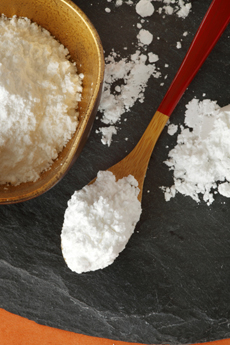
 Confectioners’ sugar, also known as powdered sugar and 10x sugar, is used in icings and for garnishing. Photo by Katharine Pollak | THE NIBBLE. Confectioners’ sugar, also known as powdered sugar and 10x sugar, is used in icings and for garnishing. Photo by Katharine Pollak | THE NIBBLE.
November 2006
Last Updated March 2015
|
|
Different Sugar Types: A Glossary Of Sugar & Syrup Types
Page 2: Cane Sugar & Other Terms With C
This is Page 2 of a seven-page glossary of different sugar types. Click on the black links below to visit other pages. See our many other delicious food glossaries.
This material is copyrighted and cannot be reproduced in whole or in part
without written permission. You are welcome to link to it.
CANE JUICE or EVAPORATED CANE JUICE or UNREFINED DEHYDRATED
CANE JUICE
An organic product, evaporated cane juice is sugar that does not go through the final stages of purification and whitening by chemicals. Evaporated cane juice is not liquid, but crystal form. It is 85% to 95% sucrose, compared to 99% to 100% for regular sugar. The cane is crushed, producing cane juice, which is clarified and concentrated through heating and evaporation; the raw sugar crystals are separated from the remaining syrup (molasses) by centrifuge. The result is a minimally processed, full-flavored sweetener that can be substituted for white sugar (a.k.a. granulated sugar, regular sugar, table sugar and sucrose), used by people who do not want chemicals in their food. With regular sugar, chemicals would then be used used to remove impurities, and whiten the product.
|
CANE SUGAR
Sugar derived from sugar cane. Both beet and cane sugars are 99.95% sucrose; the remaining .05% are trace minerals and proteins. Many bakers claim that this tiny fraction makes a difference, and that cane sugar performs better. In may be true: molasses made from beet sugar is considered too bitter for human consumption and is used for animal feed. See sugar cane.
CASTER SUGAR or CASTOR SUGAR
The British term for what Americans call superfine or ultrafine sugar. It got its name because the grains are small enough to fit through a sugar caster, called a sugar shaker or dispenser in the U.S.
CHINESE SUGAR or CHINESE ROCK
SUGAR
See rock sugar.
|
|
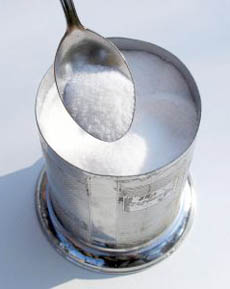
Cane sugar. Photo by Sanja G. Jenero | SXC. |
CHOCOLATE SYRUP
A syrup made from unsweetened cocoa powder, corn syrup and flavorings. It is used to flavor milk, as a sundae topping, and in a broad variety of food preparation and garnishing applications.
CINNAMON SUGAR
A mixture of granulated sugar and powdered cinnamon, popular on buttered toast and puddings. It is sold as a commercial mixture, or can be easily made using 1 part cinnamon to 7 parts sugar.
|
|
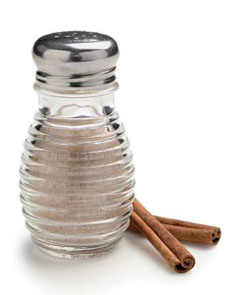
Cinnamon sugar. Photo courtesy King Arthur Flour. |
COARSE SUGAR, DECORATING
SUGAR
or SPARKLING SUGAR
Granulated sugar that processed very coarsely for baking with a larger grain size than regular granulated sugar; it tends not to change color or break down at high temperatures. It can be colored and is similar to sanding sugar, but is a larger grain than sanding sugar. It is used as decoration to give a jewel-like appearance. Also called crystal sugar and crystallized sugar.
|
|
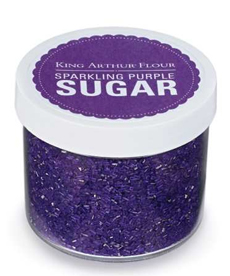
Coarse, sparkling decorating sugar. Photo courtesy King Arthur Flour. |
COCONUT SUGAR
A brownish sugar made from the sap of the coconut palm, coconut sugar does not taste like coconut. It has a creamy, caramel-like sweetness used primarily for making sweets and desserts, but is also used in curries and in rich sauces for savory dishes. Because it is not highly processed like regular brown sugar, the color, consistency, flavor and level of sweetness can vary from batch to batch, even within the same brand, such that cooks need to add it “to taste.” Palm sugar is often used as an interchangeable term, and it can be substituted for coconut sugar; although palm sugar is made from the sap of the palmyra or sugar palm. Brown sugar can be substituted for either; but for sweetening light-colored dishes, plain granulated sugar should be used. See also palm sugar.
|
|
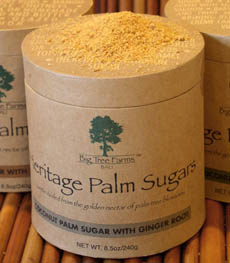
Palm sugar available from
iGourmet.com.
|
COCONUT SYRUP
This syrup can be found in Hawaii, where it’s popular as a pancake syrup and as a sweetener in mixed drinks.
|
CONFECTIONERS’ SUGAR or 10X or
POWDERED SUGAR
Spelled confectioners, confectioner’s or confectioners’, this is granulated sugar that has been crushed to a fine powder with 3% cornstarch added to prevent lumping. It dissolves readily and is also used decoratively, as a fine dusting on desserts. Sugar labeled XXXX is slightly finer than that labeled XXX, but they can be used interchangeably. One and three-quarters (packed) cups confectioners’ sugar equals 1 cup granulated sugar. It is known as icing sugar in Great Britain (because it is often used in icings) and sucre glace in France.
|
|
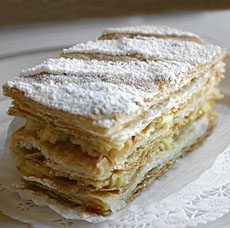
A napoleon dusted with confectioners’ sugar. Photo courtesy CafeBlanc.us. |
CORN SYRUP
Corn syrup was invented in 1812 by a German chemist, Gottlieb Kirchhoff, by heating corn starch with sulfuric acid. Ubiquitous in the U.S. and not elsewhere, this thick, sweet syrup is known as glucose syrup outside the U.S. and Canada because it is composed mainly of glucose, corn syrup is made from corn starch. It is used to sweeten soft drinks, ice cream, ketchup, breads and many other mass-produced foods. It is made in light and dark corn syrup: the light is almost clear, with a delicate flavor; dark corn syrup has a more pronounced, molasses-like flavor; but they can be used interchangeably in recipes. While some food purists decry the use of corn syrup in recipes, even good manufacturers use it because corn syrup doesn’t crystallize and turn grainy in cold temperatures, so it keeps a good consistency for fudge and caramel sauces and and candies. In mass production, baked goods made with corn syrup are moister and stay fresher longer than those made with sugar. Here’s how to make your own corn syrup from fresh corn, via Cupcake Project.com. See also high fructose corn syrup.
|
|
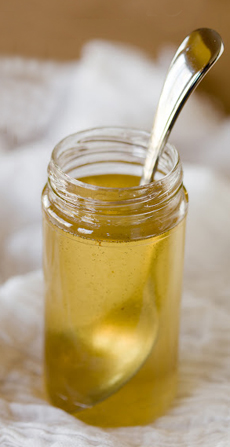
Corn syrup, homemade by CupcakeProject.com. |
CRYSTALLIZED SUGAR or CRYSTAL SUGAR or SUGAR CRYSTALS
See coarse sugar. Rock candy is essentially large sugar crystals.
Continue To Page 3: Terms With D To G
Go To The Article Index Above
|

