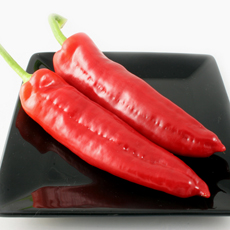
 The Anaheim chile, named because it was canned in Anaheim, California beginning in the early 1900s, was developed from the pasilla. With a modest level of heat, it is popular for stuffing. Photo by Scott Liddell | Morguefile.
October 2005
Last Updated March 2023
|
|
Product Reviews / Main Nibbles / Seasonings
Chile Pepper Types
Chile Glossary Page 4: Types Of Chile Peppers ~ A & B
This is Page 4 of an eight-page article on chile pepper types/ Click on the black links below to visit other pages. See our many other informative food glossaries.
This glossary is protected by copyright and cannot be reproduced in whole or part.
You are welcome to link to it.
Chile Glossary
Chile peppers—more accurately called chiles or chilis,* are available fresh, dried, crushed or pulped. Their chemical compounds deliver two important qualities: Some varieties are desired for their bright red color, from the pigment capsanthin; others are famous for the biting pungency of their capsaicin.
There are more than 100 types of chiles cultivated worldwide—30 different types of chiles used in Mexican cooking alone. For a true master list, see the database of chiles developed by a U.K. aficionado. The directory isn’t user-friendly—if you don’t know what you’re searching for, you essentially have to start out at the beginning of the alphabet and browse through, letter by letter. But the collection is impressive!
*When Columbus arrived in the Caribbean and the crew first tasted the new world chile, they related it to the black pepper they knew from Europe (via India). The natives called the fruit “chilli” and the Europeans added the term “pepper.” There is no relationship between the chile and legitimate pepper (i.e. piper nigrum, the black peppercorns originally from India).
AJÍ CHILE
While there are many chiles of the variety called ajíi, ajíi is also one of the native words for chili (see chile). There are more than 300 varieties of chile in Peru, but the ají amarillo, which matures to a deep yellowish-orange color, has distinctive fruity flavors, is the most popular and possibly the most important ingredient in Peruvian cooking, according to LimaEasy.com.
ANAHEIM CHILE
Also known as California chile and chile verde. Not a hot chile (1,000 to 10,000 Scoville Units), the green Anaheim was cultivated as far back as 1900 for canning in Anaheim, California. It was developed from pasilla chiles in New Mexico. With a modest heat level, 1,000 to 10,000 Scoville heat units, it is often used for stuffing. See the photo at the top left. |
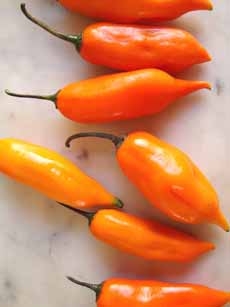
The aji amarillo chile is popular in Peruvian cooking (photo © Peru Delights).
|
|
ANCHO CHILE
The ancho is a dried, smoked poblano chile. It is large, fleshy, and full-bodied with a mild fruit flavor with hints of coffee and a faint raisin or licorice taste. Relatively mild (3 on a scale of 10), it is the chile of choice for chiles rellenos, and along with the guajillo, and the pasilla, one of the chiles used to make mole sauce; ancho also is used to flavor salsas and dips. The thick flesh means that the best flavors are achieved through long, slow cooking or soaking in boiling water to soften for a purée—it is rarely used uncooked. Dried ancho chile is used for chile powder—a pinch adds flavor to roast or grilled meats, vegetables, and mayonnaise without adding any real heat. Try it as a seasoning with cheese dishes, chocolate, potatoes, tomatoes, and yogurt. “Ancho” means wide, a reference to its broad, flat pod.
|
|
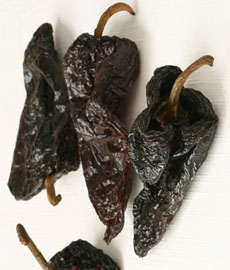
Ancho chiles are available from iGourmet. |
|
BELL PEPPER
Sold in its green immature state and its ripe red state, where it is also called pimento. There are also yellow and orange cultivars. In Great Britain, bell peppers are called capsicums after their genus (Capsicum annuum). Bell peppers have no heat: 0 on a scale of 10.
BIQUINHO PEPPER
This tiny, mild chile from Brazil is most often found pickled, and is a popular snack and garnish. As with all chile peppers, you can buy seeds and grow your own. Here’s more about it.
|
|
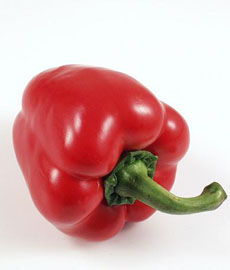
Red bell pepper. Photo courtesy Morguefile.
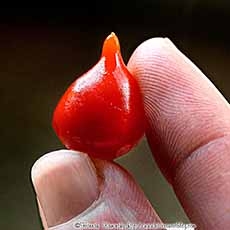
Biquhino, a tiny chile native to Brazil (photo © Bittersweet Blog), |
|
BIRDSEYE or BIRDS-EYE or AFRICAN
BIRD’S EYE or AFRICAN DEVIL or PIRI
PIRI CHILE
From Africa, the tiny, thin-fleshed birdseye chile is one of the hottest—9 on a scale of 10. It is used both raw and in cooked dishes—most popularly with fish sauce, lime juice, and sugar for a Thai-style dipping sauce. It has a clean flavor but lacks the complexity of some other chiles.
|
|
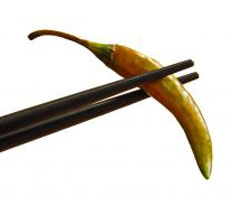
Birdseye chile. Photo by John Evans | SXC. |
|
BHUT JOLOKIA CHILE or NAGA
JOLOKIA CHILE or GHOST CHILE
Originating in Assam, India, this long, flat, orange-colored chile, an extremely hot member of the habanero family, first made waves around 2005 when it was measured at more than a million Scoville Units (SHUs). In February 2007, it entered the Guinness Book Of World Records as the world’s hottest chile. The prior record holder was the red savina, at slightly more than half the SHUs. Bhut jolokia translates as “ghost chile” in Assamese, presumably because the chile is so hot, you give up the ghost when you eat it. No sane person would want to eat one, but its intense heat concentration could provide an economical season to the packaged food industry.
|
|
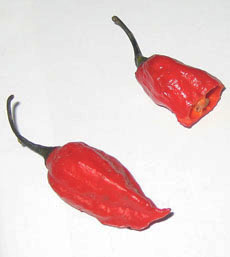
Bhut jolokia chile. Photo by Gannon Ajo | Wikimedia. |
The Dorset Naga, a variety of habanero, has tested at 876,000 SHUs. Originating in Bangladesh, it is sold with a health warning.
Continue To Page 5: Chile Glossary C
Go To Article Index Above
Lifestyle Direct, Inc. All rights reserved. Images are the copyright of their respective owners.
|