
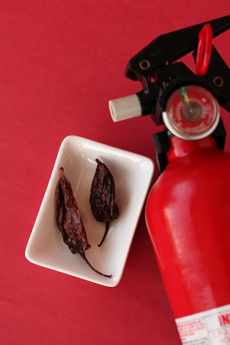
 Get the fire extinguisher! The naga jolokia chile, looking quite innocent, was the hottest chile in the world as recently as 2011. In 2012, a new “hottest” was declared, the Moruga scorpion, below. Photo by Jerry Deutsch | THE NIBBLE.
October 2005
Last Updated March 2023
|
|
Product Reviews / Main Nibbles / Seasonings
Different Chili Peppers
Chili Glossary Page 7: Pasilla, Poblano, Naga Jolokia & Other Chile Types From K To P
This is Page 7 of an eight-page article on the different types of chili. Click on the black links below to see other pages. See all of our food glossaries, covering almost every category of food.
This glossary is protected by copyright and cannot be reproduced in whole or part.
You are welcome to link to it.
|
KAMBUZI or MALAWIAN CHILE
A small, round chili pepper indigenous to central Malawi, in southeast Africa. Colors include yellow, red, and orange and the flavor is similar to the habanero, grown half a world away. Goats are known to munch on the leaves of the plant, engendering the name, which translates to “little goat” chiles. Humans use the fruit to make condiments, sandwich spreads, and sauces.
|
|
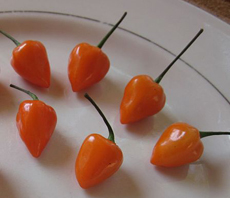
Kambuzi chiles from Malawi. Photo by Mekane | Wikimedia.
|
KASHMIRI CHILE
The slender chile, also called degchi mirchi, is a relatively spicy chile (7 on a scale of 10) of India that provides the vibrant red color to meats and curry vindaloo.
LONG CHILE
A group of bright red, thin-skinned chiles of medium heat (6 on a scale of 10), that don’t have a complex flavor so can be used whole, chopped, or crushed to add heat to virtually any dish. They are often fried whole in oil to start a curry before the other aromatics are introduced. Not to be confused with long pepper, Piper longum, an East Indian shrub that produces a long peppercorn with a flavor similar to the round black peppercorn in common use, Piper nigrum. (See our Peppercorn Glossary for more information on peppercorns.)
|
MALAGUETA CHILE
Originally from Brazil, the malagueta is an extremely hot chile (9.5 on a scale of 10), similar to the birdseye chile in both appearance and flavor. It is typically minced with oil in a salsa or as a table condiment. Not to be confused with the meleguetta pepper, Aframomum melegueta, an African rhizome plant of the ginger family whose seeds, also called Grains of Paradise, are used as a spice to flavor beer and foods. (See our Peppercorn Glossary for more information on grains of paradise.)
|
|
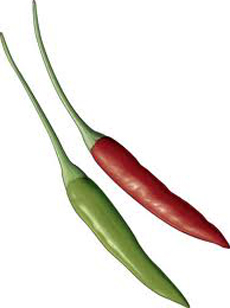
Malagueta chiles: the unripened green form and the ripe red malagueta.
|
|
MANZANO CHILE
The manzano, though cultivated in Mexico, is not a member of the Capsicum annuum species. It is part of the Capsicum pubescens species from the Andes region, a relative of the hot South American rocoto chile (between 30,000 and 50,000 SHU). Manzano means “apple” in Spanish, a reference to the shape of the chile. Manzanos are used most often in fresh form because the pods are so thick they are difficult to dry. The chiles have black seeds and turn orange when ripe.
|
|
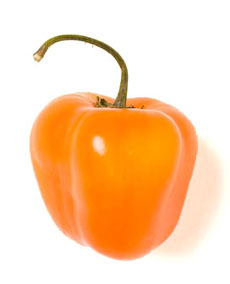
A manzano chile. Photo courtesy EatMoreChiles.com.
|
|
MARASH CHILE FLAKES
Marash chile flakes are red pepper flakes from Turkey. They have a complex flavor—fruit and smoke—with moderate heat. Marash is both smokier and a bit hotter than Aleppo pepper, but you can use them interchangeably. As a default use crushed red pepper flakes (chile flakes) which are typically cayenne-type chiles. The flakes can be blended with lemon juice and salt for a meat rub, or added to olive oil to make a vinaigrette, pasta, or rice sauce. Blend the flakes with olive oil for a bread dipper, and add to soups and stews, chili, or any meat dish.
|
|
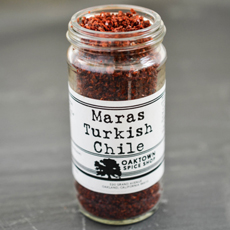
Marash chile flakes from Turkey. Photo courtesy Oaktown Spice Shop.
|
|
MORUGA SCORPION CHILE or
TRINIDAD MORUGA SCORPION
The Moruga scorpion (Capsicum chinense), was first grown in the district of Moruga in Trinidad and Tobago. The golf-ball-size chile was declared the world’s hottest chile in February 2012 New Mexico State University Chile Institute, which tested it at 2,009,231 SHU on the Scoville Scale.* Note that there’s an ongoing race among breeders to produce new cultivars that are hotter than the last declared “world’s hottest chile.” The heat isn’t overpowering at first but continues to build until it becomes “nasty,” according to one expert who has tasted it. The chile flesh has a fruit-like flavor.
*In a test of some of the hottest chile cultivars in the world, its mean heat topped more than 1.2 million units on the Scoville Scale, while fruits from an individual plant reached 2 million Scoville units.
|
|
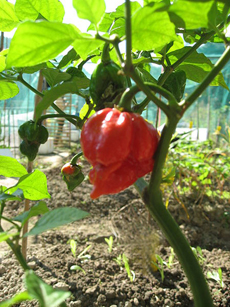
The moruga scorpion chile, from Trinidad & Tobago. Photo by Vicary Archangel | Wikimedia.
|
|
NAGA JOLOKIA CHILE
The naga jolokia chile is from the same species, but a different variety, of the chile used by Tabasco sauce. When ripe it measures two inches long and a half inch wide with an orange color, similar in appearance to the habañero chile. It has gained notoriety as “the hottest chile in the world” with a reported 855,000 SHUs besting the previous record holder, the red savina habañero. However, there was no independent verification of the first test. It grows wild in the army garrison town of Tezpur, in the northeastern state of Assam, India (the red savina is cultivated). It is also called Bih Jolokia in some places of Assam (Bih = Poison, Jolokia = chile pepper; in Assamese). Not to be confused with the bhut jolokia, or ghost chile.
|
|
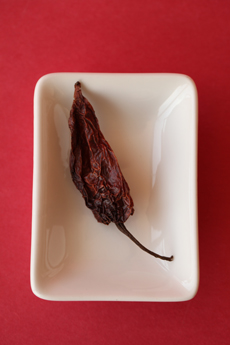
Naga jolokia, the hottest chile. Photo by Jerry Deutsch | THE NIBBLE.
|
|
NEW MEXICO CHILE or CHILE
COLORADO or COLORADO CHILE
A variant of the Anaheim chile. Hotter than the jalapeño, this chile is used to spice soups, rubs, and braised pork.
NEW MEXICO STATE UNIVERSITY CHILE PEPPER INSTITUTE
New Mexico State University's Chile Pepper Institute is the only international, non-profit scientific organization devoted to education and research related to Capsicum or chile peppers, according to information provided by the Institute.
|
|
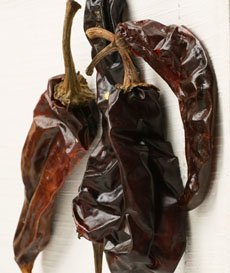
Dried New Mexico chiles are available at iGourmet.
|
NORA CHILE
The dark red nora chile, from Spain, is very mild—1 on a scale of 10—and is sometimes referred to as paprika or pepper. It is large, fat, round, and glossy with a rich, mild, and sweet flavor, and is used to give a deep red color to dishes when added whole or in slices.
|
PAPRIKA
Paprika is a sweet-to-mild variety of the chile (Capsicum annuum, order Polemoniales). It can be elongated or round fruit, bright red, yellow, or green in color. Associated with Hungary, it originated in South America and grows all over the world. In Hungarian, “paprika” refers both to the chile and to processed paprika in its different forms. The ground spice is a favorite seasoning in Hungary, where it is used in stews (the famous goulash), ragouts, stuffings, sauces and as a garnish.
|
|
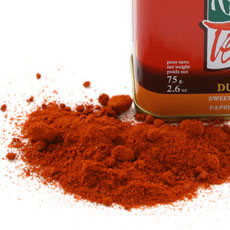
Paprika is available at iGourmet.com.
|
In fact, eight or more different varieties can be purchased there with different levels of pungency, ranging from Special Quality (Különleges), the mildest and brightest red, to Hot (Erös), light brown in color, the hottest of all the paprikas (the hottest paprikas are not the bright red ones, but the palest red and light brown spices). Paprika is also sold smoked, for additional flavor. It is most popularly used as a dry seasoning for meats or root vegetables; in soups, sauces, and marinades; or to provide a beautiful color and flavor, for example, in mayonnaise and dips.
|
PASILLA CHILE or CHILACA CHILE or CHILE NEGRO or POBLANO CHILE
The pasilla chile is a dried chilaca chile. It is dark green in color, turning dark brown upon maturing. It is long (5 to 9 inches in length by about 1-1 1/2 inches wide), wrinkly, dark brown-black, and medium-hot (6 on a scale of 10). Pasilla means “little raisin” in Spanish, and the pepper has a distinctive grape, herbaceous flavor (some say licorice) that lends itself to moles, enchiladas, chicken, duck, lamb, and pork.
|
|
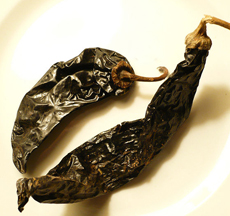
Pasilla chile. Photo courtesy Wikimedia.
|
It can be roasted for a smoky, earthy flavor. Its relatively thin flesh means that it can either be added to dishes whole or in pieces, soaked and pureed or stuffed, sliced into rings, or diced and added raw to a salad, sauce, or salsa. The pasilla is popular in marinades and as a garnish: Scatter finely sliced rings over soup, chili, eggs or other dishes. It is used in mole sauce and chile rellenos; use it to spark a standard enchilada sauce. Because of its dark brown wrinkles, the pasilla is sometimes confused with the ancho chile, a dried poblano, which also shares some raisin flavors. Some people believe the pasilla and poblano to be the same species, but they are not. Dried chilaca = pasilla, dried poblano = ancho.
|
PEPPERCORNS
Peppercorns have no relationship to Capsicums, the species to which chiles and bell peppers belong. Chiles are referred to as “peppers” because of Christopher Columbus. When he first tasted chiles in the new world, he erroneously assumed that the spicy hot flavor was related to the peppercorns he knew from the old world, and called them “peppers.” The Aztec (Nahuatl) word is “chilli.” Hence, chile peppers. Black and white peppercorns derive from the Piper genus, which contains Piper nigrum L., the source of black and white pepper. (See our Peppercorn Glossary for more information.)
|
|
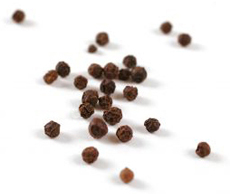
Peppercorns have absolutely no relation to chile “peppers.” Photo by Dora Mitsonia | SXC.
|
|
PEPERONCINI or PEPPERONCINI or
PEPERONCINO or PEPPERONCINO
What sells as pepperoncini (pep-per-own-CHEE-nee) in the U.S. is different from the Italian version. In Italy, the pepperoncino (singular) is a hot red (ripened) chile pepper, from 15,000 to 30,000 Scoville Heat Units. In the U.S., the more popular is the Greek pepperoncino, sweet and golden green in color (and called peperone in Italy). They are found in/on antipasti, Greek and othere salads, pizzas, and sandwiches.
PEPPERS
In the United Kingdom, Ireland, and Canada, as well as the U.S., the heatless pepper varieties are called “peppers,” “sweet peppers,” “green peppers,” or “red peppers.” See also chilli/chillies.
|
|
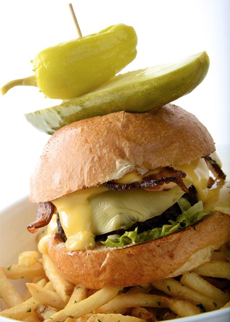
Peppeoncino and a pickle slice garnish a cheeseburger. Photo courtesy Michael Mina restaurant.
|
|
PEQUIN or PIQUÍN CHILE or BIRD CHILE
Pronounced puh-KEEN, the name means “tiny chile.” They average about 1/4" wide by 1/2" long. At maturity, they are bright red and extremely hot, reaching 100,000-140,000 SHUs. The fruit is citrusy with nutty tones; it can be smoked, adding a smoky flavor to the mix. The piquin is used in pickling, salsas, sauces, soups, and vinegars. The Cholula brand of hot sauce lists piquin and arbol chiles among its ingredients. Birds (which don’t feel the heat of capsaicin like mammals do enjoy munching on them; hence the nickname bird chile (not to be confused with bird’s eye chile).
|
|
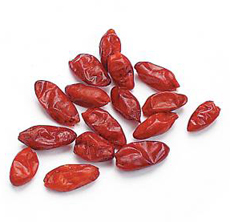
Tiny pequin chiles. Photo courtesy Rice River farms.
|
|
PERI-PERI or PIRI-PIRI or PILI PILI
Also called the African bird's eye chile, is native to Africa. While all chiles are descended from South American cultivars, but peri-peri has grown wild in Africa for centuries. Piri is the Swahili word for pepper. The chile gives its name to a very hot condiment sauce, peri-peri or piri-piri sauce, made with the chiles plus citrus peel, onion, pepper, salt, lemon juice, bay leaves, paprika, pimiento, basil, oregano, and tarragon.
|
|
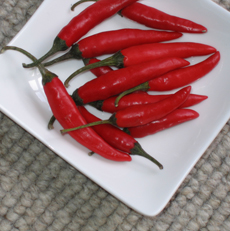
Peri-peri chiles. Photo courtesy Foods & Mouths. Here’s their recipe for homemade peri-peri sauce.
|
|
PIMENTO
The pimento is a variety of large, red, heart-shaped pepper that measures 3 to 4 inches long and 2 to 3 inches wide. Pimiento is the Spanish word for “pepper.” The flesh of the sweet pimento is sweet, succulent, and more aromatic than that of the red bell pepper. They are the red stuffing found in green olives.
|
|
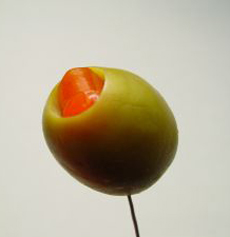
Pimento-stuffed olive. Photo by Snack Admiral | SXC.
|
|
PIQUILLO PEPPER
The piquillo pepper is a variety of chili grown in the Ebro River Valley in Northern Spain. It is not a hot chile, but when packed in vinegar it is tangy. The name means “little beak” in Spanish. in Northern Spain. After harvest, between September and December, artisan specialists slow-roast them over wood fires, which provide a complex, rich, spicy-sweet flavor. They are then peeled and de-seeded by hand and packed whole into jars. They can be served pickle-style with cold cuts and sandwiches, or stuffed with meat, seafood, or cheese as tapas. They are also chopped and added to stuffing for roasts or chicken roulade, added to salads, and mixed with chickpeas and herbs as a side dish. Here are some piquillo recipes.
|
|
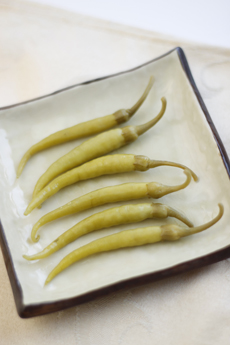
Piquillo peppers. Photo by Elvira Kalviste | THE NIBBLE.
|
POBLANO CHILE
“Poblano” refers to an inhabitant of Puebla, Mexico, the origin of these mild, green chiles. When dried, it becomes the broad, flat, chile known as ancho (meaning wide in Spanish). The chile ranges from three to six inches in length and about two to three inches wide. The immature chile is dark green or purplish green; the ripe chile ranges from red to brownish black. The poblano is popular fried, stuffed, and in mole sauces. It can be prepared a number of ways including dried, coated in whipped egg, and fried, stuffed, or in mole sauces. Chiles en nogada, served during Mexican independence day festivities, is a sophisticated dish. The poblano is filled with picadillo, a mixture of chopped/ground beef, aromatics, fruits, and spices, topped with a walnut-based cream sauce and pomegranate seeds. This produces the effect of the three colors of the Mexican flag, red, green, and white.
Continue To Page 8: Chile Glossary R To Z
Go To Article Index Above
|
|
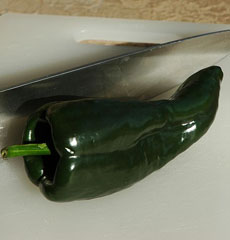
Poblano chile. Photo by P.J. Kid | Wikimedia.
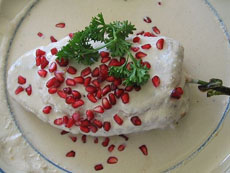
Chile en nogado. Photo by Arturo Sánchez | Wikimedia.
|
Lifestyle Direct, Inc. All rights reserved. Images are the copyright of their respective owners.
|

