Photo glossaries of more than 100 foods and beverages let you explore your favorites. Take a look!
Get all new posts by email:
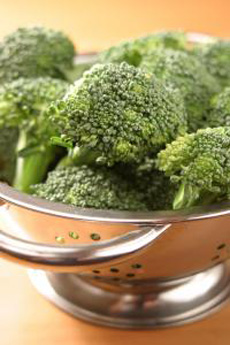
Broccoli is a member of the Brassica genus of vegetables, high in phytochemicals. Other members include bok choy, brussels sprouts, cabbage, kale, kohlrabi, mustard greens and turnips. Photo by Radek Bayek | SXC.
Antioxidant Types: A Guide To High- Antioxidant Foods
Page 2: Glossary Of Antioxidant Terms & Definitions ~ A To E
This is Page 2 of an eight-page article on antioxidant types and terms. Click on the black links below to visit other pages. See all of our food glossaries.
This glossary is protected by copyright and cannot be reproduced in whole or part.
You are welcome to link to it.
ANTIOXIDANT
An enzyme or other organic molecule that reduces the rate of particular oxidation reactions and can counteract the damaging effects of oxygen in tissues. Although the term technically applies to molecules reacting with oxygen, it is often applied to molecules that provide protection from any free radical (i.e., a molecule with an unpaired electron). While new foods seem to appear every day touting higher levels of antioxidants (the latest is the açaí berry from the rainforests of Brazil), the highest level of antioxidant foods generally found in supermarkets are, in order of strength: undutched cocoa powder; bittersweet chocolate (particularly that which has 85% or more in cocoa solids); white tea; green rooibos tea; green tea; red rooibos tea; oolong tea; and black tea.
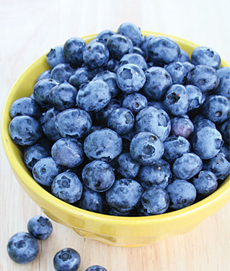
Blueberries. Photo courtesy Burpee.
Some studies claim that the blueberry (especially wild blueberry, a.k.a. bilberry) contains more antioxidants than any other mainstream fruit or vegetable when compared on the basis of equal calories. Others give the top award to Montmorency cherry juice—which does have more calories than blueberries but is accessible year-round. Other fruits and berries that are high in antioxidants include the blackberry, raspberry, cranberry, cherry (especially the Montmorency, also known as the tart or sour cherry), dried plum (prune), dark grapes (including raisins, purple grape juice, and red wine), crowberry (a North American berry that looks similar to a blueberry), kiwi, pomegranate, papaya (a source of vitamin E, lycopene and beta-carotene, three very powerful antioxidants), citrus fruit such as orange and grapefruit (the highest concentration of antioxidants are in the pulp, where the pectin is found); and leafy, dark green cruciferous vegetables (broccoli, brussels sprouts, cabbage, cauliflower, daikon radish, kale, kohlrabi, mustard/chard greens, parsnip, rutabaga, turnip and watercress). See the chart below for a more extensive list.
ANTHOCYANIN
Anthocyanins are members of the flavonoid group of phytochemicals, a group predominant in teas, honey, wines, fruits, vegetables, nuts, olive oil, cocoa, and cereals. They are pigments that appear in flowers, fruits, and leaves as red, purple, or blue. Check out these fruits and vegetables in red, purple, and blue.
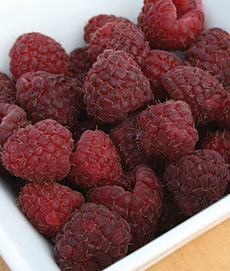
Anthocyanins are responsible for the blue in blueberries and the red in raspberries. Photo courtesy Burpee.
BETA-CAROTENE
Beta-carotene is a red-orange pigment found in plants and fruits. It is a member of the carotenoid group of antioxidants. The name comes from the Greek beta and Latin carota (carrot). The human body converts beta-carotene into vitamin A (retinol). Beta-carotene in itself is not an essential nutrient, but vitamin A is. We need vitamin A for healthy skin and mucus membranes, our immune system, and good eye health and vision. The human body doesn’t manufacture vitamin A, so we must ingest it via food.
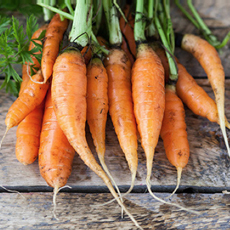
Carrots get their orange color from beta-carotene. Photo courtesy GoodEggs.com.
CAROTENOID
There are some 600 varieties of carotenoids colorful red and orange plant pigments, some of which can be turned into vitamin A by the body. They are powerful antioxidants that can help prevent some forms of cancer and heart disease and act to enhance your immune response to infections. Some carotenoids, such as lycopene, do not convert to vitamin A; although lycopene, found in papaya, tomato, and watermelon, among others, is an antioxidant even more potent than beta-carotene. Lutein is a prominent antioxidant in leafy green vegetables.
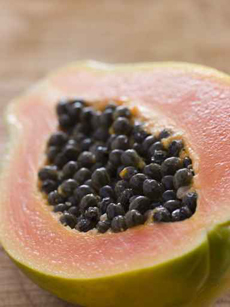
Papaya has even more lycopene than tomatoes. beta-carotene. Photo | Fotolia.
CATECHIN
Biochemically, catechins are monomers (molecules that can be chemically bound as a unit of a polymer) of flavanol, a subclass of flavonoids, which are themselves a subclass of polyphenols. Catechins make up some 25% of the dry weight of a fresh tea leaf. The concentration of catechins is higher in green and white tea†; in black and oolong teas the oxidation process inactivates the catechins. Tea contains four main catechin substances: EC, EG, EGC, and ECGC, all of which are inclusively called “catechin.” Epigallocatechin gallate (EGCG) is the one that is most abundant in tea. EGCG as an antioxidant is about 25 to 100 times more potent than the antioxidant vitamins C and E.
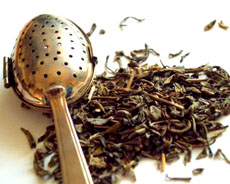
†White tea is substantially more expensive than green tea and has a few more catechins per serving. Photo courtesy SXC.
(Tea flavor, color, and astringency are in part due to the condensation of the catechins to form the bright orange-red pigment thalami.) Researchers believe that catechin is effective because it easily sticks to proteins, blocking bacteria from adhering to cell walls and disrupting their ability to destroy them. Viruses have hooks on their surfaces and can attach to cell walls. The catechin in green tea prevents viruses from adhering and causing harm. Catechin reacts with toxins created by harmful bacteria and harmful metals such as lead, mercury, chrome and cadmium.
EGCG
Epigallocatechin gallate, a specific antioxidant compound found in green tea and elsewhere, is a key biological and biochemical driver for many health benefits, for reasons noted in the “Catechin” definition. It can reduce cancers and tumors, prevent cancer cells from growing, lower cholesterol, help digest excess fat and even protect against the common cold virus. Worldwide studies are ongoing and reports regularly discover new health benefits.
ELECTROLYTE
Electrolytes are substances that have a natural positive or negative electrical charge when dissolved in water. They help the body regulate chemical reactions and maintain the balance between fluids inside and outside your cells, in addition to other benefits.