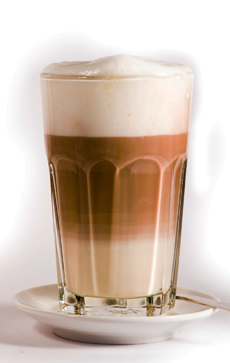
 The popular latte, with a cap of frothy, soothing milk. Photo by Christian Kitazume | SXC.
October 2006
Last Updated February 2026
|
|
Types Of Espresso
Part IV: Espresso Glossary D To Z
This is Page 4 of a four-page article on the types of espresso. Click on the black links below to read the other pages. You can find general coffee terms in our Coffee Glossary, and tons of great food information in our other food glossaries.
Espresso Glossary, D To Z
After you’ve had your fill of espresso, take a look at our other food glossaries—an easy way to get up to speed on more than 50 different food categories.
Click on a letter to go to the appropriate glossary section.
a b c d e f g h i j k l m n o p q r s t u v w x y z
This glossary is protected by copyright and cannot be reproduced in whole or in part. You are welcome to link to it.
DEMITASSE
A cup that holds a traditional shot of espresso is called a demitasse, 3 ounces or smaller. Thick porcelain is the preferred material for its ability to hold heat, although demitasses can be made of delicate porcelain, ceramic, glass, or stainless steel.
DOUBLE or DOPPIO
More than double the typical one-ounce pour. A double is usually between 2.5 and 3 ounces of espresso.
DRY CAPPUCCINO
A cappuccino with a small amount of foam and no steamed milk.
ESPRESSO
The coffee beverage that is produced by an espresso machine. Technically, espresso is a beverage made from 7 grams of finely ground dark roast coffee that produces 1.5 ounces of extracted beverage under 9 bars of brewing pressure at brewing temperatures of around 190°F to 200°F, over a period of 25 to 30 seconds of brew time. In Italy, people don’t order an espresso; rather, they order “un caffè,” which is de facto an espresso brew.
ESPRESSO LUNGO or LUNGO
An espresso shot that’s pulled “long” to maximize caffeine.
|
|
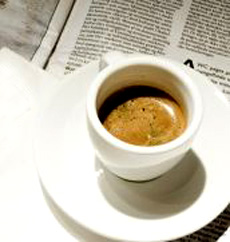
A demitasse of espresso. Photo courtesy SXC. |
ESPRESSO CON PANNA
An espresso shot with whipped cream.
ESPRESSO MACCHIATO
Same as caffe macchiato.
ESPRESSO DOPPIO
A double shot of espresso; doppio is Italian for “double.”
EXPRESSO
A colloquial (and incorrect) spelling of espresso.
EXTRACTION
The act of forcing hot water through ground coffee. This “extracts” flavors, oils, colloids, lipids, and other elements that turn water into brewed coffee.
|
|
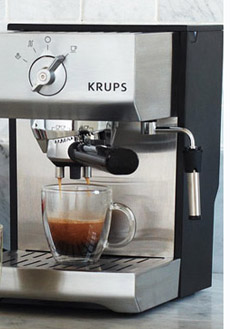
Extraction happens when hot water is forced through ground coffee. Photo courtesy Krups. |
FLAT WHITE
The flat white, a variation of a cappuccino made with microfoam instead of regular foam, was invented in Australia in the 1970s. It is made with a single or double shot of ristretto topped with microfoam, steamed milk with small, fine bubbles and a velvety consistency, made possible by modern milk foaming technology (which also is responsible for barista art). It is made in a smaller cup than a cappuccino, thus delivering a higher proportion of coffee to milk (similar to a cortado). It was introduced in the U.S. by Starbucks in January 2015. In order to allow the coffee flavors to dominate, it is used with a shorter, stronger pull of espresso, known as ristretto. Unlike the thick layer of foam served with a cappuccino (and to a lesser extent, a latte), a flat white has a thinner layer of microfoam.
|
|
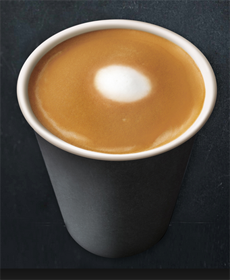
A flat white. Photo courtesy of Starbucks. |
LATTE
See caffe latte.
LATTE MACCHIATO
A cup or glass of steamed milk into which an espresso shot is poured; the top of the milk is marked with a brown dot.
LONG BLACK
Espresso and hot water in equal parts. See also caffe americano.
LUNGO
An extra-long pull (over-extracted shot), about 2 to 3 ounces, that allows approximately twice as much water through the same amount of coffee normally used for a single shot.
|
|
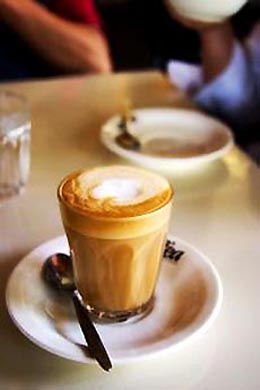
Have a caffe latte, or latte for short. Photo by Eduoard Muoy | SXC. |
MACCHIATO
See latte macchiato, above.
MICROFOAM
Microfoam is created by the steam wand of a professional cappuccino machine, used to foam a pitcher of milk. The combination of the crema atop the cup of espresso and the velvety microfoam allows patterns to be made with the foam (barista art). Other types of mill steamers and foamers do not create the tiny bubbles required for microfoam.
|
|
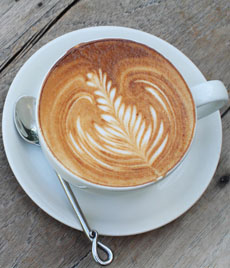
Microfoam enables the creation of delicate designs in the foam. Photo courtesy Hi Line Coffee Co. |
MAZAGRAN
A Mazagran, from an Algerian town of the same name, is believed to be the original iced coffee drink: a blend of coffee, often espresso, with lemon juice, sugar, and sometimes rum or other flavors, served over ice. You can also add fresh mint as a garnish.
If you happen to have lemon simple syrup, you can use it instead of regular sugar. If you want to make some, here’s a recipe.
|
|

Mazagran (Chat GPT Photo) |
MISUGARU LATTE
A multigrain “latte” drink was introduced to the U.S. by the Korean coffee house chain Cafe Bene. High in protein, it’s a healthful drink made from a fresh-ground or pre-packaged powder of barley, black sesame seed, black rice, and brown sugar. The flavor is nutty, with flavor nuances of oatmeal and peanut butter. The texture is grainy.
Here’s a recipe
|
|

Misugaru Latte (photo © Chrisse En Place). |
MOKA POT
Originally, a manual, stovetop method for making strong coffee, although today, electric versions exist. Many of the inexpensive ($50 to $100) consumer “espresso machines” are essentially steam pressure moka pots. Often referred to as an “espresso machine,” it is not one because it does not use high-pressure steam technology (a typical moka pot brews using 1.5 atmospheres or bars of pressure; modern espresso machines use roughly 9 atmospheres). A traditional moka pot brews by forcing hot water through a bed of coffee using the pressure of steam that builds through hot water boiling in the lower half of the pot. Here’s more information, plus the history of the moka pot.
|
|
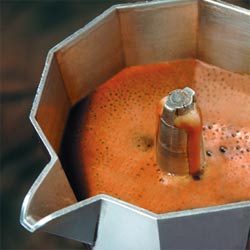
A moka pot. Photo courtesy SXC. |
| NOISETTE or CAFÉ NOISETTE
A French version of espresso that’s topped with a splash of steamed milk or cream. It’s named for its color, which is said to resemble the color of hazelnuts. Steamed milk is creamier than foamed milk. The Noisette is very close to a straight espresso, with just enough dairy to take the edge off of the acidity.
Related drinks include:
- Macchiato, espresso topped with foamed milk. It is stronger than a cortado.
- Cortado, roughly equal amounts of steamed milk and espresso. It is milder than Macchiato and Noisette as it has more milk.
|
|

Café Noisette (Abacus Photo). |
OVER-EXTRACTED
Espresso that tastes bitter or burnt is a result of the ground coffee being exposed to the brewing water for too long. Send it back!
PULL
A term used to describe brewing a shot of espresso: pulling an espresso, pulling a shot, espresso pull, et al. Its derivation is the action used to prepare espresso in machines from the 1950s and beyond, where the barista pulls on a lever to cock a spring in a piston group on an espresso machine.
|
|
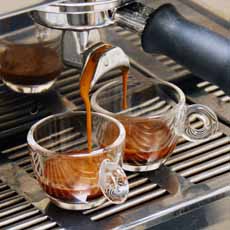
Pulling an espresso. Photo by Mark Prince | Wikimedia. |
RED EYE
A shot of espresso in a coffee cup that is then filled with drip coffee. Also called an Eye Opener, Depth Charge, Hammerhead, and Shot In The Dark. A Dead Eye, also called a Blue Eye, has three shots of espresso. A Crazy Eye has four shots. A Blind Eye has five or more shots. Also see black eye.
|
|

A red eye. Here’s the recipe (photo © Starbucks). |
RISTRETTO
An espresso shot that is pulled short to produce a richer, more intense espresso. The term literally means a “restricted” shot. Most double espresso shots are 2.5 to 3 ounces and use 14 or more grams of coffee grounds. A ristretto uses the same amount of coffee but creates only 1.5 ounces of espresso in the normal brewing period of 25 to 30 seconds. This is hard to do and requires a very skilled barista. In France, this is known as café serré.

Here’s a comparison of ristretto, espresso, and lungo shots. Check out the story at Coffee Circle.
SHAKEN ESPRESSO
A shaken espresso is an espresso shaken in a cocktail shaker or mason jar with ice, and often milk or syrup.
It's a variation of the Italian shakerato, which traditionally includes only espresso, ice, and sugar. In the U.S., versions often incorporate milk or cream for a creaminess that mellows the bitterness of espresso.
Compared to an iced latte—iced espresso with milk—a shaken espresso has one more espresso shot than a regular latte does, and less milk. In addition, the shaken espresso is shaken with a sweetener. The shaking action creates a more frothy drink.
|
|

A shaken espresso made with oatmilk. Here’s the recipe (photo © We Are Not Martha). |
SHAKERATO
The shakerato is the result of shaking chilled espresso with ice and sugar, which creates a thick froth. While every other town in Italy now claims to have invented the shakerato, its origins are unclear, even though it’s a recent creation.
One source traces it to the cafes of northern Italy in the 1990s, as baristas began experimenting with new ways to serve espresso. The drink seems to have developed organically across multiple locations.
Iced coffee in Italy actually dates to as early as the late 1700s; iced coffee was served in Salento, in Apulia—a tradition imported from Valencia, Spain via Algeria. See Mazagran, above.
|
|

A shakerato. Here’s the recipe (photo © Bon Appétit).
|
SHOT
A term for a brewed espresso.
SINGLE
A single shot of espresso, 1 to 1.5 ounces of coffee (a double is 2.5 to 3 ounces).
SPANISH LATTE
Espresso shots are combined with equal parts steamed milk and steamed sweetened condensed milk (instead of having all steamed milk).
SPECIALTY COFFEE
A term coined in 1974 to describe high-quality beans that score 80 points or more on a 100-point scale. In other words, the finest premium coffee.
|
|
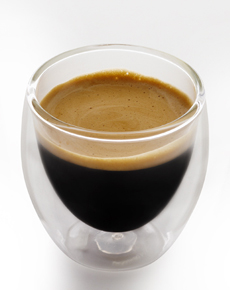
A shot of espresso, also known as a single. Photo courtesy CBTL. |
THIRD WAVE
The third wave of coffee is a current movement that considers fine coffee to be an artisanal food, treating coffee like wine connoisseurship. There is a focus on horticulture, growing regions, varietal qualities, and single-origin (and single-farm!) coffees. The term was coined in the U.S. in 2002 and refers to the creation of a “coffee culture” in the U.S. in the 1990s (but with roots dating back to the 1960s). The “first wave” began in the 19th century with a surge of branded coffee, like Folgers, in every household. The “second wave” was the proliferation of premium-roasted coffee in the 1960s by Peet's and then Starbucks.
UNDER-EXTRACTED
A coffee bed that has not been exposed to enough passing water. The resulting brew is often weak and thin-bodied.
VANILLA LATTE
Latte sweetened with vanilla syrup.
Go To Page 1: History Of Espresso
Return To Article Index Above
This glossary is the property of Lifestyle Direct, Inc. All rights reserved.
|