History Of Sushi
And Japanese Phrases To Use At A Sushi Bar
You can click on the letter of the alphabet in the bar below to get to a term
in our Sushi Glossary
a b c d e f g h i j k l m n o p q r s t u v w x y z
The History Of Sushi
Sushi began in a very different format—and elsewhere in Southeast Asia, in the areas now known as Laos, Myanmar and Thailand—as far back as the 4th century B.C.E. Cooked rice was packed with salted fish and fermented to preserve the fish. Lactic acid, produced from the fermenting rice, helped with the preservation of the fish; after two months the rice, which had deteriorated too much to eat, was discarded and the fish was consumed.
Over time, this technique spread to China, and around the 8th century C.E., to Japan, where it became more of a dish rather than a preservation technique. Its exact arrival in Japan is not known, but an old law document of referred awabi (abalone) and igai (mussel) in the nare-zushi style.
Over time, the dish went from being a longer-term fermentation to something that was prepared overnight to a dish that was served immediately.
| Period (C.E.) |
Sushi Style |
| 700 |
Nare-zushi: Salted fish and cooked rice are multi-layered in a bucket and stored under stone weight to ferment for 2 months to 1 year. Nare means fermented. |
| 1500 |
Nama-nare zushi: Fish are semi-fermented under stone weight until half-raw; the rice is also eaten. Nama means semi-fermented. |
| 1500 |
I-zushi: Cooked rice is stuffed into a carp and pressed under stone weight for several days; both rice and fish are eaten. I-zushi refers to the use of malted rice. |
| 1600 |
Haya-zushi: Vinegared rice and seasoned fish were pressed with under a weight overnight. |
| 1700 |
Hako-zushi: Thin slices of fish and vegetables are placed over rice in a wooden box and pressed by hand with a board; then cut into small rectangular pieces and served. Today, hako-sushi is part of an overall category known as oshi-zushi, pressed sushi. |
| 1800 |
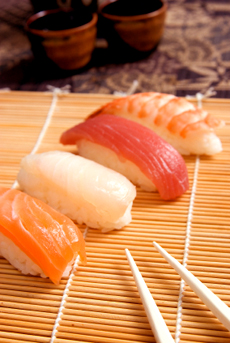
Nigiri-zushi or Edomae-zushi: Balls of vinegared rice (shari) are hand-formed together with slices of raw fish. Originated in Edo, the 19th-century name for Tokyo. Nigiri means hand-forming. |
| 1800 |
Chirashi-zushi and Gomuku-zushi: Fish, vegetables and other ingredients are scattered over rice. Chirashi means spread over; gomuku means mixed ingredients. |
| 1800 |
Maki: Sources attribute the development of this style to Buddhist monks. Maki means roll. |
| 2000 |
Kawari-zushi: Unusual rolls, made with non-traditional ingredients. These include California roll made with avocado, Philadelphia roll made with cream cheese and smoked salmon, spicy rolls, etc. Kawari means unusual. |
Nigiri-zushi, the most popular form of sushi today, originated at the beginning of the 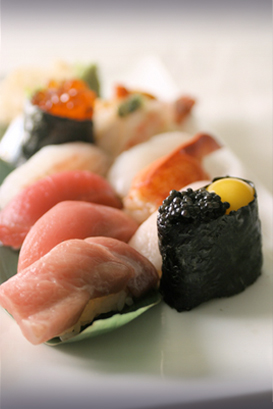 19th century in Tokyo (which was called Edo at the time). The city was dotted with small, mobile food stalls. While other forms of sushi existed, nigiri was developed by a sushi chef named Yohei Hanaya. 19th century in Tokyo (which was called Edo at the time). The city was dotted with small, mobile food stalls. While other forms of sushi existed, nigiri was developed by a sushi chef named Yohei Hanaya.
Nigiri was popular among the people of Edo for a century or so. It spread throughout Japan after the Great Kanto Earthquake of 1923, which displaced many of the skilled sushi chefs. Seeking work elsewhere in Japan, they took their skills with them. Since the 1960s, Japanese immigration to the United States have resulted in restaurants and sushi bars throughout the United States.
Nigiri sushi with two pieces of gunkan sushi (boat sushi) that hold caviar. Photo courtesy of CaviarRusse.com.
Source: Shinoda, Osamu, Sushi no hon (Book of Sushi), 1970.06.25/1993.03.15,
Shibata Shoten, ISBN: 438835189X
Speak To Your Sushi Chef In Japanese
Here are some basic phrases to get a conversation going with your itamae-san, or sushi chef:
Arigato: Thank you.
Domo/Domo arigato: Thank you/thank you very much.
Dozo: Please.
Gochiso-sama [deshita]: Traditional phrase closing a meal.
Hai: Yes.
Itadakimasu: Traditional phrase opening a meal.
Kanpai: The Japanese equivalent of “cheers,” used when drinking.
Konbanwa: Good evening.
Konichiwa: A basic Japanese greeting, equating to “Hello, how are you?”
Oaiso or Okanjo: The check.
Oyasumi nasai: Good night.
Sabinuki: No wasabi.
Sumimasen: Excuse me.
Go To Sushi Glossary
© Copyright 2005-
Lifestyle Direct, Inc. All rights reserved. Images are the copyright of their respective owners.

|