In a Spider Roll, the legs of a fried soft-shell crab extend from both sides of the roll, creating a spidery effect when the roll is cut (photo © Zuma Restaurant | NYC).
July 2007
Last Updated February 2026
|
|
All Types Of Sushi & Sashimi
Page 7: Terms Including Rainbow Roll, Sashimi, Shiso, and Other Terms With Q, R & S
All types of sushi and sashimi, with delicious pictures. If you enjoy this Sushi Glossary, we have a food glossary for almost every category of food. On this page, you’ll find explanations for Rainbow Roll and Salmon Skin Roll, favorite garnishes shiso and shoga, and much more. Check out the Seafood Glossary, too.
| |
Click on a letter to get to the appropriate glossary page.
a b c d e f g h i j k l m n o p q r s t u v w x y z
This glossary is protected by copyright and cannot be reproduced in whole or in part. You are welcome to link to it.
|
|
|
QUAIL EGG or UZURA NO TAMAGO
A raw quail egg yolk is frequently served in a gunkan-maki (boat roll) atop crunchy tobiko, flying fish roe. The creamy egg yolk contrasted with the crunchy fish roe is considered a delicacy. Quail is uzura, egg is tamago.
RAINBOW ROLL
A reverse roll with strips of variously colored fish and often, avocado, placed diagonally across the top of the sushi roll (the Japanese term is tazuna sushi). The inside can be tuna, a California roll, or whatever the chef wishes.
|
|
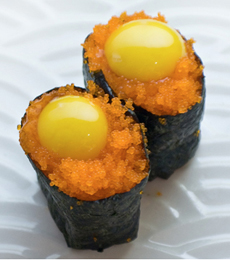
Quail egg and tobiko in a gunkan-maki, or boat roll. Photo courtesy SushiConnection.com. |
The roll was created in Little Tokyo, Los Angeles, in the late 1960s or early 1970s. Evolving from the California roll, it was designed to be more visually appealing by covering the rice-out roll with different colors of sashimi, specifically tuna, salmon, yellowtail, and avocado.

Rainbow roll (Abacus Photo)
|
RED CLAM or AKA-GAI or ARK SHELL or COCKLE
Red clam is imported frozen from Japan. The red color comes from hemoglobin in the flesh. It is a tradition to rinse the clam in rice vinegar prior to serving, since some people find the natural scent of the clam to be strong. However, over time, people have become accustomed to it. Ask the sushi chef if it has been rinsed, just so you’ll know if you are tasting vinegar or the natural flavor of the clam.
|
|
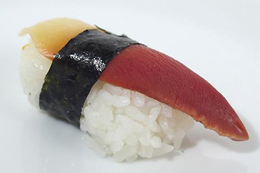
Red clam. Photo courtesy MorgueFile. |
|
RENKON
Lotus root (photo at right).
RICE BALL
See onigiri and musubi.
|
|
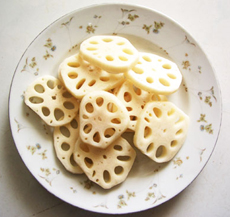
Lotus root. Photo courtesy Made-In-China.com. |
|
ROE
Fish eggs, or caviar. You can make a “roe tasting” of ikura (salmon roe), kazunoko (herring roe), masago (smelt roe), mentaiko (spicy cod roe), tarako (Alaska pollock roe), tobiko (flying fish roe), and uni (the gonad of the sea urchin). Don’t forget to add uzura no tamago (quail egg) on top of either tobiko or uni—or any of the others.
|
|
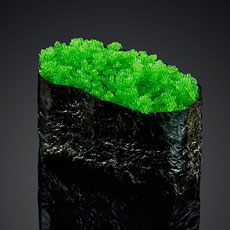
Gunkan (boat) maki with wasabi tobiko. |
|
SABA (MACKEREL)
Mackerel is not served completely raw, but is one of those fish that is cured in rice vinegar with some salt because it can carry parasites and spoils quickly.
Different types of mackerel can be found at sushi bars, including aji (Spanish mackerel also called horse mackerel), sanma (Japanese mackerel), and sawara (Spanish mackerel).
The traditional preparation, shime-saba (cured mackerel in English), is commonly salted and then marinated in rice vinegar to kill parasites and improve shelf life and flavor.
This process changes the texture and taste, giving mackerel a distinctive sour-savory profile.
Even today, mackerel is rarely served completely raw unless it has been frozen properly per health regulations (see them here).
Fresh mackerel, not marinated, is saba-no-tataki. Also see Sawara, below.
|
|

Saba, or mackerel, nigiri sushi (photo © Kissaki).

Saba sashimi (photo © OKS Food). |
SABINUKI
This term means “without wasabi” (if you’d like to request your sushi with no wasabi).
|
SAKE
Salmon, pronounced SAH-keh, has glistening orange flesh, which makes it one of the more colorful pieces on the sushi or sashimi plate. It has a wonderful, unctuous texture like toro and yellowtail, but (along with mackerel) much higher levels of Omega-3 essential fatty acids. In addition to being served plain and in spicy salmon rolls, the skin of the salmon, which tastes very different from the flesh, is often grilled and served in a hand roll (temaki).
Wild salmon is one of the species known to carry Anisakis and other parasites. With this knowledge, in Japan, salmon was not traditionally used raw in sushi until relatively recently (the late 20th century). Where it was used, it might be lightly cured or smoked.
Today, most salmon for sushi (especially in the U.S. and Europe) is farmed and flash-frozen to kill parasites, which makes it safe to serve raw. (The FDA requires all fish that are served raw or undercooked to be frozen first. The details.)
In Japan, Norwegian salmon was key in popularizing raw salmon in sushi through marketing efforts in the 1980s.
|
|
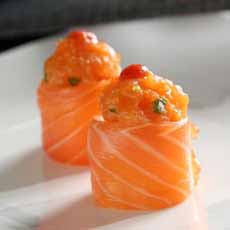
Sashimi: salmon wrapped around spicy salmon. Photo courtesy Sushi.org.pt.

Salmon nigiri, garnished with snipped chives and finger lime pearls (photo © Wildtype Foods).
|
|
SAKÉ
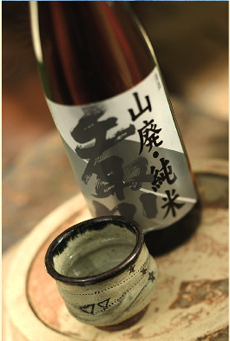
Pronounced sah-KAY. Distilled rice wine, pronounced sah-KEH. It is served hot or cold, depending on the quality. Note that, unlike regular wine, saké is a distilled product and meant to be drunk young, not aged. Read more about saké in our Introduction To Saké article and our Saké Glossary.
SAKURA-MASU
Ocean trout.
SAKURA ROLL
Named for the pink cherry blossom, a sakura roll is made with a wrap of pink beancurd (soy paper). The contents can be whatever the chef or the client wishes: fish or vegetables.
SALMON
See sake, above.
|
|
Salmon nigiri sushi. Photo courtesy Genji Sushi.
|
|
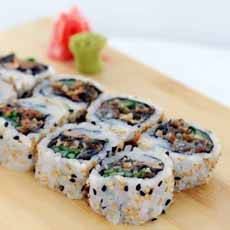
SALMON SKIN ROLL
The skin of smoked salmon is broiled and served, hot and crunchy, generally with cucumber, in a hand roll (temaki). It can also be served in a regular roll (maki), and we have seen grilled salmon skin served sashimi-style, on a plate with no rice. A concept invented in America, salmon skin is considered a delicacy, although prior to its adoption by sushi chefs, the skin was thrown away.
|
|
Salmon skin roll. Photo Sushi Haven | U.K.
|
|
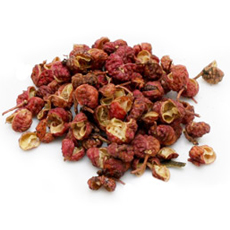
SANSHO
Called sansho in Japan, this is Sichuan (or Szechuan) pepper. It is not true pepper, like black peppercorns. The outer pod of the tiny fruit is harvested from a number of species of evergreen shrubs in the genus Zanthoxylum, known as the prickly ash. Learn more about types of pepper in our Varietal Peppercorn Glossary.
SANMA
Japanese mackerel.
|
|
Sansho, or Szechuan pepper. Photo courtesy Sansho Daiko.
|
|
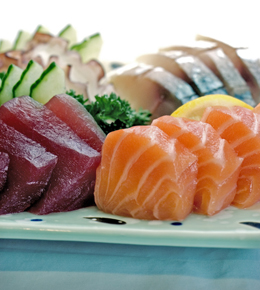
SASHIMI
Sliced raw fish that is generally served with a bowl of plain, steamed rice (not sushi rice, which is prepared with vinegar and sugar). The word literally means “pierced body.” No one is certain of the origin, but it may have come from the former practice of sticking the tail and fin of the fish on the slices, to let it be known which fish one was eating. Regardless, it must be interesting for a native Japanese speaker to order a “pierced body” platter. While there is no rice implied in the term sashimi, it is generally served with a bowl of plain, boiled white rice.
|
|
Sashimi. Photo © Directphoto |
Dreamstime.
|
|
SASHIMI-GRADE FISH or SUSHI-GRADE
FISH
See grade of fish.
SAYORI
Springtime halfbeak, a fish not often found in the U.S.
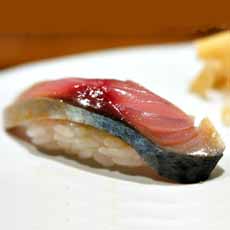
SAWARA
Spanish mackerel. See also aji.
SEA BASS
See suzuki.
SEA BREAM
See madai.
|
|
Spanish mackerel, sawara in Japanese (photo © Sushi 311).
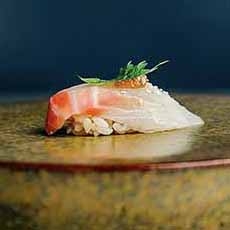
Sea bass, or suzuki (photo © Kissaki | NYC).
|
|
SEA URCHIN
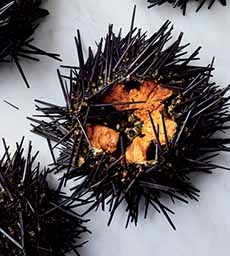
Sea urchins (uni in Japanese) are small, spiny, globular animals related to sand dollars. Because they are a challenge to harvest, they are one of the more expensive items at the sushi bar.
There are different species, with shades from black to blue, brown, green, purple, and red. The name “urchin” is an archaic word for hedgehog, which the spiny sea urchins resemble (photo below). Also, see uni.
|
|
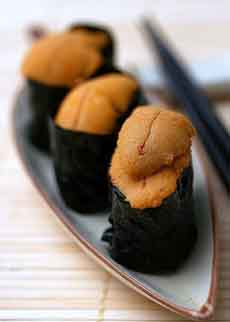
Above: uni, sea urchin roe, in gunkan-maki (boat rolls, photo copyright Beryl | Three’s Company | Flickr). At left: the roe seen in a halved sea urchin shell (photo above © Santa Alicia Winery, photo at left © 50 Best Things To Eat & Drink Right Now).
|
SEIGO
Young sea bass.
|
SENBEI
Thin, crisp rice crackers, flavored with soy sauce (or other seasonings). Senbei can be crumbled and added to sushi rolls for crunch, flavor, and decoration, in the manner of panko.
SHAKO
Mantis shrimp are feisty crustaceans that are neither shrimp but get their name from their combined resemblance to shrimp and the praying mantis. About 12 inches in length, they have powerful claws that they use to kill prey, and can snap a finger from a diver. Mantis shrimp have been known to break through aquarium glass with a single strike from a claw.
|
|
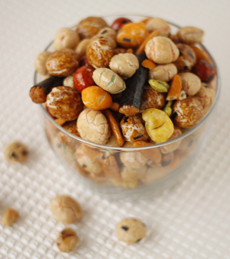
Rice crackers, or senbei. Photo by Elvira Kalviste | THE NIBBLE.
|
SHAMOJI
A plastic or wooden flat spoon that’s used to scoop and serve rice.
SHARI
A sushi bar term for sushi rice.
|
SHICHIMI TOGARASHI or
NANAMI TOGARASHI
Literally, “seven flavor chili,” the components of this Japanese spice blend, used as a table spice, vary by region. One of the most popular table seasonings in Japan, it is used to add both heat and flavor to everything from beef tataki to rice, soba noodles, and udon.
The seven spices can include black, white, and toasted sesame seeds; cayenne; ginger; nori; shiso seeds; and Szechuan pepper. Here’s more about it, plus recipes.
SHIMA-AJI
Striped horse mackerel. This variety of horse mackerel, caught by pole off the Izu Peninsula, is possibly the best mackerel in Japan. The generic name for all mackerel is aji (photo).
|
|
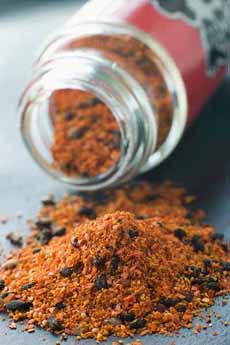
Shichimi togarashi, or Japanese seven-spice, is available at many supermarkets. McCormick makes a version (photo Yahoo | Colourbox).
|
|
SHIME-SABA
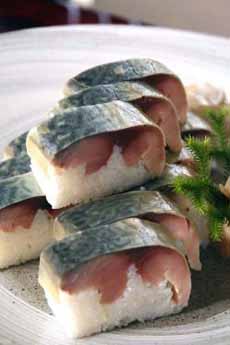
Marinated mackerel for raw consumption, as opposed to fresh mackerel for cooking (saba-no-tataki). Raw mackerel is marinated to cure it, both as a spoilage preventative (some fish spoil more quickly) and as an anti-parasitic.
The photo at right shows a beautiful cross-section of mackerel-pressed sushi (oshizushi), with its silvery skin and rosy flesh.
Also see kaninohazushi, where persimmon leaves are additionally used to cure mackerel.
SHIRAKO or MILT
Shirako is the sperm sac of fish, also known as milt. It is a luxury product, seasonal, and very pricey. The sac is typically left intact; the insides have a soft, creamy texture, which some find similar to brains or soft cream cheese. The sac is cooked to eliminate the toughness. It can be steamed, tempura-fried, or served raw, out of the sac, like uni. Shirako is also served as a garnish on chawanmushi, an egg custard.
SHIRAUO
Whitebait, served as several tiny whitebait fish in a gunkan-style boat wrap.
|
|
Albacore tuna. Photo courtesy SushiConnection.com.
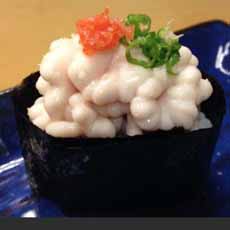
A shirako gunkan-maki. Photo courtesy Sushi Bar Maumi | Vancouver.
|
|
SHIRO-GOMA
White sesame seeds (shiro=white, goma=sesame seeds).
SHIRO-MAGURO
Albacore, or white, tuna. Not to be confused with escolar, a problematic fish that is often sold as “white tuna.”
SHIROMI-DANE
Literally, white meat (shiro=white, dane=meat). About a dozen varieties of sashimi and sushi fish fall into this category, including hamachi (yellowtail), hirame (flute/flounder/halibut), kanpachi (older yellowtail), karei (flounder), shiro-maguro, above, and tai (snapper).
|
|
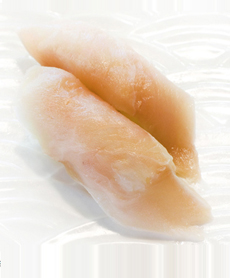
Albacore tuna. Photo courtesy SushiConnection.com.
|
|
SHISO or PERILLA LEAF
Perilla is a genus of herb that is a member of the mint family, Lamiaceae, and is grown primarily in East Asia and India. Its botanical name is Perilla frutescens var. japonica, and it has a fennel-mint-like flavor (in Nepal and parts of India, it is called silam and is also called ohba). In North America, perilla is called by its Japanese name, shiso, since most people have made its acquaintance through sushi bars. There are both green-leafed and purple-leafed varieties. Red shiso is slightly less spicy than green shiso, with an anise flavor. The Japanese use it to color umeboshi (plum paste) and shoga (pickled ginger), as a seasoning with tofu (bean curd) dishes, and wrapped around pieces of meat, as green shiso is wrapped around raw fish.
|
|
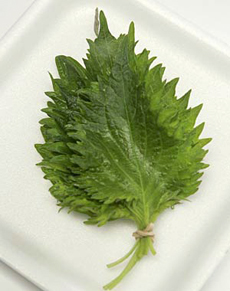
Shiso leaf. Photo courtesy AsianHealthSecrets.com.
|
In addition to sushi and sashimi, green shiso is added to soups, fried in tempura or dried and sprinkled over rice. The shiso leaf may be viewed by some Americans as a decorative garnish, but it is a delicious and costly addition to a sashimi plate (or to a sushi roll: negi-hamachi-shiso, yellowtail with scallions and shiso leaf, is an exquisite combination). In addition to its flavor, shiso is rich in calcium and iron and has anti-inflammatory properties. Along with the leaves, the flower buds and the seeds collected at the end of the season are sprinkled on salad and rice. The seeds are often added to shichimi, the “seven spices of Japan,” a blend that was developed more than 300 years ago in Kyoto.
|
SHOGA
Ginger root. Many people erroneously learn this as the word for pickled ginger when they ask for the word for “ginger” at a Japanese restaurant. However, they mean to ask for the word for “pickled ginger,” which is gari.
There is a separate type of shoga, beni-shoga, that is colored red and cut into small, thin strips as a garnish for food other than sushi.
|
|
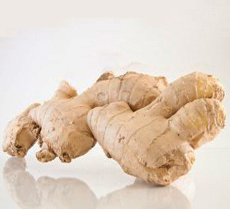
Shoga, ginger root. Photo by Jan Schone | SXC.
|
|
SHOYU (SOY SAUCE)
Soy sauce is a salty sauce made from fermented soybeans. There are all levels of quality, from “supermarket level” to artisan soy sauces. As with any other product, you can taste the difference. The finest soy sauces aren’t merely salty: You can taste a winey flavor and the beans themselves. Usukuchi shoyu is “light” soy sauce. Check out our reviews of the best soy sauces.
A word about aged soy sauce:
Aged soy sauce differs from everyday soy sauce in key ways:
- Aging: It’s fermented for much longer periods, often 2-5 years, compared to the 6 months to 2 years for regular soy sauce. Some premium aged varieties ferment for decades.
- Complexity: The extended aging process creates deeper, more nuanced flavors. Aged soy sauce develops rich umami notes, subtle sweetness, and complex layered tastes that regular soy sauce lacks. It's less salty and harsh, with a smoother, more rounded profile.
- Color and texture: Aged varieties are typically darker and may be slightly thicker due to the concentration that occurs during long fermentation. The color ranges from deep brown to nearly black.
- Production methods: Aged soy sauce often uses traditional brewing methods in wooden barrels or ceramic crocks, while everyday soy sauce is frequently made using faster, industrial processes with added chemicals to speed fermentation.
- Price and availability: Aged soy sauce commands premium prices due to the time investment and smaller production volumes. It's considered a specialty ingredient rather than an everyday condiment.
|
|
 |

Soy sauce is made from fermented soybeans. Check out all the different types of soy sauce at the link (photo © Webstaurant Store).

A premium barrel-aged soy sauce like Yamaroku Tsurubishio costs $40 for 500ml. Often considered the gold standard for aged soy sauce, their flagship “Tsurubishio” is aged 3-5 years using traditional barrel fermentation in cedar kioke barrels. Find it here (photo © Omakase Tokyo).

Momofuko barrel-aged soy sauce is steeped with kombu for 48 hours for a great depth of flavor. It’s $12 for 8 ounces and used on is great on braised meats and in marinades plus with sushi and other recipes. You can get it here (photo © Momofuko Goods). |
While regular soy sauce works well for cooking and as a table condiment, aged soy sauce is often used more sparingly as a finishing sauce or for special dishes where its complex flavor can shine. The aging process concentrates and mellows the flavors, creating a sophisticated condiment that’s prized in high-end cooking, particularly in Japanese and Chinese cuisine.
|
SHRIMP
See ebi, ama-ebi, and odori-ebi.
SOBA
Buckwheat noodles.
SOBA-ZUSHI
Sushi that’s made with soba instead of rice.
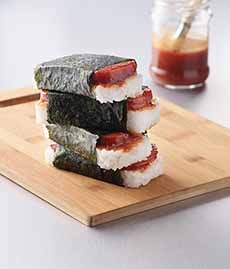
SPAM MUSUBI
These photos may look like SPAM sushi, but sushi requires vinegared rice, and this rice has no vinegar. Instead, musubi rice is the same as onigiri, a Japanese rice ball (made in different shapes) that’s made with regular steamed rice, no vinegar. Meat, fish, or vegetables are tucked inside the rice. Here’s more about it, plus recipes. August 8th is National SPAM Musubi Day, following July 31st, National SPAM Day. The history of SPAM musubi and 25+ SPAM musubi recipes.
|
|
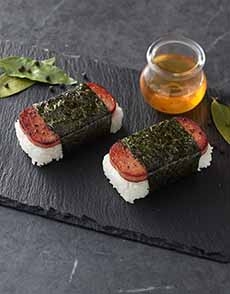
Conventional SPAM musubi (photos © SPAM Brand Institute).
|
|
SPICY TUNA ROLL
In this American invention, originally developed to hide the discoloration of older tuna, toubanjan (Chinese hot paste) and shichimi (red pepper flakes) are often blended into mayonnaise and mixed with the chopped fish. An American chile pepper sauce like Tabasco, mixed with mayonnaise, or plain hot chile oil, or hot chile oil, can be used instead. The dish became so popular that spicy salmon, spicy scallops, and spicy yellowtail are now commonly found.
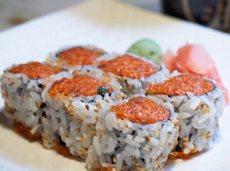
A conventional spicy tuna roll blends chopped tuna with hot sauce or spicy mayonnaise (photo © Ten Zan | NYC).
|
|
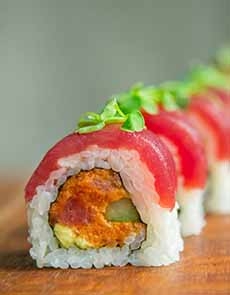
A fancier spicy tuna roll, topped with a slice of regular tuna (photo © Sushi Den | Denver).
|
|
SPIDER ROLL
An American invention, this is a roll, often prepared in the uramkai (inside-out) style, consisting of tempura-fried soft-shell crab and vegetables. The legs of the crab stick out at either end of the cut roll, resembling the legs of a spider (well, a very tasty spider).
|
|
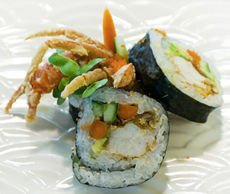
Spider roll. Photo courtesy SushiConnection.com.
|
|
SQUID
See ika.
SU
Rice vinegar. Part of the derivation of the word, sushi. Rice is shi in Japanese. (Photo at right.)
SUIMONO
A clear soup that’s based on fish stock. It is generally offered as an alternative to miso soup prior to the sushi or sashimi course.
SUJI
Toro sinew, that’s served grilled.
SUKIMI
These are bits and pieces of fish that are scraped from the bones of salmon, tuna, and yellowtail to be used in rolls.
|
|
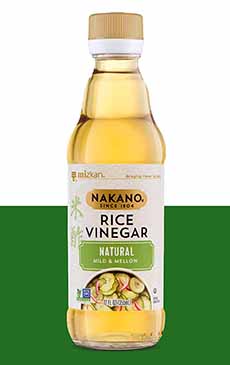
Su, rice vinegar (photo © Nakano Flavors).
|
|
SUNOMONO
Vinegared foods, as distinguished from aemono (a puréed tofu dressing/sauce) or oshinko (pickled vegetables). A sunomono “salad” of vinegar-marinated bean sprouts can often be found on Japanese restaurant menus.
SURF CLAM
See hokkigai.
|
|
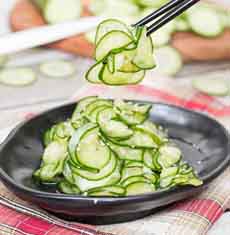
Cucumbers marinated in vinegar are a type of sunomono. Here’s the recipe from Cooking the Globe.
|
|
SURIMI
Surimi refers to a paste made from inexpensive fish, flavored, colored, and shaped to look like a more desirable ingredient. It’s made in many shapes, forms, and textures. The most commonly found variety in the U.S. is imitation crab meat, also sold as crab stick, mock crab, and sea leg, and in kamaboko, fish sausage.
The earliest surimi was developed in Asia centuries ago (more). There is also meat surimi, made from ground meat and poultry. And artistic surimi: Take a look at these beauties.
|
|
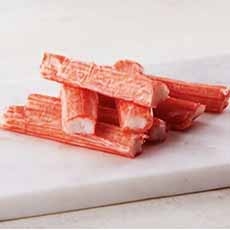
Crab leg surimi (photo © Fresh Direct).
|
|
SUSHI
A variety of preparations that are made with vinegared rice. Contrary to popular opinion, sushi does not mean “raw fish,” but “vinegar rice”: su = vinegar, shi = rice. See Zushi for issues of correct spelling. There is vegetarian sushi as well as sushi made with cooked fish and with raw and cooked meat. The main types of sushi are maki sushi (rolls, including temaki and hand rolls), nigiri sushi (slices of fish on pads of rice), and oshi-sushi (rice with fish and other toppings molded in a wooden box and cut into bite-size rectangles or squares). The photo at the left shows, clockwise, salmon and tuna sashimi, cucumber and tuna rolls (maki), and four nigiri: shrimp, yellowtail, salmon, and tuna.
|
|
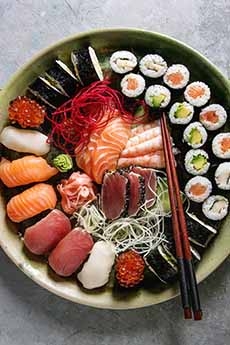
A classic presentation of sushi and sashimi (photo © Yummy Mummy Kitchen).
|
SUSHI BAR
In Japan, the sushi bar is a relaxed and informal alternative to a restaurant. True aficionados sit at the actual sushi bar on a stool, watching the itamae (sushi chef) prepare the selections.
|
SUSHI BURRITO or SUSHIRRITO
In the mash-up food culture of 2014-2015, the sushi burrito joined the ranks of the Bruffin (brioche and muffin), the Cragel (croissant and bagel), the Creffel (French crepe and Belgian waffle), the Cronut (croissant and donut), the Scuffin (scone and muffin), and the Wookie (waffle and cookie). Two fast-casual concepts—Sushirrito in the San Francisco area and Komotodo Sushi Burrito in Denver—launched overstuffed Mexican tortillas packed with sushi ingredients as well as cooked foods (chicken, fish, steak).
|
|
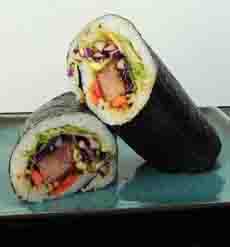
A sushi burrito with grilled sirloin steak. Photo courtesy Komotodo Sushi Burrito.
|
SUSHI-DANE
The type of “meat” (i.e., fish): white meat, red meat, and “shining fish” (silvery meat, hikari-mono).
SUZUKI
Sea bass. Also called black sea bass, the fish has a delicate white color with red stripes on the skin. The flavor is delicate as well.
Continue To Page 8: Definitions T - Z
Return To Alphabet Index Bar Above
|