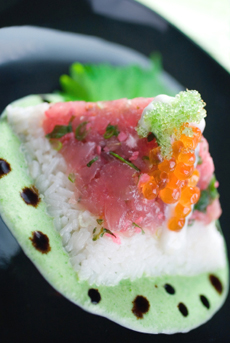
 For some people, heaven is a Kobe steak; for others, it’s exquisite sushi like this tuna tataki (the equivalent of tartare) with ikura (salmon roe), wasabi-flavored tobiko (capelin roe), and nori flakes (seaweed). Photo by Kelly Cline | IST.
July 2007
Last Updated June 2026
|
|
|
Types Of Sushi Sashimi
And A Glossary Of Sushi Sashimi Terms
Sushi has gone from being an exotic food to one that is found almost everywhere in America. Learn the types of fish and much more in our comprehensive guide to sushi and sashimi.
Jump to the glossary below.
The Difference Between Sushi And Sashimi
Sushi is a dish made of vinegared rice combined with seafood, vegetables, egg, and, in the world of nouvelle cuisine, other items from beef to barbecue chicken. Sushi does not mean “raw fish,” but “vinegar[ed] rice.” While much of the fish used to make sushi is raw, some of the items are blanched, boiled, broiled, marinated, or sautéed.
Sushi was originally developed as a snack food—as the story goes, to serve at gambling parlors so the gamblers could take quick bites without stopping the action. There are different styles of sushi:
- Nigiri-sushi, slices of fish or other foods on pads of rice (nigiri means hand-formed).
- Maki-sushi, rolled sushi (including hand rolls, temaki—maki means roll).
- Chirashi-sushi, fish and other items served on top of a bowl of vinegared sushi rice (chirashi means to scatter).
- Oshi-sushi, squares or rectangles of pressed rice topped with vinegared or cooked fish, made in a wooden mold (oshi means pushed or pressed).
- Stuffed sushi, including chakin-zushi or fukusa-sushi, ingredients wrapped in a thin egg crêpe, and inari-sushi, with ingredients stuffed into a small pouch of fried bean curd (tofu).
- Sashimi is sliced fish that is served with a bowl of regular boiled rice on the side (the word means “pierced body,” and may derive from the culinary practice of keeping the fish’s tail and fin with the cut slices to identify the fish being eaten.
While this is not meant to be a glossary of Japanese food in general, we’ve included definitions of other items that often accompany a sushi meal. We have not included definitions for every type of fish, but only those that are generally available in the U.S. We’ve also included some phrases to say to the sushi chef. If you’d like to suggest additional words or think we should consider other definitions than those we have provided, let us know. You may also enjoy one of our 60-plus other food glossaries, including the Seafood Glossary.
Note Re Names
In the U.S., Japan, and elsewhere, many fish are called by their local names. Thus, Pagrus major, the botanical name for what is variously called red snapper or sea bream in the U.S., is madai in Japan. What is called mebaru in some areas of Japan is called rockfish in the Northwest and western Canada.
We’d love to find a source that has all the names of the top 20 raw fish varieties. But the bottom line is: Understand that names vary, and if you really want to know, search online for the various names, especially the botanical name, which ensures they’re the same fish.
| |
Click on a letter to go to the appropriate glossary section.
a b c d e f g h i j k l m n o p q r s t u v w x y z
This glossary is protected by copyright and cannot be reproduced in whole or in part. You are welcome to link to it.
|
|
|
ABALONE or AWABI
The “king of clams” has exquisite pearlized coloring on the inside of its shell (which is used to make jewelry and decorative items). The meat has a crisp, chewy texture and briny flavor and is prized as a luxury item.
Abalone is a mollusk, a large sea snail with a distinctive, flattened, ear-like shell and a colorful mother-of-pearl interior. Its shape has given it the nicknames It is most commonly called the Sea Ear or Ear Shell.
It uses its giant muscular foot to cling tightly to rocks and reefs. This is the part that is eaten. Because the foot is so dense, it is usually sliced into “steaks” and pounded with a mallet until the muscle fibers break down.
Prized for its unique texture and briny flavor, abalone is served as nigiri or sashimi.
It can also be cooked. It might have a specific preparation like simmering (ni-awabi), or could be paired with its guts (kimo-joyu) for added richness.
It can be garnished with kimo-joyu, a sauce made from the abalone’s liver (kimo) mixed with soy sauce, butter, and mirin. The liver is considered the most flavorful part of the mollusk and is a prized ingredient for making the rich, buttery sauces. Kimo-joyu is incredibly creamy, briny, and earthy, with a deep umami punch that enhances the relatively mild flavor of the muscle.
|
|

Awabi, or abalone, nigiri sushi (Gemini Photo).

Above, a whole abalone before being removed and sliced. Below, the inside of an abalone shell (Gemini Photos).
 |

Sliced abalone sashimi served in its shell (photo © Mister Crab).
|
ABURA-AGE or ABURAAGE
A rectangular, twice-fried slice of bean curd (tofu) that is sliced open to create a pouch that holds a filling. It is used in inari sushi. They are prepared by cooking the bean curd in mirin (sweet cooking saké), shoyu (soy sauce), and water.
It is made by thinly slicing firm tofu and deep-frying it twice, first at a lower temperature to expand it, and then at a higher temperature to form a golden crust. The double-frying creates a hollow, spongy texture that soaks up flavors well. It can be added to miso soup or served as a topping for udon noodles in a dish called kitsune udon.
When the tofu pouches are simmered in a sweet and savory broth of soy sauce, mirin, sugar, and often dashi, they are stuffed with sushi rice and other ingredients to become inari sushi. (sushi rice pouches),
The name inari comes from Inari ĹŒkami, the Shinto deity of rice and prosperity. Foxes are believed to be the deity's messengers and have a fondness for fried tofu, hence the reference.
While the deity is ancient, inari sushi as a specific dish appeared during the late Edo period (late 18th to mid-19th century). It was originally a cheap, portable “fast food” sold (as with other sushi) by street vendors, especially near theaters. Historically, people would leave fried tofu as an offering at Inari shrines to pray for a good harvest.
|
|

Aburaage, ready to be stuffed (SmarterPix Photo).
Stuffed with seasoned sushi rice with optional fish or vegetables, aburaage becomes inari sushi (Gemini Photo). |

The pockets of aburaage are filled with sushi rice and other items to create inari sushi (photo © Tasty Island Hawaii).
AEMONO
A purée of tofu and seasonings, used as a dressing or sauce for other dishes.
|
AGARI
While the Japanese word ocha refers to all tea, agari is a lower-grade tea given away at lower-end sushi bars. It is not a whole leaf, but made of a mix of the residual dust, fannings, leaf particles, and bits of stem broken off and sifted out during the processing of quality teas, like gyokuro or sencha (paradoxically, it’s low-quality tea from high-quality leaves).
The tiny particles of tea that pass through a strainer give the tea a strong green color and an intense flavor. The flavor is also bitter, a taste that complements the flavor components of sushi and sashimi very well.
|
|
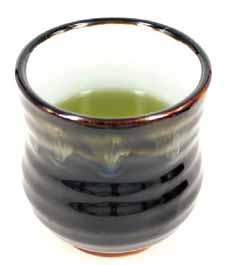
Agari green tea. Photo courtesy Dengonet.
|
AGEMONO
Any deep-fried or pan-fried food.
|
AJI
Spanish mackerel, also known as horse mackerel. It is fillet marinated in vinegar to cure it before serving. Also called sawara.
AJI-NO-MOTO
The largest brand of monosodium glutamate (MSG) in Japan. The word has become a generic, like Kleenex and Sanka in the U.S.
|
|
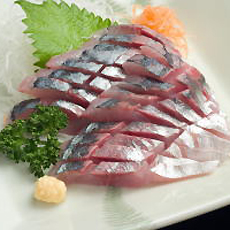
Aji fillet, Spanish or horse mackerel. Photo courtesy OKSFood.
|
|
AHI
Ahi tuna is also known as big-eye and yellowfin (not to be confused with yellowtail, or hamachi, which is not tuna but a different species). Ahi is a very popular sushi and sashimi fish. It is also used for tuna tataki (see photo at top left) and tuna tartare. When American restaurants offer an entrée of seared tuna, it is often ahi.
AKAGAI
Red clam or ark shell. Ark clam is the common name for a family of small to large-sized saltwater clams. They vary both in shape and size. The family comprises some 200 species worldwide. (photo courtesy PopDish.Blogspot.com).
AKAMI
Red meat tuna.
|
|
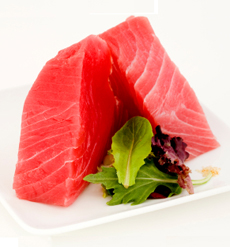
Ahi tuna, also known as big-eye and yellowfin. Photo by Robert Simon | IST. Below: akagai.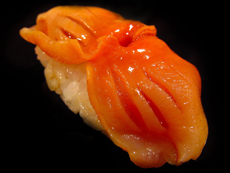 |
|
ALBACORE TUNA
High-fat and rich in omega-3 fatty acids, the albacore has the lightest flesh (white with a hint of pink) and is the only tuna with meat that can be called “white tuna” in the U.S. Its prized white flesh and mild flavor make it prized for both sushi and canning; it is the most expensive canned tuna, with comparisons to chicken (this earned it the sobriquet “chicken of the sea” and created a major brand of the same name). Charlie the Tuna was an albacore. Albacore tuna are commonly 80 pounds and can reach 200 pounds. Albacore goes by other names in different countries, including longfin and bonito del norte.
|
|
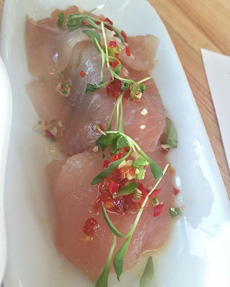
Albacore tuna sashimi. Photo courtesy Herringbone Restaurants. |
|
AMA-EBI
Sweet shrimp, served raw. If it is served with the deep-fried shells of the shrimp, the shells are to be eaten as well.
AMBERJACK
A more mature hamachi or yellowtail.
AMERICAN SUSHI
California rolls, Philadelphia rolls, spicy rolls, spider rolls, and even salmon skin rolls were born in the U.S.A. Read more about them under the individual listings.
|
|
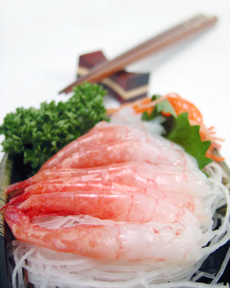
Ama-ebi, sweet raw shrimp. Photo by Radu Razvan | IST. |
|
ANAGO
Saltwater eel, a.k.a. conger eel. Saltwater eel is less fleshy and less rich than freshwater eel (unagi), but “richness” is a relative term: As apple lovers enjoy different varieties of apples, eel fanciers welcome both types. Eel is not served raw, but is pre-boiled and then freshly grilled prior to serving. In Japan, each restaurant is judged by its anago, since the recipe each uses to steam, boil, marinate, and grill differs. Most of our anago supply comes from Japan.
ANA-KYU-MAKI
Conger eel and cucumber rolls (the saltwater eel, anago).
ANKIMO (MONKFISH LIVER)
Ankimo is considered one of the great delicacies in Japanese cuisine. Often called “the foie gras of the sea,” ankimo has a rich, creamy, buttery texture and a deep umami flavor.
The cleaned liver is typically seasoned with saké and a small amount of salt. It’s then tightly wrapped in plastic wrap or cheesecloth to form a compact cylindrical (sausage-like) shape, steamed, and chilled.
It is usually served chilled, sliced into rounds, and plated with ponzu sauce, grated daikon radish, and scallions.
|
|
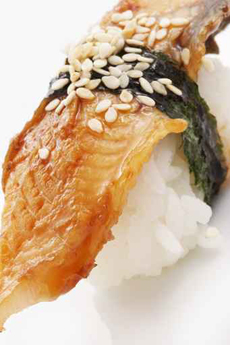
Anago, salt water eel. Photo by Radu Razvan | IST.

Creamy and luscious, ankimo is typically served with grated daikon and scallions (shown) plus ponzu sauce (photo © Katana Sushi | Facebook). |
ANKO-NABE
Monkfish stew.
|
AOYAGI
Yellow round clam (top photo).
AWABI
Abalone—see above.
BAIGAI
Small water snails.
BAKAGAI
Orange clam, a beautiful orange color, like a Creamsicle (see second photo). They are harvested off of Long Island; the adductor muscle of the clam is called kobashira and is served separately as a “boat roll.”
|
|
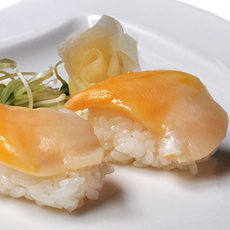
Aoyagi, yellow clam. Photo courtesy Pafco.net.
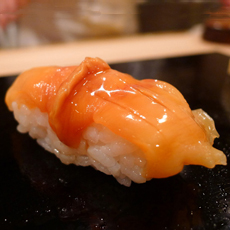
Bakagai, orange clam. Photo courtesy Caveman Circus.
|
BAMBOO LEAF OTHER LEAVES USED IN SUSHI
While the use of a bamboo leaf to present sushi is an aesthetic one today, its origins are very practical. The leaves contain natural antimicrobial properties that help to inhibit the growth of bacteria and fungi. Before refrigeration, the leaves were used to keep the fish fresh for longer journeys. Today, in addition to subsituting as a plate, the leaves are used as a divider in bento boxes and for other decorative purposes. In high-end establishments, some chefs often use a technique called baran or haran, showing their knife skills by cutting the leaves into decorative shapes like mountains or cranes.

Bamboo leaf with salmon nigiri and ikura gunkan-maki (photo: The Nibble).
- Bamboo leaf (take no ha) are long, wide, and sturdy, making them perfect for lining platters, separating different types of rolls, or acting as a base for sushi.
- Sasa leaf is a dwarf bamboo leaf used in traditional packaging and plating.
- Lotus leaf (hasu-no-ha) are massive, waxy lotus leaves that substitute for a tray in larger, multi-person platters,
- Banana leaf, while less traditional in Japanese sushi, are common in Western fusion restaurants and tropical climates to present large sushi and poke platters.
- Hinoki leaf is a small, delicate evergreen branch tips (cedar/cypress) that are sometimes used as seasonal, decorative accents to elevate the presentation of high-end sashimi.
BARA SUSHI
In the Kansai region of Japan, bara sushi is similar to chirashi but with a twist: ingredients are mixed into the sushi rice to make a kind of rice salad. In another part of Japan, Okayama Prefecture, in the far southern part of Honshu, bara sushi is a luxurious dish that weaves the fish on top of the rice, in a mosaic-like pattern.
|
BASASHI or SAKURA
Raw horse meat sashimi, typically served on a bed of shredded daikon (white radish) with shiso leaves. Horse sashimi is a delicacy in parts of Japan. It is a specialty in Kumamoto on the island of Kyushu, and some restaurants specialize in it. Due to its pink color, it is often called “cherry blossom [sakura] meat.” Horse meat is low in fat, cholesterol, and calories, and high in protein.
It is not served as nigiri or other sushi for a couple of reasons:
|
|
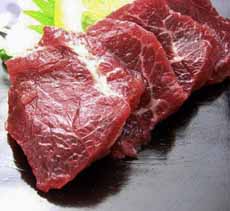
Basashi, horsemeat sashimi. Photo courtesy @ReynaudDeVos | Twitter. |
|
BATTERA-SUSHI or PRESSED SUSHI or BOX SUSHI
Oshi-zushi (sushi made in a square or rectangular wooden mold called an oshiwaku) is the overall category; when topped with mackerel it is battera-sushi (gizzard shad is also used). Along with hako sushi, battera lines the mold with plant leaves (e.g., aspidistra leaves), which makes it easier to remove the block of fish-topped rice. Because of the oily quality of mackerel, the fish can stay fresh for several days. In fact, the style evolved in the more inland areas where fish had to be imported from coastal or lake areas.
To make battera, the mackerel is salted, allowed to stand for six or seven hours, washed, and marinated in a vinegar mixture, placed on the rice, and pressed.
|
|

Battera, pressed mackerel sushi on a bamboo leaf. The creative design features the dfark skin next to the light flesh. (photo: The Nibble). |

An oshiwaku (wooden mold) is used to press the sushi (photo: The Nibble).
|
BEEF SUSHI SASHIMI
Top-quality beef, including wagyu, is served as sushi or sashimi. For nigiri sushi, the beef can be served lightly cooked as well as raw. Sliced very thin, it is absolutely delicious (and one of our favorite ways to eat wagyu, cooked and raw). Horsemeat is also served—see bashashi.
BENI-SHOGA
Red pickled ginger. The color can range from deep pink to light red.
|
|
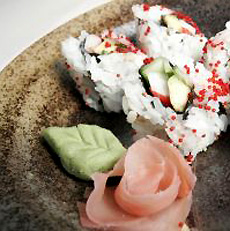
Beni-shoga, red pickled ginger. Photo | SXC. |
|
BENTO BOX
Bento boxes are a popular choice at Japanese restaurants. In the U.S., they typically include five different popular foods in a sectioned lacquer box: a selection of dumplings, pickles, tempura, negimaki, fish, and sushi or sashimi are commonly offered. They can also be more “gourmet” in nature, with more unusual dishes like the ones in the photo. In Japan, there are fast-food bentos packed in disposable plastic boxes and reusable plastic or metal bentos packed at home for lunch. Bento originates from a Chinese term meaning convenient. The word was imported to Japan in the 12th century; at the end of the 16th century, it referred to a meal served in a traditional black-lacquered box with compartments (called a Shokado bento). To tempt both children and adults, some chefs have raised the art of bento, turning ingredients into bunnies, piglets, and other cute shapes. See some examples here.
|
|
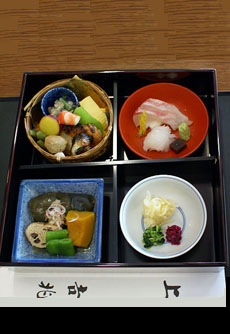
A bento box with (from upper left) mixed seafood, sushi, pickles, and vegetables. Photo courtesy 663 Highland | Wikimedia. |
|
BIRU
Beer.
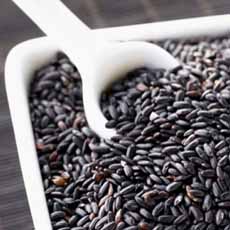
BLACK RICE SUSHI or BLACK SUSHI
Since the early 21st century, the desire to eat healthier has created a demand for brown rice sushi in the U.S. Its success engendered multigrain sushi rice and quinoa,* substituting for rice entirely. One company with a Korean heritage began serving multi-grain rice in 2007 in New York City and trademarked the name “Black Sushi.” They now use all-black forbidden rice, an ancient strain from China.
Any grain other than white rice changes the characteristic flavor of sushi, but those seeking better nutrition willingly trade off.
Black rice is even more nutritious than brown rice. The dark color of black rice comes from the same powerful anthocyanin antioxidants found in blackberries and blueberries.
*Purists will note that su-shi means “vinegar rice,” not “any grain with vinegar.”
|
|
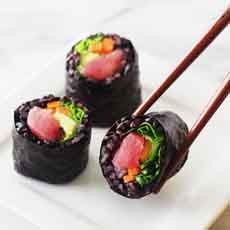
Above: Black sushi, so-called because it uses black rice. Here’s the recipe from Savor The Best Below: Uncooked black rice. When cooked, it takes on a purple color (photo courtesy MixRecipe.com.
|
|
BLOWFISH
See fugu.
BO SUSHI or BOZUSHI
A pressed sushi that is made in a long, candy bar-type shape and then cut into bite-sized pieces. Bo means “stick.” The photo shows yaki-anago bozushi, grilled conger eel.
|
|
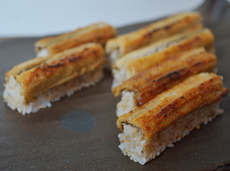
Yaki-anago (conger eel) bozushi. Photo courtesy Washoku NYC. |
|
BONITO or KATSUO
Bonito, also known as skipjack tuna (an all-dark-meat tuna), is eaten as a cooked fish, but is also smoked and dried into a popular Japanese seasoning called katsuo-bushi (the Japanese word for bonito is katsuo). Dried bonito flakes are used to make stock for miso soup, stews, sauces, dips, and other foods. In sushi bars, they are often used as a garnish atop mackerel sushi, spinach, and other dishes.
|
|
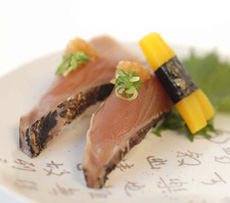
Bonito, skipjack tunaPhoto courtesy I Love Blue Sea. |
|
BOTAN EBI
Botan ebi are spot prawns (Pandalus platyceros), a premium species of shrimp highly prized in Japanese cuisine. The name “botan” comes from the Japanese word for the peony flower, referencing the shrimp’s delicate pinkish color when cooked. However, when served raw in sushi or sashimi, the flesh is white (see photo).
Botan ebi are sweet, tender crustaceans with a flavor that’s more delicate than regular shrimp.
|
|

Botan ebi sushi with a garnish of finger lime pearls (photo © Sushi By Bae). |
|
BOTAN RICE
Botan rice has nothing to do with botan ebi. It’s a well-known brand of quality rice that happens to be branded with the Japanese name for the peony. It grows different varieties, including Calrose, an extra-fancy medium-grain japonica rice known for its clean flavor, sticky texture when cooked, and great pairing in Japanese cuisine, especially sushi and onigiri (rice balls). Calrose is a particular variety of rice, similar to how other basmati and jasmine are different varieties. It was developed at the University of California and is grown in the state.
|
|

A sack of Botan brand Calrose rice (photo © JFC International). |
BURI
Older yellowtail. Younger yellowtail are called hamachi. Hamachi is unusual in that the same fish is called by a different name at different stages of life.
BURI-TORO
Fatty yellowtail, the belly strip of the fish. Given the fatty richness of yellowtail to begin with, this is an extremely rich piece of fish with a buttery flavor. It is a delicacy and is rarely found in the average sushi bar.
Continue To Page 2: Definitions C To E
Go To The Alphabet Index Bar Above
|