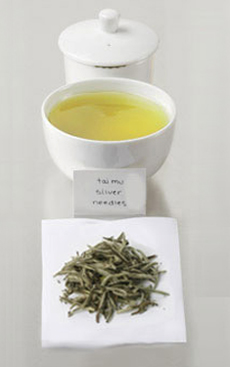
 Silver Needle, one of the finest white teas. Photo courtesy TeaForte.com. Silver Needle, one of the finest white teas. Photo courtesy TeaForte.com.
March 2005
Last Updated March 2012
|
|
Types Of Teas & Tea Terminology
Tea Glossary Page 13: Teas & Terms With S
This is Page 13 of a 15-page glossary of teas. Click on the links below to visit other pages. This Tea Glossary is one of our many informative food glossaries.
Click on a letter to go to the appropriate glossary page:
a b c d e f g h i j k l m n o p q r s t u v w x y z
This glossary is protected by copyright and cannot be reproduced in whole or part.
SAMOVAR
A metal urn with a spigot, traditionally used in Russia to boil water for tea and traditionally having a chimney and heated by coals. The teapot at the top is used to brew a strong concentrate of tea, which is diluted with boiled water from the main container. They were developed in the late 18th century and continue in use today—including modern electrified versions.
SAW PALMETTO TEA
An herbal tea used as an anti-inflammatory to treat certain male urinary problems associated with non-cancerous enlargement of the prostate. |
|
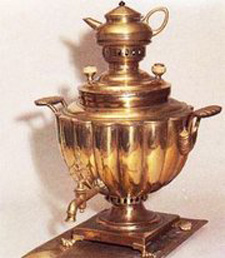 A samovar. Photo courtesy Wikipedia. A samovar. Photo courtesy Wikipedia.
|
SCENTED TEA
Green, semi-fermented (oolong) or black teas that have been flavored by the addition of flowers, flower petals, fruits spices or natural oils. Examples of these are Earl Grey, cinnamon, jasmine, orange and rose pouchong teas.
SELF-DRINKING TEA
Any tea with sufficient aroma, flavor, body, and color to stand alone without need of blending for improvement.
SENCHA or SEN-CHA TEA
A Japanese green tea noted for its delicate sweetness, mild astringency and flowery-green aroma, sencha is what most people think of as “green tea.” The brew is typically golden yellow, with a grassy yet balanced flavor profile and a crisp finish. In Japan, sencha means a quality green tea. It is also the most common tea: Approximately 80% of the tea produced in Japan is sencha. It was invented in the 18th century by a Japanese tea producer who used a method of steaming, drying and rolling the tea. Sen means to brew, steep, or boil, referring to a mixture of medicine or a healing drink (tea was originally used as a medicine). Cha is the Japanese and Chinese word for tea.
|
|
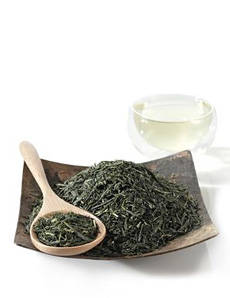
Sencha tea. Photo courtesy Teavana.com. |
Sencha is grown in full sunlight and is made from the young leaves of uncovered plants (usually the top parts of the tea leaves and the buds). The earliest season’s harvest (the first month’s sencha harvest) is called shincha. Later harvests of sencha have more astringent qualities, a more robust flavor and generally less aroma. Prices vary greatly with the grade.
SEMI-FERMENTED TEA
Tea that has been partially fermented before being fired or dried. This tea, known as oolong, has the qualities and appearance halfway between a green and black tea.
SHIZUOKA PREFECTURE
Japan’s main tea-growing region, located in the vicinity of Mt. Fuji. The mild, maritime climate lends a mellower taste to the tea.
SILVER NEEDLE TEA
The finest white tea, plucked the day before the downy white leaf buds unfurl.
SINCHA or SHIN-CHA
Shincha, meaning “new tea,” is the first tea picked during the spring season, considered among the finest. Since the tea plants have been dormant through the winter, shincha captures an array of vibrant flavors, contains higher amounts of vitamin C and catechins. It is handpicked and immediately thereafter, the leaves are lightly steamed to preserve the fresh flavor. Because of this light and gentle processing, shincha is far more delicate than other teas and should be consumed within a few months after the harvest, before its flavors fade. |
|
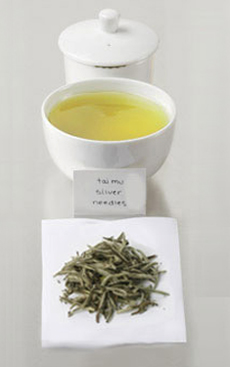
Silver Needle, a fine white tea. Photo courtesy of TeaForte.com. |
SINGLE ESTATE TEA
A blend of teas from one particular estate or garden.
SMOKED TEA or SMOKEY TEA
Black tea from Fujian, China or Taiwan that has been smoked over a wood fire, like Lapsang Souchong, imparting a smoky aroma and flavor. Smoked tea was developed by accident in Fujian around 1820.The Chinese army had requisitioned a plantation and the owner, who had many wet leaves, tried to dry them out quickly by lighting a fire with some roots of a spruce tree. It dried the leaves but left them with a smokey taste, and he threw them out. A few days later a foreign trader discovered the discarded batch. He enjoyed the aroma and took it to Europe, where it met with great success. Spruce root continues to be used today.
SOFT
The opposite of briskness, soft tea lacks “live” characteristics and is caused by under-fermentation and/or faulty drying. |
|
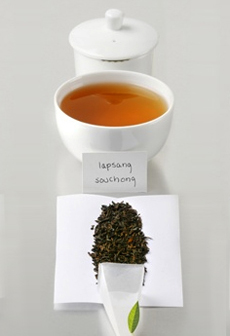
Lapsang Souchong, a smoky black tea. Photo courtesy TeaForte.com. |
SOUCHONG
Meaning “large leaves,” these are black teas derived from the third and fourth leaf of the tea shoot (the leaves at the tip are smaller). Originating in China, souchong tea was made from a small bush whose leaves were allowed to develop to a large size. Processed tea is sieved to insure that leaves of uniform size are packaged together. See photo above.
SPECIALTY TEA
A blend of teas that can take its name from the area in which it is grown, a particular person or event it was blended for, or a particular time of day during which it is intended to be drunk.
SPRING TEAS
Taiwan teas picked in the April-May season.
STALK or STALKY
Red stalk pieces can end up in the leaf mix as a result of a hard plucking. This produces inferior tea and a flavor referred to as “stalky.”
STEWED or STEWY
A soft liquor with an undesirable taste that lacks point. Caused by faulty firing, or drying at low temperatures and often with insufficient airflow through the oven during tea manufacture. Also descriptive of tea that has been brewed too long and has become bitter.
STRENGTH
The intensity of the tea flavor in the cup.
SUMATRA
A tea-producing island of Indonesia.
SUMMER TEAS
Taiwan teas picked in the June-September season.
SUN TEA
A method of preparing tea where the leaves are combined in a jar or jug with water from the faucet, then placed in the sun to brew slowly with solar heat over the course of three to four hours.
SUSHI TEA
See kona-cha.
|
|
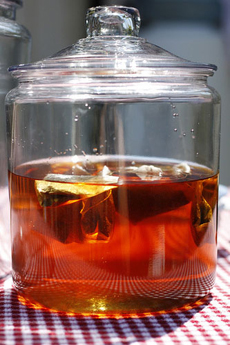
Sun tea can be brewed on a windowsill, porch or any sunny place. Photo courtesy HerbCompanion.com. |
SWEATY
A disagreeable taste indicating poor tea.
SZECHWAN
A non-smoky black tea from the eponymous province in China, with narrow leaves and flowery fragrance.
Continue To Page 14: Tea Terms Beginning With T
Go To The Alphabet Index Above
Lifestyle Direct, Inc. All rights reserved. Images are the copyright of their respective owners.
|