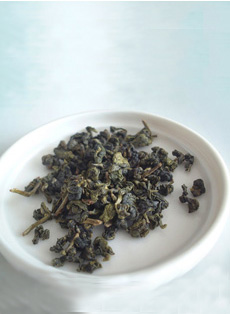
 Oolong tea from the Wuyi mountains in China’s Fujian province. Photo by Shizhao | Wikimedia. See a photo of the unfurled leaves, below. Oolong tea from the Wuyi mountains in China’s Fujian province. Photo by Shizhao | Wikimedia. See a photo of the unfurled leaves, below.
March 2005
Last Updated March 2012
|
|
Types Of Tea & Tea Terminology
Tea Glossary Page 10: Terms N & O
This is Page 10 of a 15-page glossary. Click on the links below to visit other pages. This Tea Glossary is one of our many other food glossaries.
Click on a letter to go to the appropriate glossary page:
a b c d e f g h i j k l m n o p q r s t u v w x y z
This glossary is protected by copyright and cannot be reproduced in whole or part.
NEEDLE
The dried tea leaf, rolled from a natural leaf shape into a long, narrow “needle” shape. See the photo of orange pekoe tea “needles” below.
NILGRI TEA
A dark, intensely aromatic, fragrant and flavorful tea grown in the southern portion of the Western Ghats mountains of Southern India (the Nilgiris district of Tamil Nadu) and other areas. Its strong flavors make it desirable for blending into quality Orange Pekoe.
NOSE
The aroma of the infusion.
|
|
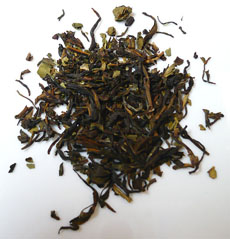
Nilgri tea. Photo by Badagnani | Wikimedia Commons. |
OOLONG
Oolong is semi-fermented or semi-oxidized (semi-green) tea that falls between green and black tea on the fermentation continuum (black tea ferments for two to four hours; for oolong, the fermentation process is interrupted in the middle).
The flavor and caffeine content of oolong are also midway between black and green tea: While the tea looks similar to black tea, the taste is closer to the green tea, with a more rounded flavor and mouthfeel.
The liquor of oolong is often golden to dark brown, but the colors can vary widely (see photo below). Its taste and aroma range from fruity to floral. It is sometimes referred to as “blue tea” because some varieties have a blue tinge (others have a green tinge). The long, blackish-green leaves inspired its name, which means “black dragon” in Chinese.
|
|
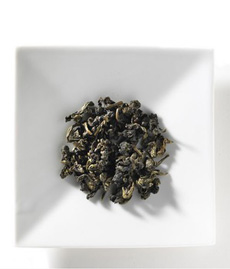
Oolong means “black dragon.” These leaves do look a bit dragonish. Photo of Ti Kuan oolong courtesy Mighty Leaf Tea. |
Geography
Oolongs are produced in the Fujian province of China and on the island of Taiwan, formerly called Formosa (ihla formosa means “beautiful island” in Portuguese, named by the Portuguese sailors and traders who were the first Westerners to see it). The name Formosa Oolong can be found on teas hailing from Taiwan.
Chinese oolongs tend to be more green and floral (orchid aromas come to mind; Ti Kuan Yin, a type of oolong (see photo above), is often described as smelling like orchids). Oolong from Taiwan, known as Formosan Oolong, is oxidized and fired longer and has a fruity flavor reminiscent of ripe peaches.
Oolongs, like green teas, should be brewed at 195°F.
|
|
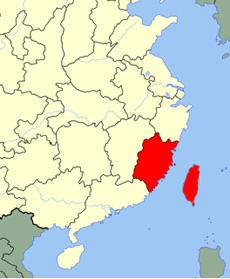
The island of Taiwan sits in the China Sea, across the Taiwan Strait from Fujian Province on the China mainland. |
Production
Oolongs are traditionally fired into hot woks and cooked very quickly, which stops the fermentation process. Oolong’s unique character is the result of a meticulous, multi-step process that begins with withering and a brief oxidation of the plucked leaves in direct sunlight. As soon as the leaves give off a distinctive fragrance—often compared to apples, orchids or peaches—the process is halted.
Formosan oolongs are oxidized longer, fired longer and brew a more ripe, fruity cup. Examples include pouchong, qing tea, red hood/red robe (dà hóng páo), ti kwan yin, wuyi and generic oolong.
|
|
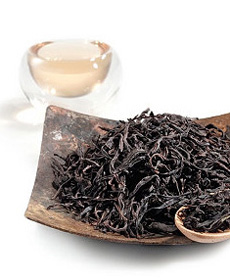
Oolong from the Phoenix Mountains on the mainland, is a light oolong (see below). |
From the mainland, Golden Phoenix Oolong comes from the historic tea trees of Feng Huang Shan. While some sources say that oolong is a 19th-century creation, Golden Phoenix Oolong was cited in Song Dynasty Tribute Tea Records of the 11th and 12th centuries. Once reserved exclusively for emperors of China, the trees were guarded by soldiers. Golden Phoenix Oolong has a floral, nectar-like aroma of ripe peaches and apricots. Like a great wine evolving in a glass, it takes on a different intensity and character with each consecutive infusion. The tea is available at RishiTea.com.
The following information is provided by PalaisDesThes.com, Parisian purveyor of fine teas:
- Categories: Oolongs are divided into two categories: light oolongs, which are lightly fermented (10% to 15% fermentation) prepared in the so-called Chinese way; and dark oolongs, where the fermentation process is much more important (60% to 70% fermentation) in which the teas are processed according to a method more specifically developed in Taiwan. In practice, the preparation of semi-fermented teas is less clear-cut than this: Each plantation has its own recipes and produces teas with different degrees of fermentation. Rather than adhere to the traditional divisions of Chinese versus Taiwanese methods, all semi-fermented teas have to go through the following procedures:
- Withering: The leaves are left to wither in the sun for a few hours. They are placed into baskets and shaken, which bruises the leaves and exposes the juices in the leaves to the air, which begins the process of oxidation (fermentation). They are then put in the shade to cool.
- Sweating: The most important stage in the preparation of oolong teas. The leaves are placed in a room that is kept at a constant temperature of between 22°C and 25°C with a humidity level of roughly 85%, in which they are continually stirred with ever-increasing force. This allows the aroma to be released and facilitates the evaporation of water. The final degree of sweating depends on the duration of this process: in the so-called Chinese method the fermentation is halted as soon as the leaves have reached a 10% to 12% degree of fermentation and this produces light teas with a leafy flavor. The so-called Taiwanese method involves a longer period of sweating allowing fermentation to progress to a level
of up to 70% and producing darker, fruitier teas.
-
Roasting: Once the desired degree of fermentation is reached, roasting allows the tea enzymes’ reaction to be halted. This procedure is identical to the one used to produce green teas.
- Rolling: As with green teas, the rolling process gives the leaves their twisted shape. The leaves are often very large and are just creased or sometimes rolled into large pearls.
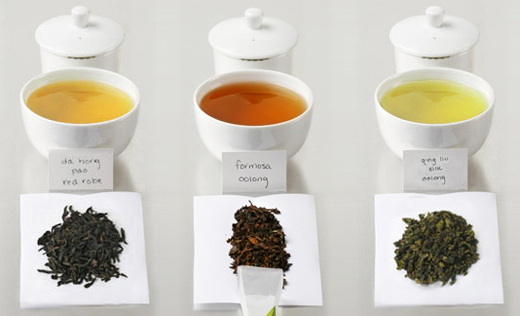
A trio of oolongs: Oolong tea: Da Hong Pao Red Robe Oolong from China, Formosa Oolong and Silk Oolong from China. Formosa oolongs are oxidized longer and have a darker liquor. Photo courtesy TeaForte.com.
Oolong contains a wide range of tea polyphenols (antioxidants): catechins, theaflavins, thearubigins and theabrowins. It is undergoing extensive scientific study for properties which may support cardiovascular health, and the healthy digestion of fats. Read more about oolong tea and see our review of Ito-En’s Oolong Shot.
ORANGE PEKOE
Pronounced peck-oh, orange pekoe is not a type of tea but a grade of tea. It is the second highest grade in a seven-tier grading system for black tea. It describes the size and physical condition of the leaf, not a particular kind of tea, quality, or flavor. (Most teas labeled Orange Pekoe are blends.) Pekoe is derived from the Chinese word for white, which referred to the white hair on the leaf bud. Early Western merchants used the word to mean that the leaves so graded were exclusively plucked from the tip of the branch: the leaf bud and the two leaves below the bud. Its use in India and Sri Lanka broadened to mean whole leaves of a uniform size, and this is what it generally means now. It may include leaves picked from lower on the branch. (See Flowery Orange Pekoe.) |
|
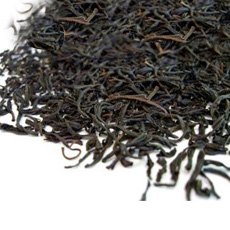
Orange pekoe-grade Ceylon tea from the Kenilworth estate in Sri Lanka. You can buy it on Amazon.com. |
Orange is variously described as a reference to the Dutch House of Orange or a reference to an old Chinese practice of including orange blossoms as a flavoring agent.
ORGANIC
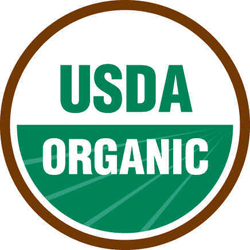
The USDA’s National Organic Program certifies products as organic based on farming, handling, manufacturing, distribution and labeling practices. Requirements include: no antibiotics or growth hormones for animals, animals must be raised on organic feed and have free range to graze, crops must be raised with no synthetic pesticides or fertilizers containing synthetic chemicals, no sewage-sludge fertilizer, no bio-engineered foods or irradiation, and no GMOs (genetically modified organisms). Farming practices should enhance and preserve soil and water. |
|
 |
A government inspector must certify the farm after visiting it; farmers must keep detailed records on crops. There is a network of certifying organizations outside the United States who do the certification, for example, in China and other tea-producing regions.
ORTHODOX
Prepared using a technique which leads to larger leaf styles, mirroring hand-produced teas.
OXIDATION
A heating/panning process that converts the plucked tea leaf to oolong or black tea. Green tea is barely oxidized; delicate white tea is not oxidized at all. See fermentation.
Continue To Page 11: Tea Terms Beginning With P
Go To The Alphabet Index Above
Lifestyle Direct, Inc. All rights reserved. Images are the copyright of their respective owners.
|