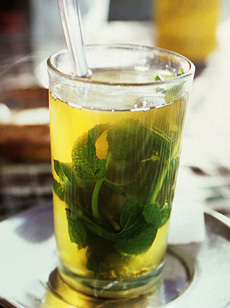
 Hot mint tea—thé à la menthe—is the most popular beverage in Morocco. There’s more mint tea information below. Photo by Olive Utne | Wikimedia. Hot mint tea—thé à la menthe—is the most popular beverage in Morocco. There’s more mint tea information below. Photo by Olive Utne | Wikimedia.
March 2005
Last Updated May 2026
|
|
Tea Information: Types Of Tea & Tea Terminology
Glossary Page 9: Terms K To M
This is Page 9 of a 15-page glossary of tea information. Click on the links below to visit other pages. This Tea Glossary is one of our many food glossaries, where you can get the scoop on your favorite foods. There’s also plenty of tea information in our Gourmet Tea Section.
Click on a letter to go to the appropriate glossary page:
a b c d e f g h i j k l m n o p q r s t u v w x y z
This glossary is protected by copyright and cannot be reproduced in whole or in part. You are welcome to link to it.
KABUSE
The Japanese word for “wrapped,” kabuse, refers to the practice of wrapping the tea bush for 4-5 days before harvest, to slow down the growth of the leaves. This practice creates a more intense green color, less astringency, and more L-Theanine amino acid. The latter creates a more flavorful tea.
|
KEEMUN TEA
A fine grade of black China Congou tea produced in Anhui province in central China. It is typically hand-rolled and fired. Keemun was first produced in 1875 by Yu Quianchen, a former civil servant, who traveled to Fujian province to learn about black tea production. Because Keemun goes so well with milk and sugar, it quickly gained popularity in England (although it is drunk black in China). Keemun is a smooth and medium-bodied tea with notes of fresh pine and brown sugar.
|
|
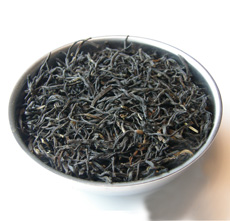
Organic Keemun tea. Photo courtesy Tea24.pl. |
KENYA
A country that produces some of the finest black teas on the African continent. Kenyan teas are used for blending purposes and are sold as specialty teas in their own right. They are bright coppery teas with a pleasantly brisk flavor.
KONA-CHA
Also called “sushi tea” because it is frequently offered free at sushi bars, kona-cha is a lower-quality tea made of the fannings and dust that are byproducts of tea processing. It is less expensive than whole-leaf tea. The leaves can be anything from ban-cha to gyokuro, so the taste will vary.
|
KUKICHA or KUKI-CHA
Also called winter tea, kukicha is made from twigs and branches with a few leaves pruned from the tea plant during its dormant season and dry-roasted over a fire. It is earthy in flavor, with a lingering sweetness. It is popular as a health food drink in Japan and in macrobiotic diets. Karigane kukicha is made from stems and stalks that remain after making gyokuro green tea. It is a delicate, naturally sweet style.
LACKING
Describes a neutral liquor with no body or pronounced characteristics.
|
|
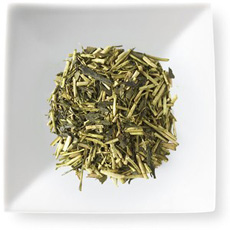
Karigane kukicha tea is available from MightyLeafTea.com. |
|
LADY GREY TEA
A blend created by Twinings, Lady Grey tea has a base of Earl Grey tea (which is flavored with bergamot orange), with added lemon and Seville orange oils. The blue cornflower petals (also known as bachelor’s buttons) in this particular blend have a beautiful visual appeal and also impart a subtle clove flavor.
|
|
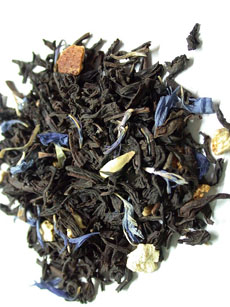
Lady Grey tea. Photo by S.Jahn | Wikimedia. |
LAPSANG SOUCHONG TEA
A black tea from the Wuyi Mountains of China’s Fujian province (it is also produced in Taiwan). The Fukienese term literally means “smoky little variety” or subvariety. The tea is smoked over a pine wood fire, giving it its distinctive smoky, tarry flavor and aroma. People who love smoked foods and cigars will love this tea! Legend claims that the smoking process was discovered by accident. There are at least two different tales. One story, which takes place during the early days of the Qing Dynasty (1644 to 1911), tells that an army unit commandeered a tea factory in Xingcu (Star Village). The factory was filled with fresh leaves awaiting processing. After the soldiers left, the workers realized that it was too late to dry the tea leaves the usual way. Instead, they lit open fires of pine wood to hasten the process. The tea reached the market in time, and the smoked pine flavor was a success.
|
Another story tells of a threat to the tea crop one year, which led the villagers of Tong Mu to quickly harvest their tea and dry it over freshly cut pinewood. While the farmers were not fond of the smoky flavor, European customers enjoyed it, so the new process remained. In yet another version, the army commandeered the tea factory while the tea was being fired. When they left, the tea had been overcooked; the smokiness was considered “burned.” The tea was tossed in a bin at the roadside when an English tea merchant happened by. He was attracted to the smoky scent and asked to buy the tea. Whatever the real story, today the tea is produced by withering the leaves over pine, cypress or cedar fires. The tea leaves are then placed in bamboo baskets and hung over smoky pine fires. This process provides the smoky taste and aroma. The smokiness makes lapsang souchong a popular cooking tea as well.
|
|
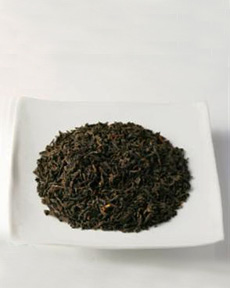
Lapsang souchong tea. Photo courtesy TavalonTea.com. |
|
LEMON TEA
Hot tea served with a slice of lemon, in the Russian style, instead of milk, which is the British style. While the Chinese drank tea straight and the British used milk to cool it and sugar to sweeten it, the custom of adding sour lemon originated with refreshments for exhausted travelers at posts along the road. Sour and salty foods were known to cure sea-sickness; pickles and sauerkraut were offered to travelers. While no one knows who first thought of adding lemon to tea, the refreshment was a big success and migrated from far-lung posts to metropolitan salons. Black tea with a slice of lemon became known as “Russian tea.” See also Russian tea.
|
|
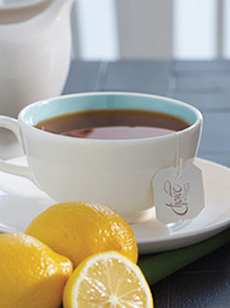 Lemon tea—tea with a slice of fresh lemon— was made popular in Russia. Photo courtesy ChoiceTea.com. Lemon tea—tea with a slice of fresh lemon— was made popular in Russia. Photo courtesy ChoiceTea.com.
|
LIGHT
Tea leaves that are light in weight, of poor density, and sometimes flaky, or brewed tea lacking strength and depth of color.
LIQUOR
The brewed tea.
LOOSE TEA
Whole tea leaves that are infused without a tea bag. Since the earliest times, they were placed in a pot, and the hot water was poured over them. In modern times, numerous devices—from mesh tea balls to metal perforated spoons that hold the tea—have been created. Our favorite is this clever infusing pot, the IngenuiTEA.

Tea infuser spoon (photo The Nibble | Abacus).
MALAWI
An African country with teas of good color and flavor, which are mainly used for blending purposes.
MALTY
Slightly over-fired tea producing a subtle, underlying malt flavor, characteristic of Assam tea.
MASALA CHAI
Indian spiced tea. See chai.
|
MATCHA
This powdered green tea, the consistency of talc, is used in the Japanese tea ceremony, or cha no yu. Matcha has a wonderful aroma, a creamy, silky froth, and a rich, mellow taste. Matcha is made of ten-cha leaves, which are gyokuro leaves that have not been rolled into needles but are steamed and dried. The tea bushes are shaded from sunlight for three weeks before harvesting, producing amino acids that sweeten the taste. Unlike whole leaf tea, which is steeped, the leaves are then ground like flour—here, slowly and finely in a stone mill. The powder is whisked into water. Powdered tea is the original way in which tea was prepared: steeping dried leaves in boiling water didn’t arrive until the Ming Dynasty (1368-1644).
|
|
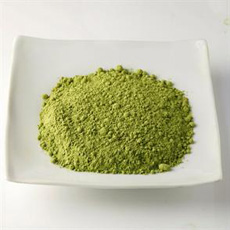
The highest grade matcha is from Uji, the premier matcha-producing region in Japan. Ajirogi Matcha is among the very best matcha in all of Japan. Matcha means “rubbed tea.” Photo courtesy TavalonTea.com. |
Matcha contains a higher amount of nutrients (vitamins, minerals, L-theanine amino acids, polyphenols, chlorophyll, and fiber) than other teas. In recent years, matcha has become a popular cooking and baking ingredient, and now comes in different grades for different uses. In the absence of green tea ice cream, sprinkle some matcha on vanilla ice cream. Matcha is unique in that the entire tea leaf is consumed in its powdered form, instead of being steeped like other teas. This was the original Japanese style of consuming tea. There are two basic types of matcha:
- Ceremonial Matcha, made from the youngest tea leaves, with the stems and veins removed entirely. The leaves are stone-ground, which makes the matcha suitable for a thick-style tea. A bright green color easily distinguishes it from the other grades.
- Culinary Matcha is used for cooking and baking. It’s also fine to drink culinary matcha, which is still a very high-quality tea, just with a slightly different flavor profile than ceremonial grade matcha. Culinary-grade matcha isn’t necessarily a lower-quality product; it’s just prepared differently for a different use, i.e., to pair with other flavors in lattés and baked goods.
- Within these two categories are five different grades, from premium to classic. Here’s a detailed explanation.

Matcha powder whisked into a cup, part of the cha no yu tea ceremony (photo © Palais Des Thés).
MATURE
Not bitter or flat.
|
MAURITIUS TEA
Mauritius is a black tea mixed with vanilla to provide a very flavorful and fragrant tea, with a natural sweetness from the vanilla bean. The tea is very finely ground to the consistency of ground espresso beans. This process, the traditional style of Mauritius, generates a stronger brew.
In 1819, vanilla was brought from Mexico to the island of Mauritius and nearby Réunion Island by the French. Unfortunately, a cyclone in 1892 wiped out the vanilla crops on Mauritius, and nearby Madagascar became the world’s dominant vanilla producer. Mauritius has more recently revived small-scale vanilla cultivation. The tea is still grown and processed in Mauritius.
|
|

The vanilla flavor makes Mauritius tea a beautiful pairing with shortbread (photo © Walker’s Shortbread). |
The first tea plant was brought from China to Mauritius in 1765 by priest Rene Francois Galloys, and the first tea plantation, Bois Chéri, was founded in 1892 (and produces more than half of Mauritius’ tea).

Mauritius is a powdered tea (Gemini Photo).
MEAT TEA
Another term for high tea.
MENCHA
A by-product of sencha, made during the sifting process in the production of sencha. It contains coarse, broken tea leaves and incipient baby tea buds that are of good quality but too small to stay inside the sieve.
METALLIC
A sharp, coppery taste.
MILK TEA
Milk tea is a broad category of beverage that simply refers to any tea (black, green, oolong, white) combined with milk (dairy, creamer, or plant-based) and usually a sweetener. It exists globally in many forms, like the three in the photo below: British tea with milk, Indian masala chai, and Hong Kong silk stocking tea (a.k.a. Hong Kong milk tea). There are numerous other popular milk teas, including the trending bubble tea that originated in Taiwan.

Photo: The Nibble | Abacus.
|
MINT TEA
Mint tea is more of a mainstay of northern Africa and other Arab countries, as afternoon tea is in the U.K. That’s because it’s drunk all day. A very sweet tea, it is traditionally prepared with gunpowder green tea or other strong Chinese tea. A large quantity of fresh spearmint leaves and sugar are added to the pot (the classic recipe is 5:1 sugar to mint), and boiling water is poured over them, to steep for three to five minutes. The hot tea is served in a glass (see photo at the top of the page). The Arabic word for mint tea is touareg or tuareg. This traditional Moroccan drink is also considered therapeutic: the mint turns it into a digestive aid that fights heartburn.
|
|

Mint green tea from Artful Tea. Mint tea is also available in black and herbal varieties, and you can make your own herbal mint tea by steeping fresh mint in boiling water. |
|
MONKEY PICKED TEA
According to legend, more than ten centuries ago, a pet monkey observed his master pick tea leaves. In an instance of “monkey see, monkey do,” it climbed to the top of the tree, picked tea leaves, and brought them down for its master. Monkeys have been trained to pick tea ever since. However, most tea gardens have pruned back the trees to bush height, so trained humans can do the job more efficiently. This is more of a novelty and does not necessarily indicate a better quality tea.
MUDDY
A dull, opaque liquor.
|
|
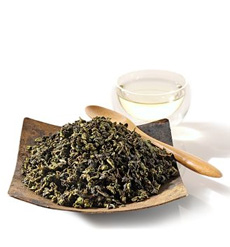
Monkey picked oolong tea from Teavana.com. |
MUSCATE
A grapey (muscatel) taste, characteristic of Darjeeling teas.
MUSHY
A result of being packed or stored with a high moisture content.
MUSTY
A scent that indicates the possibility of mold.
Continue To Page 10: Tea Terms Beginning With N & O
Go To The Alphabet Index Above
Lifestyle Direct, Inc. All rights reserved. Images are the copyright of their respective owners.
|